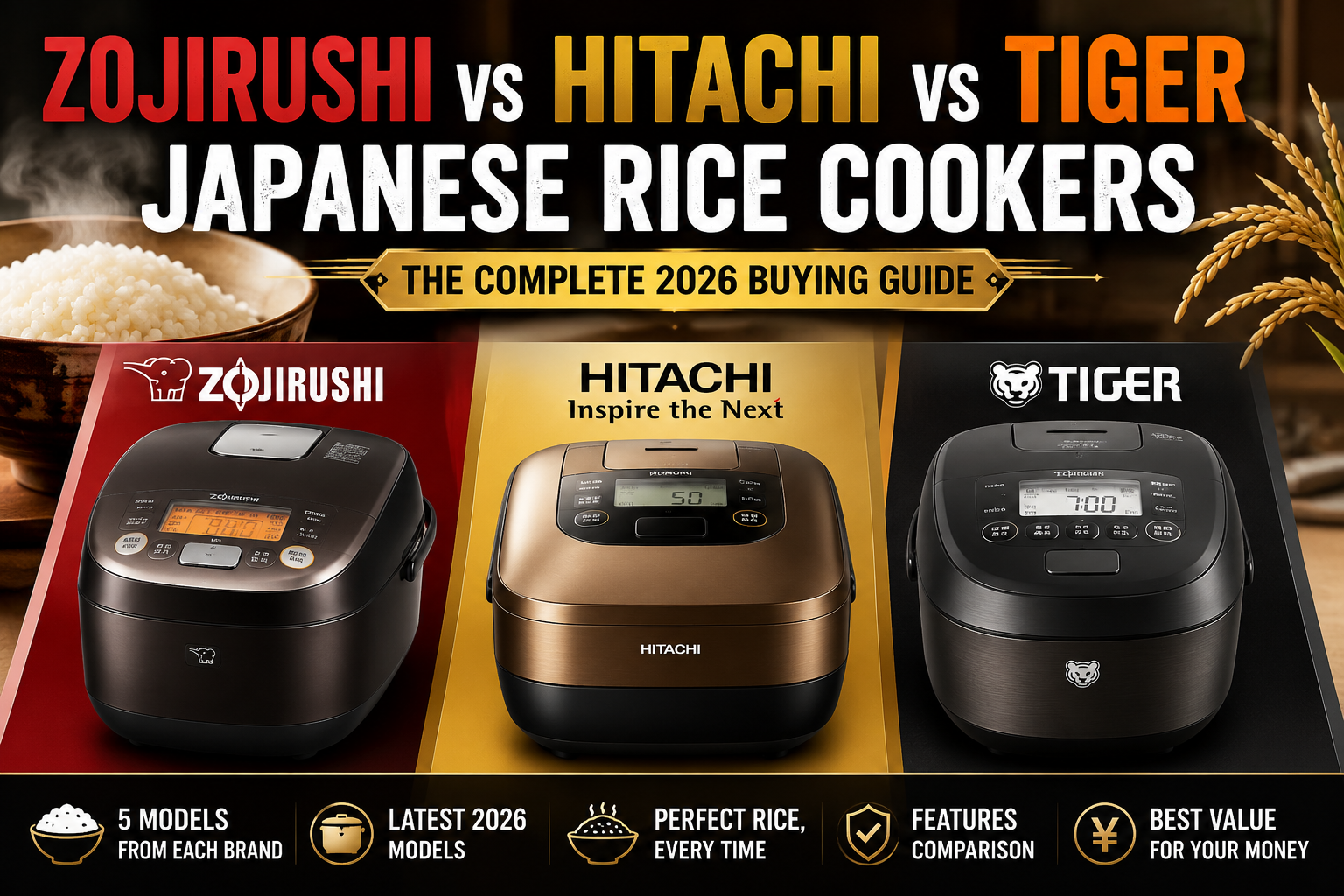
Ask anyone who has eaten rice cooked in Japan why it tastes different, and they’ll struggle to put it into words — it’s sweeter, glossier, and somehow holds its shape without turning to mush. That difference isn’t the rice. It’s the rice cooker. And three Japanese brands in particular have spent decades perfecting it
If you’ve searched for the best Japanese rice cooker brand, you’ve almost certainly landed on the same three names: Zojirushi, Hitachi, and Tiger. Each one has its own philosophy about what makes a “perfect” bowl of rice, and each one builds machines that genuinely feel different to use, not just different to look at. This guide breaks down Zojirushi vs Hitachi vs Tiger in plain terms, walks through five real, currently available models from each brand, and helps you figure out which one belongs on your counter.
- Why Japanese Rice Cookers Are in a League of Their Own
- Before You Compare Brands: IH vs. Pressure IH vs. Microcomputer (What These Terms Actually Mean for Your Rice)
- Zojirushi’s Top 5 Rice Cookers You Can Order from Japan
- Hitachi’s Top 5 Rice Cookers You Can Order from Japan
- Tiger’s Top 5 Rice Cookers You Can Order from Japan
- Zojirushi vs. Hitachi vs. Tiger: Head-to-Head Comparison
- Which Brand Is Right for You? (By Household Size, Budget, and Priority)
- What to Check Before Ordering a Japanese Rice Cooker Internationally (Voltage, Capacity, Warranty)
- How to Order a Rice Cooker from Japan via Discovery Japan Mall
- Frequently Asked Questions (FAQ)
- Which is better, Zojirushi, Hitachi, or Tiger?
- What is the difference between IH and pressure IH rice cookers?
- Can I use a Japanese rice cooker outside Japan?
- Do Japanese rice cookers work with non-Japanese rice varieties?
- Is a pressure IH rice cooker worth the extra cost?
- Can I order a rice cooker from Japan and have it shipped internationally?
- What voltage and warranty should I check before ordering?
- How do I clean and maintain a Japanese rice cooker?
- Final Thoughts: There’s No Wrong Choice — Only the Right Fit
Why Japanese Rice Cookers Are in a League of Their Own
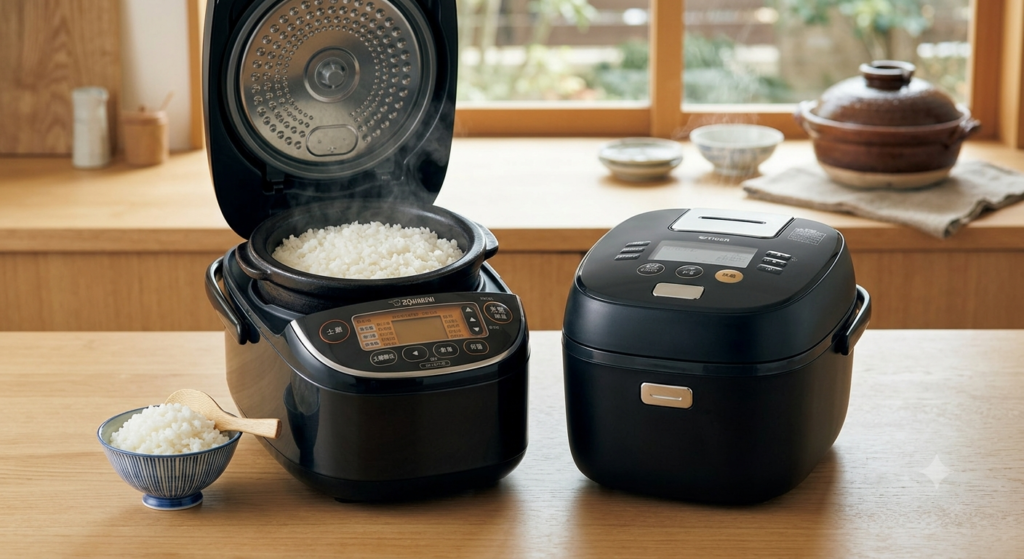
In most of the world, a rice cooker is a bucket with a heating element and a “cook” button. In Japan, it’s treated more like a musical instrument — something that rewards precision engineering with a genuinely better result. Japanese households cook rice daily, often multiple times a day, so manufacturers have spent generations chasing incremental gains in texture, sweetness, and aroma.
That obsession shows up in the details: pots that mimic the convection of a wood-fired kamado, keep-warm systems that pump steam back into the pot so rice doesn’t dry out overnight, and inner pots literally made from fired clay. As one deep dive into what makes Japanese rice so tasty explains, the goal of all this engineering is the same: breaking down the rice’s starch structure just enough to release natural sweetness without collapsing the grain. Zojirushi, Hitachi, and Tiger each attack that problem from a slightly different angle, which is exactly why comparing them side by side is worth doing before you buy.
Before You Compare Brands: IH vs. Pressure IH vs. Microcomputer (What These Terms Actually Mean for Your Rice)
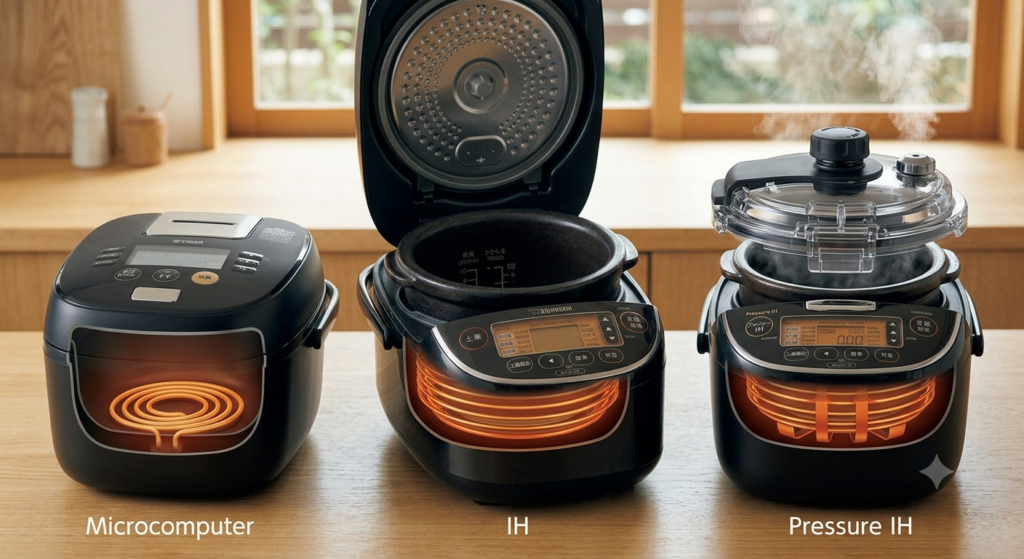
Every listing you’ll see for a Japanese rice cooker mentions one of three heating systems. Understanding them takes the guesswork out of the rest of this guide.
- Microcomputer : Heats from the bottom only, using a computer chip to fine-tune timing. It’s the most affordable category and can cook a little unevenly, but it’s perfectly fine for everyday rice.
- IH (induction heating): Heats the entire inner pot via induction rather than a single bottom element, giving noticeably more even cooking than microcomputer models.
- Pressure IH : Adds pressure on top of IH heating, cooking rice above 100°C. This is what produces that sweeter, glossier, more resilient texture that reheats well — it’s the standard technology behind the higher-end lines from Zojirushi, Hitachi, and Tiger.
Some Hitachi and Tiger flagship models take this a step further with steam IH or earthenware (donabe) pots, which we’ll get into brand by brand below.
Zojirushi’s Top 5 Rice Cookers You Can Order from Japan
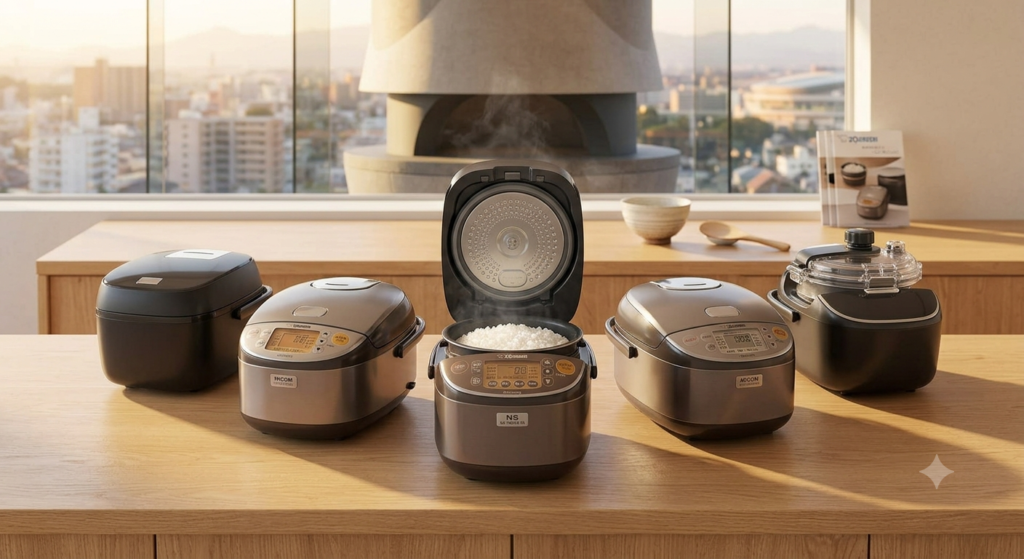
Zojirushi is the rice cooker brand most Japanese households grew up with, and it remains the country’s best-selling name in the category. Its rice cookers lean on neuro-fuzzy microcomputer logic, thick “Kuromaru” inner pots, and a long list of texture and porridge settings, prioritizing consistency over flashy pressure-cooking claims.
NS-YMH18 — the family-size all-rounder
The NS-YMH18 is Zojirushi’s 10-cup microcomputer rice cooker built for overseas voltage, and it’s the model to start with if you’re cooking for a household of four or more. It uses the brand’s 1.7mm “Kuromaru Thick Pot,” a round-bottomed inner pan designed to let rice circulate and cook more evenly, plus an “aged cooking” menu that lets rice soak longer to draw out natural sweetness.
- Heating type: Microcomputer (neuro-fuzzy logic)
- Capacity: 1.8L / 10 go (cups)
- Inner pot: 1.7mm Kuromaru thick, round-bottom pot
- Best for: Families and batch cooking
Browse this model on Discovery Japan Mall →
NS-YMH10 — the everyday 5-cup workhorse
Essentially the NS-YMH18’s smaller sibling, the NS-YMH10 covers up to five cups of rice and carries the same stew function, dual porridge settings, and long-grain rice support. If you’re a couple or small family who wants Zojirushi reliability without oversizing your countertop appliance, this is the sweet spot.
- Heating type: Microcomputer (neuro-fuzzy logic)
- Capacity: 1.0L / 5 go (cups)
- Inner pot: 1.7mm Kuromaru thick, round-bottom pot
- Best for: Couples and small households
Browse this model on Discovery Japan Mall →
NS-ZCC18 — the 120V pick for North America
If you’re shopping from the US, Canada, or another 120V region, the NS-ZCC18 is built specifically for you. It’s a Neuro Fuzzy microcomputer rice cooker with the same black thick-pot design, but wired for 120V/60Hz outlets rather than the 220-230V spec common elsewhere. Its round pot promotes convection with less energy, and the stainless steel inner lid lifts out for easy washing.
- Heating type: Microcomputer (Neuro Fuzzy logic)
- Capacity: 1.8L / 10 cups
- Inner pot: Black thick pot, removable stainless inner lid
- Best for: US, Canada, and Latin America buyers wanting family size
Browse this model on Discovery Japan Mall →
NS-ZCC10 — the 120V compact option
The 5.5-cup version of the NS-ZCC18, this model brings the same Neuro Fuzzy microcomputer cooking and English-labeled menu to a smaller footprint. It’s an easy recommendation for solo cooks or couples in 120V countries who still want genuine Zojirushi engineering rather than a downsized budget unit.
- Heating type: Microcomputer (Neuro Fuzzy logic)
- Capacity: 1.0L / 5.5 cups
- Inner pot: Black thick pot, removable stainless inner lid
- Best for: Solo cooks and couples in 120V regions
NS-LLH05-XA — the compact 3-cup model for small kitchens
At just 0.54L, the NS-LLH05-XA is Zojirushi’s answer for studio apartments, dorm rooms, and anyone who mostly cooks for one or two people. It’s a straightforward overseas-spec microcomputer cooker with an English and Chinese menu, plus Japanese and Korean sticker overlays, and a full multilingual instruction manual.
- Heating type: Microcomputer
- Capacity: 0.54L / 3 cups
- Inner pot: Standard non-stick coated pot
- Best for: Solo cooks, small kitchens, and first-time buyers
Browse this model on Discovery Japan Mall →
Hitachi’s Top 5 Rice Cookers You Can Order from Japan
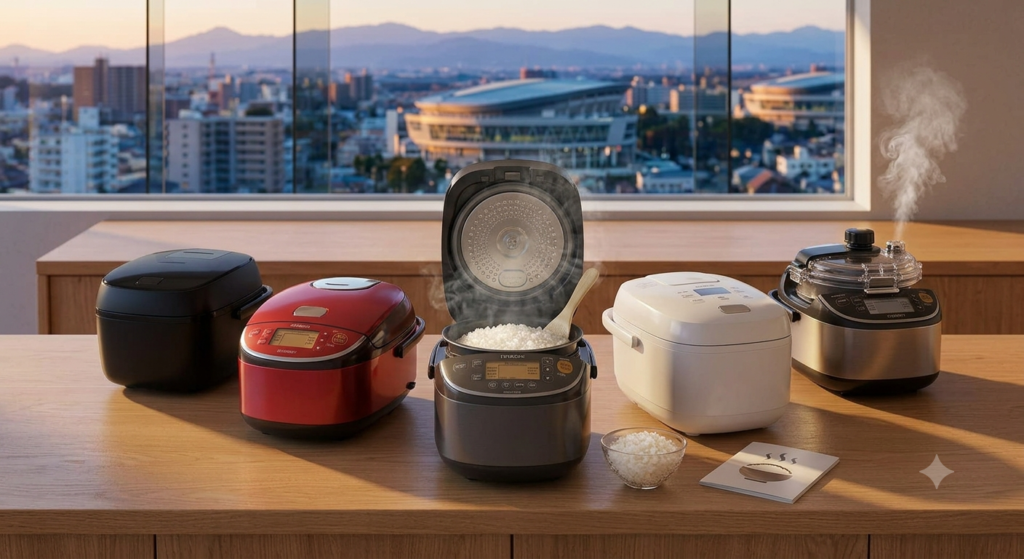
Hitachi takes a distinct approach with Pressure + Steam IH, injecting steam during cooking and again during keep-warm to stop rice from drying out. The result is often described as a slightly firmer, less sticky bite compared to the softer texture typical of other pressure IH cookers — a real point of preference for people who grew up eating firmer rice styles.
RZ-KG18Y — the pressure IH flagship for families
The RZ-KG18Y is Hitachi’s overseas-spec Pressure IH rice cooker, and it leans directly into the brand’s signature strength: it periodically re-injects steam during keep-warm, with steam storage rated up to 24 hours, so rice stays fresh-tasting rather than crusty. It’s a 10-cup unit finished in gold, aimed at households that keep-warm their rice for long stretches between meals.
- Heating type: Pressure IH
- Capacity: 1.8L / 10 cups
- Inner pot: Multi-layer pressure-rated inner pan
- Best for: Families who keep rice warm for extended periods
Browse this model on Discovery Japan Mall →
RZ-W2000Y-R — Pressure & Steam IH “Superb Cooking” for smaller households
Marketed under Hitachi’s “Superb Cooking” line, the RZ-W2000Y-R packs the brand’s full Pressure & Steam IH system into a 5-cup body finished in red. It’s built for couples or smaller households who still want the firmer, distinctly Hitachi texture without stepping up to a 10-cup unit.
- Heating type: Pressure & Steam IH
- Capacity: 5 cups
- Inner pot: Multi-layer pressure-rated inner pan
- Best for: Couples and rice-texture perfectionists in smaller households
RZ-D18XFY — the do-everything multicooker
The RZ-D18XFY trades outright pressure performance for sheer menu breadth. This 10-cup microcomputer model can handle white, jasmine, brown, and sticky rice, plus porridge, steaming, cake, bread, slow cooking, and a “double cook” mode with an included double-cook basket. A 12.5-hour countdown timer rounds it out.
- Heating type: Microcomputer
- Capacity: 1.8L / 10 cups
- Inner pot: Standard coated inner pan with steam and double-cook baskets
- Best for: Households that want one appliance to replace several
RZ-VMC10Y — the compact fuzzy-logic multicooker
Think of the RZ-VMC10Y as the RZ-D18XFY’s smaller, 5.5-cup cousin. It’s a fuzzy-logic rice cooker that also handles mixed and sticky rice, brown rice, slow cooking, cake and bread baking, porridge, and a “Super Rapid” setting for quick white or jasmine rice, all through an LCD-driven menu.
- Heating type: Microcomputer (fuzzy logic)
- Capacity: 1.0L / 5.5 cups
- Inner pot: Standard coated inner pan with steam basket
- Best for: Small households wanting steaming and baking versatility
RZ-WS2Y-N — the ultra-compact single-serving cooker
At just 0.09L to 0.36L capacity, the RZ-WS2Y-N is built for genuinely small servings — think a single bowl of rice at a time. It’s overseas-spec at 220-230V and made in Japan, aimed squarely at solo diners, dorm rooms, or anyone who wants fresh rice without cooking a full batch.
- Heating type: Microcomputer
- Capacity: 0.09L–0.36L (roughly 0.5–2 cups)
- Inner pot: Compact coated inner pan
- Best for: Solo diners and single-serving cooking
Tiger’s Top 5 Rice Cookers You Can Order from Japan
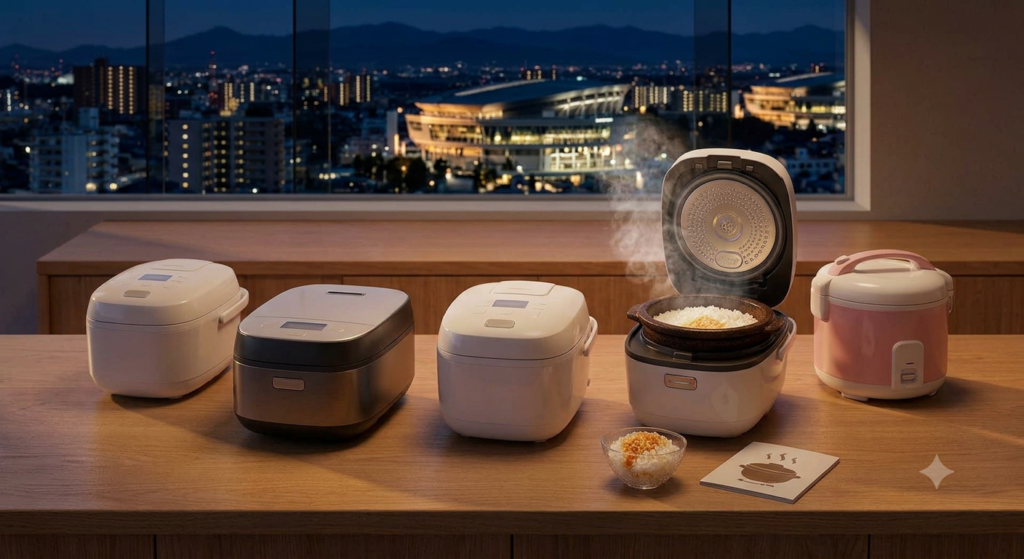
Tiger is the brand most associated with earthenware, or donabe-style, cooking — the traditional clay-pot method that produces a fragrant, slightly caramelized bottom layer. Its “Gohou-Taki” lineage pairs earthenware or earthenware-coated inner pots with high-heat IH, some reaching cooking temperatures near 300°C, to chase that donabe effect without the manual labor.
JPC-W10W — variable double Pressure IH with a donabe-coated pot
The JPC-W10W is Tiger’s clearest expression of its earthenware philosophy in an overseas-ready package. It uses variable double pressure cooking together with a 9-layer inner pot roughly 2.5mm thick, finished with an earthenware coating, plus a wide-IH express menu that cooks 1–2 cups in about 17 minutes. It even includes a carrying handle for the pot, and only three removable parts for easy cleaning.
- Heating type: Variable double Pressure IH
- Capacity: 5.5 cups
- Inner pot: 9-layer, ~2.5mm, earthenware-coated
- Best for: Rice-texture perfectionists chasing donabe-style flavor
Browse this model on Discovery Japan Mall →
JKT-F10W — Pressure IH with a far-infrared ceramic pot
The JKT-F10W leans on a far-infrared, 3-layer ceramic-coated inner pot that retains heat at the pot’s outer surface to bring out sweetness, paired with a powerful IH heating element. Its Express-Limited Cup setting cooks 1–2 cups in about 17 minutes, making it a strong pick for anyone who wants pressure-cooked texture on a weeknight timeline.
- Heating type: Pressure IH
- Capacity: 5.5 cups
- Inner pot: Far-infrared 3-layer ceramic-coated pot
- Best for: Busy households wanting fast pressure-cooked rice
Browse this model on Discovery Japan Mall →
JAX-S10A WZ — the Tacook synchro-cooking pick for AU/NZ voltage
Wired for 230-240V with an O-type (Australia/New Zealand) plug, the JAX-S10A WZ is a microcomputer rice cooker built around Tiger’s “tacook” synchro-cooking tray, letting you steam a side dish above the rice while it cooks. It’s a genuinely useful shortcut on busy weeknights, and its far-infrared effect helps cook rice fluffy from the core.
- Heating type: Microcomputer with Tacook synchro-cooking
- Capacity: 1.0L / 5.5 cups
- Inner pot: Multi-layer coated pan
- Best for: Australia/NZ buyers wanting one-pot rice-plus-side meals
Browse this model on Discovery Japan Mall →
JAX-S10W CZ — the multilingual budget-friendly Tacook model
The JAX-S10W CZ brings the same tacook synchro-cooking concept to 220V households, with an instruction manual and recipe book available in English, Vietnamese, and Chinese. It’s a practical, no-frills entry point for someone buying their first authentic Japanese rice cooker.
- Heating type: Microcomputer with Tacook synchro-cooking
- Capacity: 1.0L / 5.5 cups
- Inner pot: Multi-layer coated pan
- Best for: First-time buyers and budget-conscious households
JNP-1800P — the classic large-capacity workhorse
The JNP series is one of Tiger’s longest-running lines, prized more for simplicity and reliability than cutting-edge cooking tech. The JNP-1800P is the 10-cup overseas-spec version, well suited to large households or anyone who batch-cooks rice for the week and just wants a dependable, no-nonsense machine.
- Heating type: Microcomputer
- Capacity: 10 cups
- Inner pot: Coated multi-layer pan
- Best for: Large households and budget batch-cooking
Zojirushi vs. Hitachi vs. Tiger: Head-to-Head Comparison
Zooming out from individual models, here’s how the three brands stack up on the things that actually affect your daily bowl of rice:
| Brand | Signature Technology | Rice Texture | Best For | Price Range | Browse on DJM |
|---|---|---|---|---|---|
| Zojirushi | Neuro-fuzzy microcomputer, thick Kuromaru pots | Soft, sweet, sticky | Households wanting a proven, consistent all-rounder | US$165–US$744 | Shop → |
| Hitachi | Pressure + Steam IH | Firmer, less sticky (“shakit”) bite | Cooks who prefer a firmer bite plus long keep-warm performance | US$484–US$532 | Shop → |
| Tiger | Earthenware (donabe) pots plus high-heat IH | Fragrant, closest to clay-pot rice | Small households and donabe-style rice lovers | US$140–US$639 | Shop → |
Which Brand Is Right for You? (By Household Size, Budget, and Priority)
If you’re still torn between Zojirushi vs Hitachi vs Tiger, it usually comes down to what you personally care about most:
- Solo cooks and couples: Zojirushi’s NS-LLH05-XA or Hitachi’s RZ-WS2Y-N cover small batches without wasting counter space.
- Families and meal preppers: The 10-cup Zojirushi NS-YMH18/NS-ZCC18, Hitachi RZ-KG18Y, or Tiger JNP-1800P all handle large batches comfortably.
- Rice-texture perfectionists: Tiger’s JPC-W10W and JKT-F10W chase donabe-style depth of flavor; Hitachi’s pressure-and-steam models chase a firmer, restaurant-style bite.
- Budget-first buyers: Tiger’s JAX-S10W CZ and Zojirushi’s microcomputer lineup offer the most accessible entry points into authentic Japanese rice cooking.
- Multi-taskers: Hitachi’s RZ-D18XFY and RZ-VMC10Y double as steamers, slow cookers, and even light bakers.
There’s genuinely no wrong pick here — every model above earns its keep. The real decision is about which experience you value more: consistency, texture, or versatility.
What to Check Before Ordering a Japanese Rice Cooker Internationally (Voltage, Capacity, Warranty)
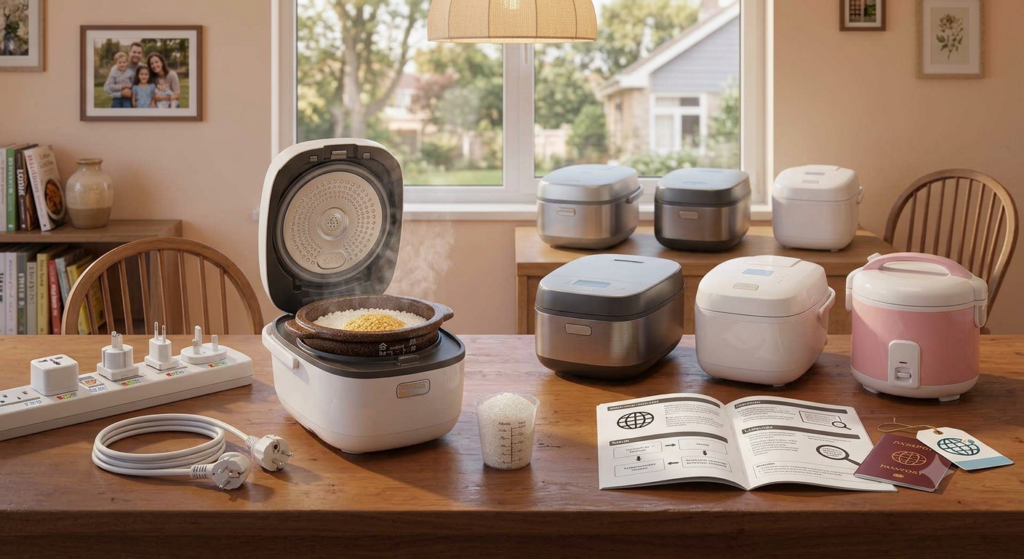
Before you add anything to your cart, run through this checklist so the rice cooker actually works once it lands:
- Voltage and plug shape: Most overseas-spec Japanese rice cookers ship in 220-230V (SE plug) or 120V (A-type plug) versions. Double-check your home country’s standard voltage and outlet shape before ordering — using the wrong voltage unit can damage the appliance or simply not work.
- Capacity in go (合): Japanese capacity is measured in go, roughly 180ml of raw rice per go. A 5.5-cup cooker suits 1–3 people; a 10-cup model suits larger households or batch cooking.
- Language support: Look for English-labeled control panels and multilingual instruction manuals, which most overseas-spec models include.
How to Order a Rice Cooker from Japan via Discovery Japan Mall
Discovery Japan Mall ships authentic Japanese-brand home appliances directly from Japan to over 120 countries and regions. The checkout process supports English and other languages, and accepts payment methods such as credit cards and PayPal. To order a rice cooker:
- Browse the full rice cooker category or jump straight to a specific brand’s listings.
- Confirm the model’s voltage and plug type match your country before adding it to your cart.
- Check the listed capacity (go/cups) against your household size.
Frequently Asked Questions (FAQ)
Which is better, Zojirushi, Hitachi, or Tiger?
There’s no single “better” brand — it depends on your priorities. Zojirushi is the safest all-rounder with soft, sweet rice and proven reliability. Hitachi suits people who prefer a firmer bite thanks to its Pressure + Steam IH system. Tiger is the pick for donabe-style, earthenware-cooked rice with a fragrant, slightly caramelized layer.
What is the difference between IH and pressure IH rice cookers?
IH (induction heating) heats the entire inner pot evenly instead of just the bottom, improving consistency over basic microcomputer models. Pressure IH adds cooking pressure above 100°C on top of that induction heating, producing sweeter, glossier, more resilient rice that reheats especially well.
Can I use a Japanese rice cooker outside Japan?
Yes — overseas-spec models are built specifically for this. Brands sell dedicated 220-230V and 120V versions with region-appropriate plugs, so as long as you match the voltage and plug shape to your country, the cooker will work fine outside Japan. Check the rice cooker listings for the correct voltage variant.
Do Japanese rice cookers work with non-Japanese rice varieties?
Yes — most modern models, including several featured in this guide, include dedicated menu settings for long-grain, jasmine, brown, and mixed-grain rice alongside standard Japanese short-grain settings, so you’re not limited to one type of rice.
Is a pressure IH rice cooker worth the extra cost?
For most rice-texture perfectionists, yes — pressure IH produces a noticeably sweeter, glossier grain that holds up better on reheat, according to hands-on comparisons of premium Japanese rice cookers. If you mostly cook plain white rice and aren’t chasing restaurant-level results, a well-made microcomputer model may be all you need.
Can I order a rice cooker from Japan and have it shipped internationally?
Yes — Discovery Japan Mall ships authentic Japanese rice cookers to more than 120 countries and regions directly from Japan, with tracked and insured delivery and support for multiple payment methods and languages.
What voltage and warranty should I check before ordering?
Confirm the model matches your country’s standard voltage (commonly 120V or 220-230V) and outlet shape, and check which regions the manufacturer’s warranty actually covers, since overseas warranties are often limited to specific countries and typically last about one year.
How do I clean and maintain a Japanese rice cooker?
Most inner lids and steam vent caps are removable and should be washed after every use to prevent residue buildup, while inner pots (unless earthenware-coated) can typically be rinsed directly, since manufacturers design the round-bottomed pans to double as a washing bowl for the rice itself.
Final Thoughts: There’s No Wrong Choice — Only the Right Fit
After putting Zojirushi, Hitachi, and Tiger side by side, the honest takeaway is that all three brands can absolutely deliver that “why does rice from Japan taste so much better” moment — they just get there differently. Zojirushi leans on decades of microcomputer refinement, Hitachi leans on steam-assisted pressure cooking for a firmer bite, and Tiger leans on earthenware tradition for fragrant, donabe-style depth. Whichever one matches your household size, budget, and taste preference, you’re getting genuine Japanese engineering built around a single goal: a better bowl of rice.
Ready to see the full lineup for yourself? Browse Discovery Japan Mall’s complete selection of authentic Japanese rice cookers from Zojirushi, Hitachi, and Tiger, all shipped directly from Japan.

Comments