A japanese rice cooker is one of the easiest upgrades you can make if you eat rice often. Instead of watching a pot on the stove and hoping the texture is right, a dedicated rice cooker measures heat, steam, timing, and rest time for you.
In this guide, Discovery Japan Mall explains how Japanese rice cookers work, how to choose the right size and technology, how to cook short grain japanese rice step by step, and which models fit home kitchens, sushi lovers, and professional use.
- Quick Answer: How to Cook Perfect Rice in a Japanese Rice Cooker
- What Makes a Japanese Rice Cooker Different? (Conventional vs Micom vs IH vs Pressure)
- Types of Japanese Rice Cookers & How to Choose the Best One for Your Needs
- How to Cook Rice in a Japanese Rice Cooker Step by Step
- Beyond White Rice: What You Can Cook in a Japanese Rice Cooker
- Troubleshooting: When Your Rice Isn’t Perfect
- Key Features That Matter in Japanese Rice Cookers
- Product Image Section – Visual Guide to Popular Japanese Rice Cookers
- Use-Case Based Classification: Which Japanese Rice Cooker Should You Choose?
Quick Answer: How to Cook Perfect Rice in a Japanese Rice Cooker
Modern Japanese rice cookers, especially Micom, induction heating, and neuro fuzzy models, make perfect rice almost foolproof. The basic cooking process is simple: measure rice, rinse it, add water to the correct line, choose the correct menu, and press start.
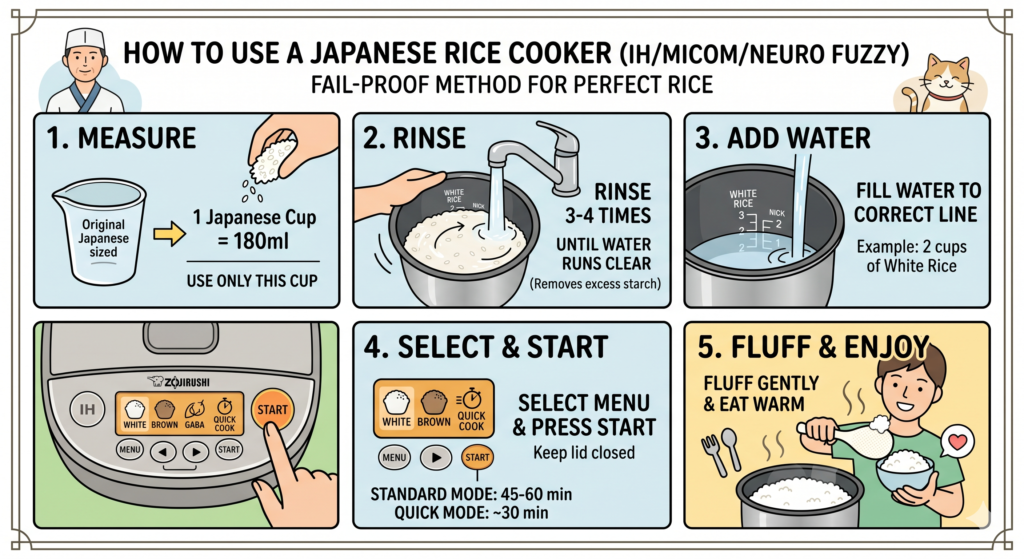
- Measure rice with the included rice measuring cup. One Japanese rice cup is 180 ml, not a standard US cup.
- Rinse the uncooked rice 3–4 times until the water is less cloudy. This removes excess starch and helps prevent sticky or gummy results.
- Add water to the matching line inside the inner pot, such as “WHITE RICE 2” for 2 cups of short grain white rice.
- Select the right menu, such as WHITE, SUSHI, BROWN, GABA BROWN, MIXED, PORRIDGE, or QUICK COOK.
- Press START and keep the lid closed until the cooking cycle finishes.
- For 2 cups of short grain white rice in a Zojirushi Micom or induction heating rice cooker, expect about 45–60 minutes in standard mode or around 30 minutes for quick rice.
- Fluff the cooked rice gently with the rice paddle, then serve while it is warm.
Japanese cookers can handle white rice, brown rice, mixed rice, porridge, quinoa, jasmine rice, and oats. The key is matching the water line and menu to the grain, because each rice type needs a different amount of water and heat.
What Makes a Japanese Rice Cooker Different? (Conventional vs Micom vs IH vs Pressure)
A basic rice maker turns heat on and off. A Japanese Micom, fuzzy logic, or induction heating rice cooker actively manages time, temperature, steam, and rest periods to produce delicious rice with fewer dry, mushy, or scorched spots.
- Conventional rice cookers are the most basic type, featuring just a thermostat and a heating element for cooking rice. They are suitable for simple cook rice tasks and a no frills rice cooker setup, but they are limited for sushi rice, brown rice, mixed rice, or grains that need controlled soaking and steaming.
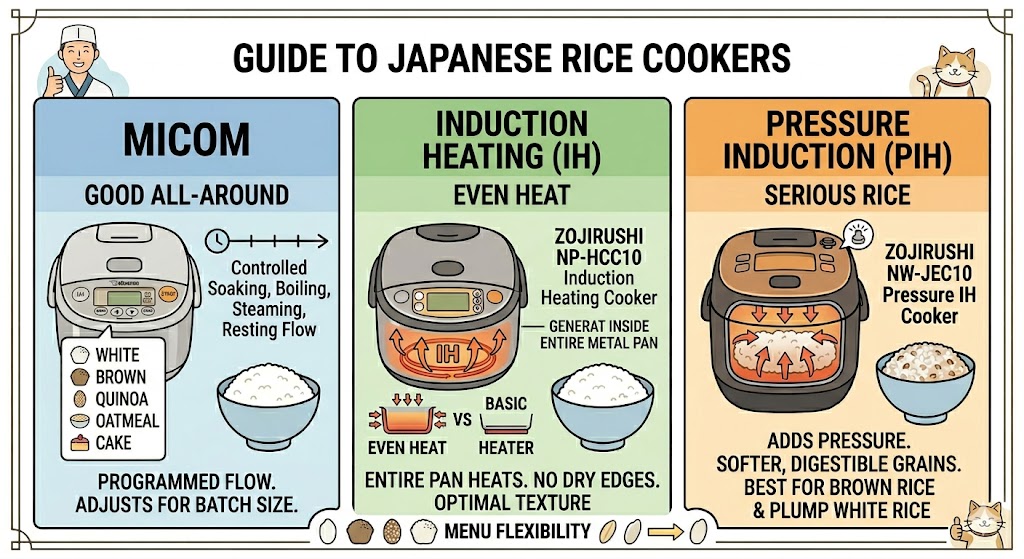
- Micom, or micro-computerized rice cookers, have programmed cooking flows that adjust cooking time and temperature for better results. A micom rice cooker uses sensors and software to manage soaking, boiling, steaming, and resting. Advanced rice cookers utilize fuzzy logic technology, which allows them to adjust cooking time and temperature based on the type of rice and the amount being cooked, ensuring even cooking and optimal texture.
- A zojirushi micom rice cooker such as the Zojirushi NL-BAC05 is a strong compact choice because it offers menus for white rice, brown rice, long grain rice, quinoa, steel cut oatmeal, cake, and quick cooking. Tiger and Toshiba Micom units use similar microcomputer-controlled cooking functions.
- A neuro fuzzy rice cooker is Zojirushi’s term for advanced fuzzy logic. Classic models such as the Zojirushi NS-ZCC10 Neuro Fuzzy cooker are known for making small adjustments during the cooking process, which helps when producing rice in different batch sizes.
- Induction heating (IH) rice cookers utilize induction technology to heat the inner pot, providing more even cooking compared to traditional electric heaters. An induction heating rice cooker heats the inner cooking pan itself, not just the bottom plate. This helps create evenly cooked grains and reduces the chance of dry rice at the edges or burnt rice at the bottom.
- Choosing a rice cooker with Induction Heating (IH) and Fuzzy Logic/Microcomputer technology is critical for achieving evenly cooked rice with the desired texture. The Zojirushi NP-HCC10 Induction Heating Rice Cooker is highly regarded for its ability to produce evenly cooked, fluffy rice thanks to its Micom technology and induction heating capabilities.
- Pressure rice cookers apply pressure during cooking, which can enhance the texture and flavor of the rice, making it a top choice for serious rice enthusiasts. Pressure Induction Heating (PIH) combines induction heat with pressurized cooking, creating softer and more digestible rice grains. Pressure IH models such as Zojirushi NW-JEC10 or NP-NWC10 are excellent for plump white rice, short grain brown rice, and making sushi rice.
- Japanese IH and pressure IH cookers may take longer than basic other rice cookers, but the result is often better flavor, better aroma, and more consistent texture. A serious rice eater will notice the difference between just rice and perfectly cooked rice.
Discovery Japan Mall curates Japanese rice makers across these categories and is part of a broader online marketplace for authentic Japanese products. Browse our Japanese rice cooker collection and IH rice cooker options to compare current availability.
Types of Japanese Rice Cookers & How to Choose the Best One for Your Needs
The best rice cooker depends on capacity, budget, and how you eat rice. A student who cooks one bowl of white rice needs a different machine from a family making bento lunches, or a sushi bar holding shari through dinner service.
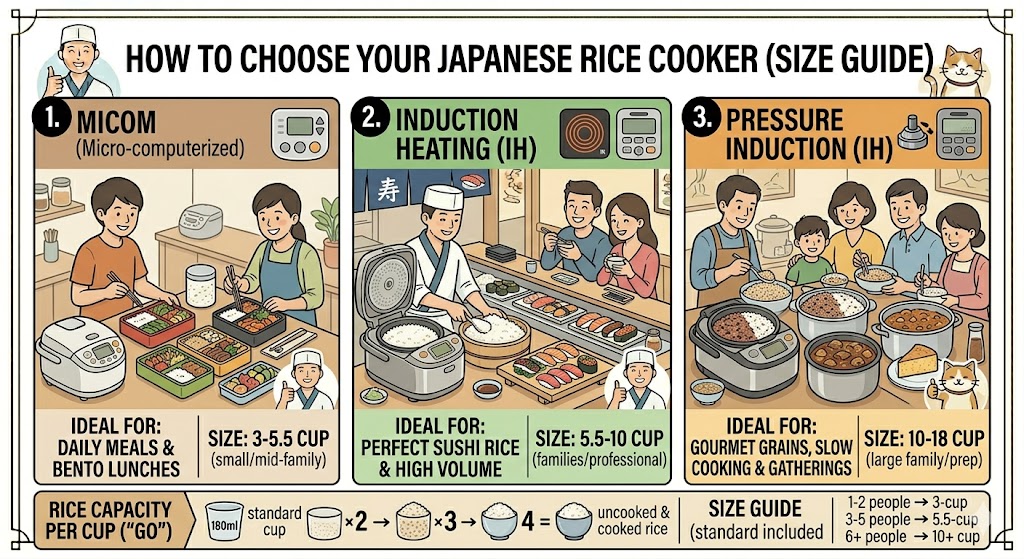
- Capacity is usually shown in Japanese “go.” One go is 180 ml, the same size as the included rice measuring cup.
- A 3-cup rice cooker holds about 0.54 L of uncooked rice and suits singles, couples, dorms, and small kitchens.
- A 5.5-cup model holds about 1.0 L of uncooked rice and suits families of three to five.
- A 10-cup model holds about 1.8 L of uncooked rice and suits large families, meal prep, and frequent hosting.
- Rice cookers can vary in capacity, with smaller models typically holding around 3 cups of uncooked rice, while larger models can accommodate up to 20 cups.
- When choosing a rice cooker, consider the capacity, as it typically indicates the maximum amount of uncooked rice that can be cooked, with a 3-cup cooker suitable for singles or couples, a 5.5-cup for families of four, and a 10-cup for larger families.
Product tiers are also important:
- Entry-level: basic on/off or simple Micom, great for people who mainly cook white rice a few times a week.
- Mid-range: Micom with multiple menus such as white, brown, sushi, porridge, quick cook, and cake.
- High-end: induction heating rice cooker and pressure IH for enthusiasts and sushi lovers seeking perfect rice every time.
Rice cookers can vary significantly in features, with some models offering fuzzy logic technology that adjusts cooking time and temperature based on the type of rice being cooked, while others may have basic on/off functions. If you only make plain white and brown rice occasionally, a small rice cooker such as the NL-BAC05 may be enough. If you eat rice daily, the NP-HCC10 or NP-HCC18 gives stronger heating, better water control, and more stable rice warm performance.
Cuckoo rice cookers are known for their customizable features, including a “My Mode” setting that allows users to adjust cooking parameters for different rice types. The Cuckoo CRP-P1009 10-Cup Electric Pressure Rice Cooker is noted for its ability to cook sushi and brown rice exceptionally well, utilizing pressure cooking to achieve faster cooking times and better texture. Still, for Discovery Japan Mall customers looking for Japanese rice cooker models, zojirushi rice cookers remain a central choice because of their interface, menus, and reliable keep-warm logic.
How to Cook Rice in a Japanese Rice Cooker Step by Step
Buttons differ slightly between Zojirushi, Tiger, Toshiba, Panasonic, and other brands, but the core method is the same. Rice cookers simplify the cooking process by allowing users to just measure rice and water, press a button, and let the machine do the work, freeing up time for other meal preparations.
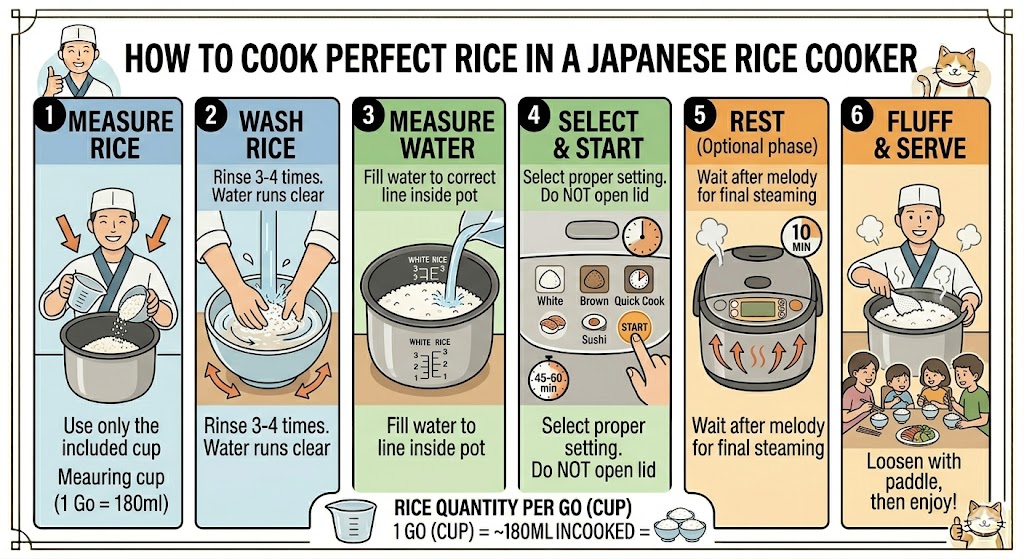
- Measure rice
Use the included 180 ml rice measuring cup. For a family of four, 3 cups of uncooked rice is a common amount. Do not use a standard kitchen cup unless you adjust the water manually. - Wash rice
Place the rice in the cooking pan or a separate bowl. Rinse short grain white rice 3–4 times, gently stirring and draining until the water is less cloudy. This removes excess starch and bran dust. - Measure water
Put the washed rice into the inner pot and add water to the correct line. For example, in a Zojirushi NP-HCC10, use the “WHITE RICE 3” line for 3 cups of short grain rice. Brown rice lines differ because brown rice needs more water and more time. - Select the menu
Choose WHITE, SUSHI, BROWN, GABA BROWN, MIXED, PORRIDGE, QUICK COOK, JASMINE, or another matching setting. Rice cookers can prepare a variety of rice types, including short grain, medium grain, long grain, jasmine, and brown rice, each requiring specific settings for optimal results. - Start the cooking cycle
Press START. Do not open the lid mid-cycle. Opening the lid releases steam and disrupts the heat balance, especially in IH and pressure cooking models. - Let the rice rest
Standard cooking time for white rice is usually about 45–60 minutes. Quick cooking is often around 30 minutes. After the completion melody, let the rice sit for about 10 minutes if your model has not already included a final steaming phase. - Fluff and serve
Use the included rice paddle to loosen the rice from the sides and bottom. This releases extra steam and helps create fluffy rice instead of compacted grains.
Use the Delay Timer when you want steel cut oats ready at 7:00 am or rice ready at 7:00 pm for dinner. When selecting a rice cooker, look for user-friendly features such as clear measurement markings, automatic keep warm functions, and the ability to delay the start of cooking, which enhance the cooking experience.
Beyond White Rice: What You Can Cook in a Japanese Rice Cooker
Japanese rice makers can handle far more than plain white rice. A good machine can function as a grain cooker, a porridge maker, a partial slow cooker, and in some cases a steam cook appliance.
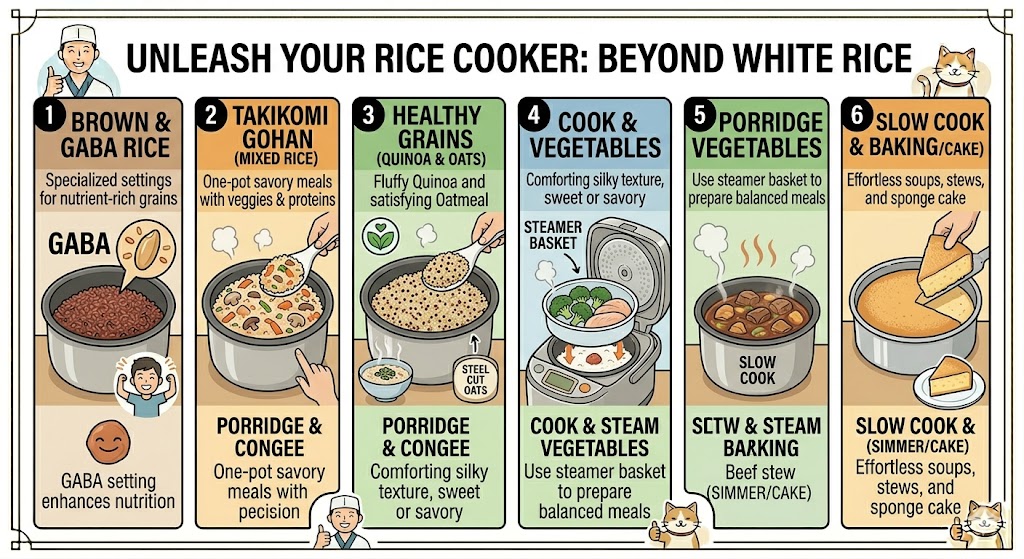
- Short grain white rice is the standard for japanese rice and everyday meals. It is also the foundation for sushi rice.
- Medium grain rice and long grain rice can be cooked in many IH and Micom cookers. Use LONG GRAIN, JASMINE, WHITE, or MIXED settings where available.
- Jasmine rice benefits from a dedicated JASMINE setting because the cooker protects fragrance while keeping grains separate.
- Brown rice and short grain brown rice should use BROWN or GABA BROWN. The Zojirushi Induction Heating Rice Cooker is praised for its specialized settings for various rice types, including GABA rice, which enhances the nutritional value of brown rice by activating GABA content during cooking.
- White and brown rice need different menus and water levels, so do not use the same line for every grain.
- Mixed rice and Takikomi Gohan should use MIXED. This helps seasonings, vegetables, and rice cook together without becoming too soft.
- Sweet rice requires its own setting when available because glutinous grains absorb water differently.
- Quinoa and other grains can be cooked in models with QUINOA or mixed grain programs.
- Steel cut oats and rolled oats work well on OATMEAL, PORRIDGE, or SLOW COOK modes. The NL-BAC05 includes a steel cut oatmeal menu.
- Many rice cookers also have the capability to cook other grains such as quinoa and oats, as well as prepare porridge and congee.
- Porridge and congee use more water than standard rice. Japanese okayu is usually lighter, while Chinese-style congee is often softer and more broken down.
- Rice cookers can also function as steamers, allowing users to steam vegetables or proteins while cooking rice, enhancing their versatility in meal preparation.
- Some premium IH and Micom units include slow cook, SLOW COOK, or SIMMER programs for simple soups, curries, and stews.
- Cake functions on some Zojirushi Micom models allow sponge-style cakes without an oven.
The best rice cookers not only cook rice but also have the ability to prepare other grains and foods, making them versatile kitchen appliances. Rice cookers often include multiple settings for different types of rice and grains, allowing for versatility in cooking beyond just rice, such as quinoa and porridge.
Troubleshooting: When Your Rice Isn’t Perfect
Even with an excellent rice cooker, issues can happen because of water level, rice age, menu choice, or maintenance. Use these fixes before assuming the machine is the problem.
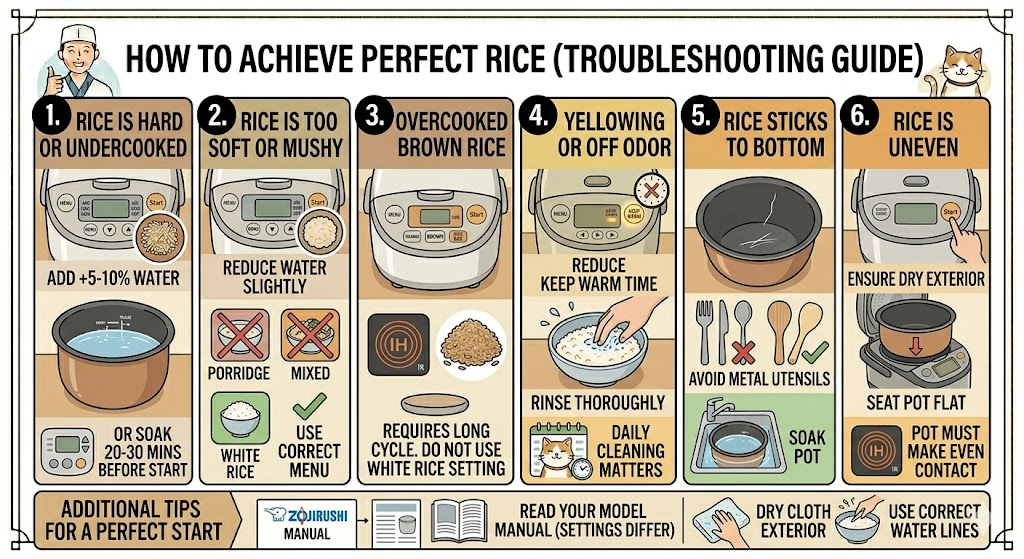
- Rice is hard or undercooked: Add 5–10% more water next time, especially for older rice. You can also soak rice for 20–30 minutes before cooking.
- Rice is too soft or mushy: Reduce water slightly and confirm you did not use PORRIDGE or MIXED for plain white rice.
- Overcooked brown rice: Use the BROWN setting, not WHITE. Brown rice needs a longer programmed cycle, not just extra water.
- Rice turns yellow or smells off: Rinse more thoroughly and avoid leaving rice on Keep Warm too long. Some advanced models can hold rice longer, but daily cleaning still matters.
- Water bubbles over or spits: The pot may be overfilled, or foamy ingredients may have been added. Stay below the maximum line.
- Rice sticks to the bottom: The nonstick surface may be scratched, or the warm setting may have been used too long. Soak the inner pot and avoid metal utensils.
- Rice is dry after holding: Use Extended Keep Warm if available, and stir the rice before serving.
- Rice is uneven: Make sure the inner cooking pan is seated flat and the outside of the pan is dry before cooking.
- Manual mismatch: Read your model manual because Zojirushi, Tiger, and Panasonic water lines and menu names differ between Micom and IH cookers.
Rice cookers can produce consistently fluffy and well-cooked rice, reducing the risk of user error that often occurs with stovetop cooking methods. If the same problem repeats, check the measuring cup, water line, lid gasket, and steam vent.
Key Features That Matter in Japanese Rice Cookers
Choose features that fit how often and what you cook. The most expensive model is not always the best japanese rice cooker for your kitchen.
- Fuzzy logic / Micom: Adjusts heat and timing automatically. This is useful if you cook different rice types or different batch sizes.
- Neuro fuzzy: A more advanced fuzzy logic system associated with Zojirushi. It helps your favorite rice cooker adapt to real cooking conditions.
- Induction heating: Heats the inner pot directly for more precise control and evenly cooked grains.
- Pressure IH: Adds pressure for plumper, softer grains and deeper flavor.
- Triple heater: Heating from the bottom, sides, and lid improves consistency. Zojirushi notes triple heaters on models such as the NP-HCC series.
- Spherical pan design: Helps circulate heat and water more evenly.
- Clear water markings: High-contrast inner-pot lines make it easier to measure rice and water correctly.
- Removable inner lid: Top-tier Japanese rice cookers often include a removable inner lid for easy cleaning and maintenance.
- Steam vent cap: A removable cap helps prevent odor buildup.
- Inner pot coating: Most modern models use nonstick coatings. Some buyers look for ceramic-coated or stainless steel alternatives because of PFAS/PTFE concerns.
- Stainless steel exterior: Many premium models use stainless steel or easy-clean coated surfaces for durability.
- Stainless steel pot options: Some commercial or specialty models use a stainless steel pot, but many home Japanese cookers use coated aluminum for heat transfer.
- Keep Warm and Extended Keep Warm: Many rice cookers come with a Keep Warm function that maintains the rice at serving temperature without drying it out, making it convenient for serving later.
- Long holding ability: Japanese rice cookers can keep cooked rice fresh and moist for up to 48 hours without spoiling or yellowing due to superior insulation and advanced sensors, though you should always follow the manual and local food safety guidance.
- Delay Timer: Useful for breakfast oats or dinner rice.
- Sound settings: Zojirushi melody signals make it easy to know when cooking starts and ends, but some users also enjoy pairing their kitchen with decorative Rhythm brand wall clocks for a cohesive Japanese home aesthetic.
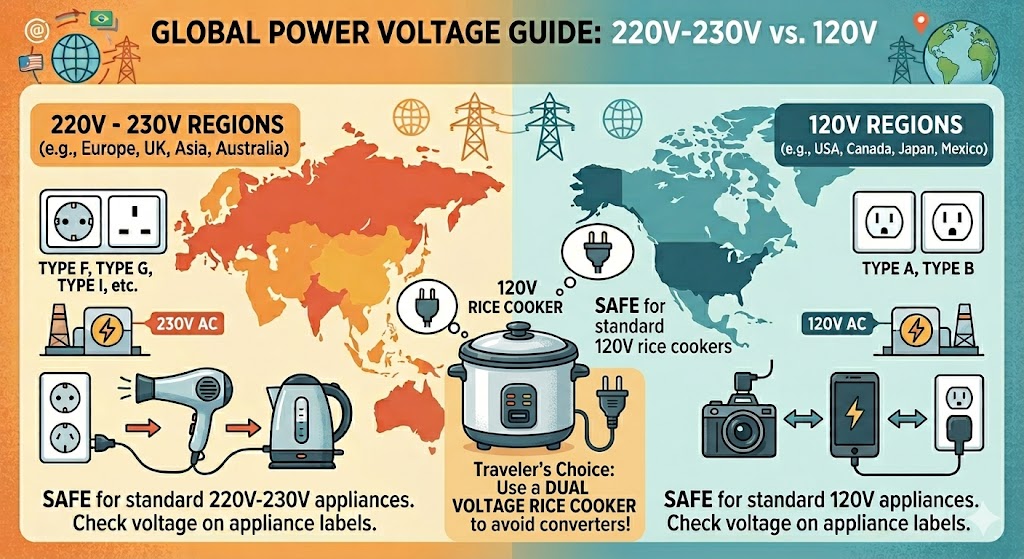
- Voltage: Japan domestic models are often 100 V, while export models may be 120 V. Check this before importing, and consider overseas-supported options such as the Zojirushi NS-YMH10 5-cup rice cooker.
- Wattage: IH models use more power. For example, Zojirushi lists the NP-HCC10 at 1,230 W and the NP-HCC18 at 1,350 W, while larger export-ready units like the Zojirushi NS-YMH18 10-cup rice cooker are designed for 220–230 V regions.
A heating rice cooker warmer is not just about heat. The better models manage moisture, temperature, and steam so your rice warm holding time does not ruin texture.
Product Image Section – Visual Guide to Popular Japanese Rice Cookers
Discovery Japan Mall curates authentic Japanese models with official product images so readers can visually compare size, control panels, lid design, and build quality. In the final store layout, this section should use a 2- or 3-column responsive grid on desktop and stack to one column on mobile.
Zojirushi 5 Cup ETL IH Rice Cooker & Warmer NS-YMH10 – 5 cups, induction heating rice cooker warmer, best for families and sushi rice lovers. View on Discovery Japan Mall
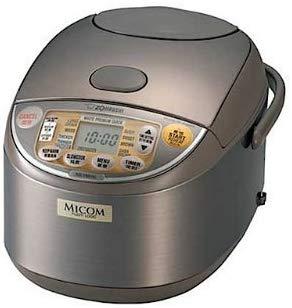
Zojirushi 10 Cup ETL IH Rice Cooker & Warmer NS-YMH18 – 10 cups, IH technology, best for large families and batch cooking. View on Discovery Japan Mall

Recommend !
Pressure IH Rice Cooker 5.5 Go NP-BQH10 BA 220-230V Made in Japan, best compact cup rice cooker for singles and couples. View on Discovery Japan Mall
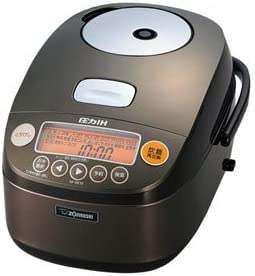
The premium price of the NP-BQH10—the pinnacle of Zojirushi’s export-model rice cookers—is justified by a single guarantee: it brings Japan’s ultimate culinary technology straight to your overseas kitchen.
Here is why it stands out as the ultimate choice:
- Unmatched Taste & Textures: Combining “Pressure IH (Induction Heating)” with a premium “Gohitsu Hagama” inner iron pot, it generates intense heat to cook every grain to plump, chewy perfection. Its internal Platinum Coating alters water quality to boost the rice’s natural sweetness by 30%.
- Optimized for Global Cuisines: Unlike domestic Japanese models, it features specialized programming tailored for international staples—including dedicated settings for Long-Grain (Jasmine) rice and dual settings for thick or thin Congee.
- Authentic Made-in-Japan Quality: Manufactured strictly in Japan under rigorous quality standards, this flagship model offers unparalleled durability and prestige.
This is not just a rice cooker; it is an investment that transforms everyday international ingredients into Japanese restaurant-quality dining.
Use-Case Based Classification: Which Japanese Rice Cooker Should You Choose?
Discovery Japan Mall recommends different products based on how and where you cook, not just by price.
Home use – Singles & Couples
Choose a 3-cup Micom model such as the Zojirushi NL-BAC05. It is compact, easy to store, and ideal for apartments, dorms, and small kitchens. It can cook small portions of short grain white rice, brown rice, steel cut oats, quinoa, and cake without the bulk of a larger unit.
This is also a good rice cooker for people who eat rice a few times a week and want reliable results without paying for premium IH.
Family use (3–5 people)
Choose a 5.5-cup induction heating model such as Zojirushi NP-HCC10. It offers the best balance of capacity, cooking quality, and daily convenience.


Comments