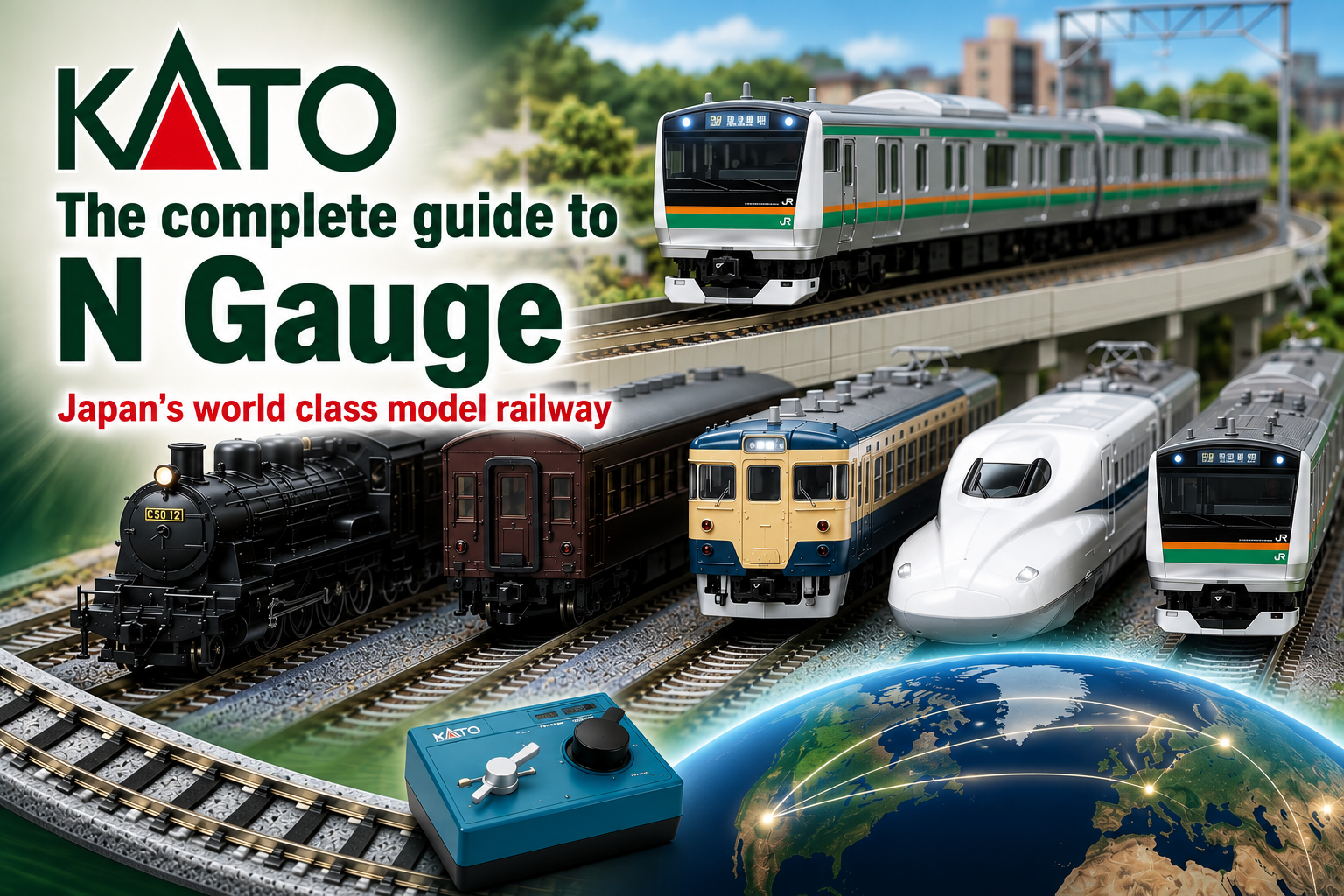
If you’ve ever searched for “n gage” hoping to find model railroad information, you’ve likely encountered results about a very different product. This guide cuts through the confusion and delivers everything you need to know about N Gauge – the world’s most popular model railroading scale – with a specific focus on Japanese manufacturers, their competitors, and where to buy authentic products.
- What Is N Gauge?
- Japanese N Gauge Manufacturers at a Glance
- KATO (Kansui Kinzoku): A World-Class Japanese N Gauge Brand
- TOMIX (Tomytec): Expansive Track Systems and Japanese Prototypes
- Micro Ace: A Treasure Trove of Rare Prototypes and Original Model Private Railway Models
- Greenmax: Kits and Finished Models for the Creative Hobbyist
- Other Japanese N Gauge Manufacturers and Brands
- N Gauge Standards and the Difference Between “N Gauge” and “Nokia N-Gage”
- Major N Gauge Retail Stores in Japan
- Purchasing N Gauge Online: Discovery Japan Mall’s Role
- Getting Started with N Gauge: Basic Steps
- Advanced Enjoyment: Expanding Your Japanese N Gauge Hobby
- Bringing Japan’s Railroad World to Your Fingertips
What Is N Gauge?
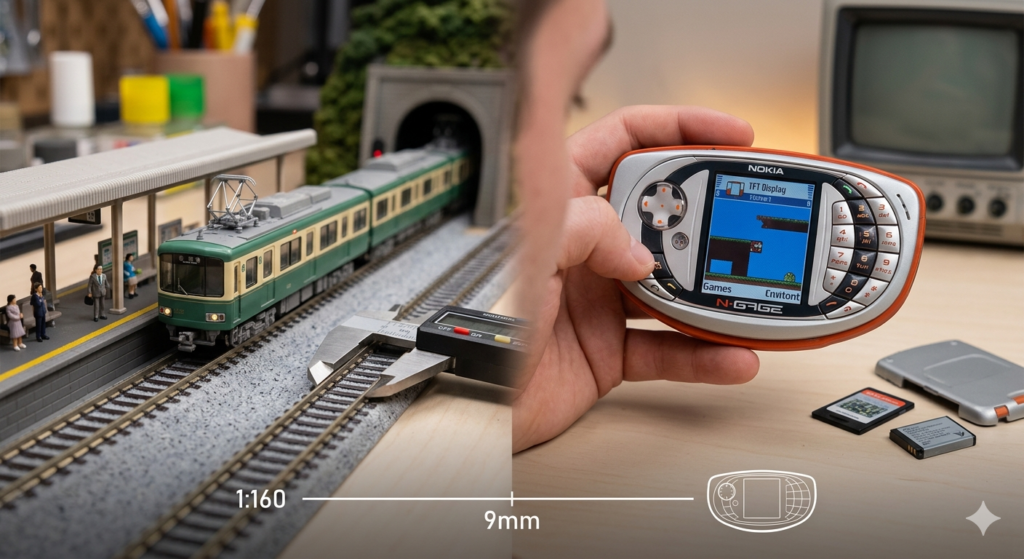
N Gauge is popular for model railroading and refers to a miniature train standard defined by two key measurements. Scale refers to the size ratio of the model compared to the real train, while gauge refers to the distance between running rails on the track. N Gauge track rails are 9 millimeters apart, and in North America and Europe, the standard scale for N Gauge is 1:160. In Japan, conventional line models use 1/150 scale, while Shinkansen models are produced at 1/160.
Why is N Gauge so widely adopted in Japan?
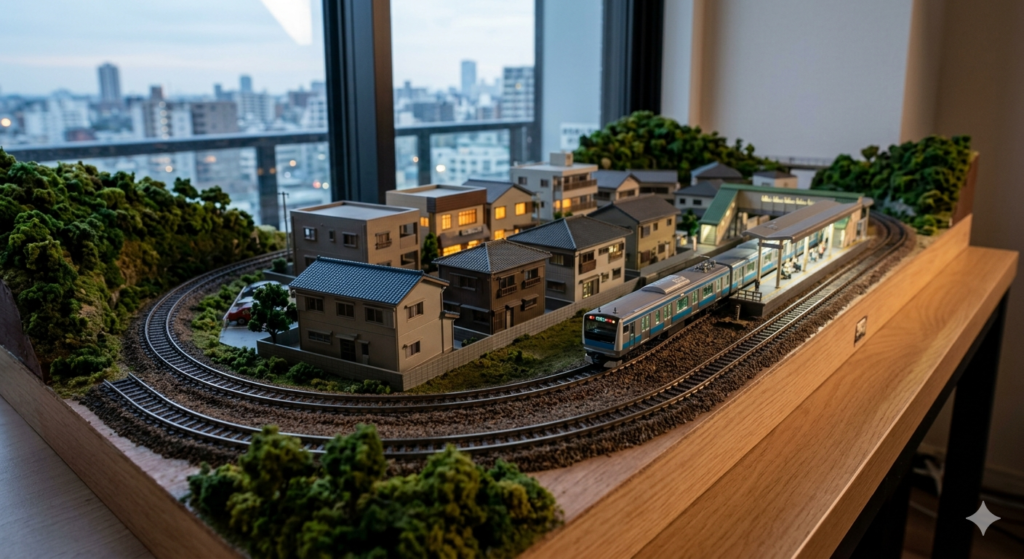
- N Gauge is ideal for hobbyists with limited space for layouts – a complete oval fits on a desk
- N Gauge allows builders to model expansive landscapes in compact rooms
- N Gauge allows for realistic long trains and sweeping landscapes even in small apartments
- N Gauge is space efficient for building complex layouts with multiple routes
- Modern manufacturing enhances detail in N Scale models despite their size
- Various scales exist for model trains with different size requirements, but N Gauge strikes the best balance of detail and compactness
The scale varies slightly depending on the prototype being modeled, but the 9mm gauge remains constant. At Discovery Japan Mall, we specialize in connecting overseas fans with genuine Japanese-made N Gauge products.
Japanese N Gauge Manufacturers at a Glance
Japan’s N Gauge market is one of the most competitive in the world, with manufacturers ranging from industry giants to specialized niche producers. Here are the key players, each with distinct strengths:
- KATO (Kansui Kinzoku) – The precision pioneer. Known for JNR/JR prototypes like the 165 series and N700S Shinkansen
- TOMIX (Tomytec) – The system builder. Comprehensive track and rolling stock lineup including JR East E231 and EF210 freight locomotives
- Micro Ace – The niche specialist. Covers rare types like KiHa 54 diesel cars and regional private railway vehicles
- Greenmax – The customizer’s choice. Offers unpainted kits and finished models of metropolitan private railway trains (Tokyu, Odakyu, Seibu)
- MODEMO (Hasegawa) – The limited-edition artisan. Tramcars and private railway vehicles like Tokyo Toden 7000 series
- Tenshodo – The luxury collector’s brand. Brass models and sound-equipped vehicles with over 70 years of heritage
- Tramway (TORM.) – Steam locomotives and freight cars with high fidelity
- Railway Collection (Tomytec) – Display models convertible to running N Gauge with motorized car parts sold separately
KATO (Kansui Kinzoku): A World-Class Japanese N Gauge Brand
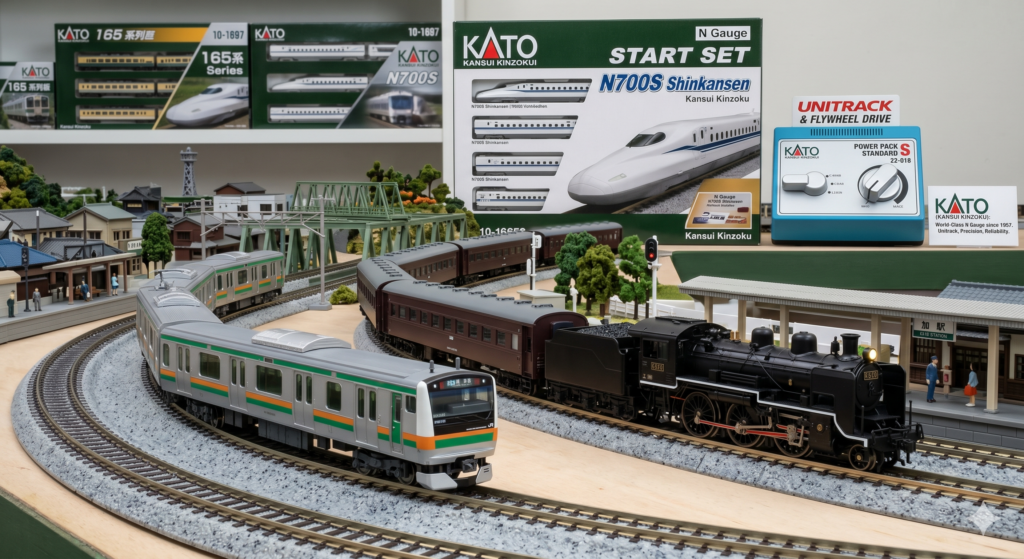
Founded in 1957, KATO released Japan’s first domestically produced plastic N Gauge models – the C50 steam locomotive and Oha 31 passenger car – in 1965. The brand has since become synonymous with precision and reliability.
Representative products include the 10 series passenger cars, 165 series electric trains, N700S Shinkansen, and E233 series commuter trains. Each release reflects meticulous attention to the original model prototypes.
Key features that define KATO:
- Unitrack system – Snap-together track with integrated roadbed for stable, solid connections
- Flywheel-equipped motors – Inertia drive system for smooth, realistic running performance
- Compact layout compatibility – Designed with Japanese housing in mind, offering tight-radius curves and modular options
- International presence – Products are shipped to the American and European market, though their Japanese-prototype lineup remains the core
For beginners, KATO’s starter sets (such as the E233 series set) include everything needed to play right out of the box: track, power pack, and rolling stock.
TOMIX (Tomytec): Expansive Track Systems and Japanese Prototypes
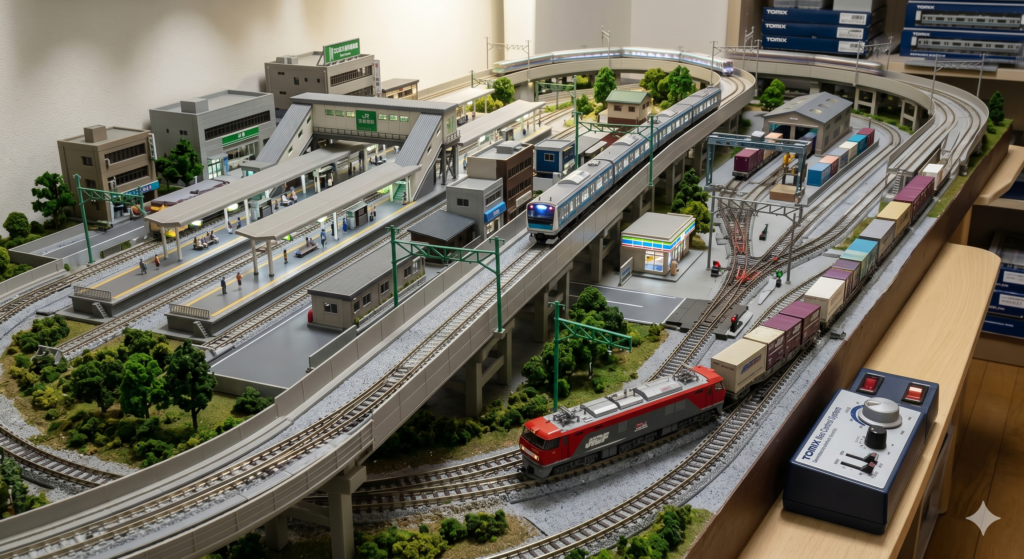
TOMIX launched in 1976 when Tomy established domestic manufacturing for its N Gauge line, previously importing from Hong Kong. The brand quickly became KATO’s primary competitor, and the rivalry between the two has driven innovation for decades.
The Fine Track system is a standout feature, offering track with integrated roadbed in multiple variations – from standard 280mm radius curves to wide PC rails and double-track viaducts.
What makes TOMIX distinctive:
- Broad vehicle lineup – JR East E231 commuter trains, JR Freight EF210 locomotives, Kyushu Shinkansen 800 series, and loads of regional and private railway types
- Scenery and structures – Platforms, station buildings, commercial structures, and yard accessories for complete layout creation
- Advanced controllers – Evolution from basic power units to the NECST and Neo control systems
- Turnout variety – Extensive selection of powered switch tracks for complex layout ideas
TOMIX’s infrastructure-focused approach makes it the go-to brand for users who want to create immersive, scenery-rich layouts.
Micro Ace: A Treasure Trove of Rare Prototypes and Original Model Private Railway Models
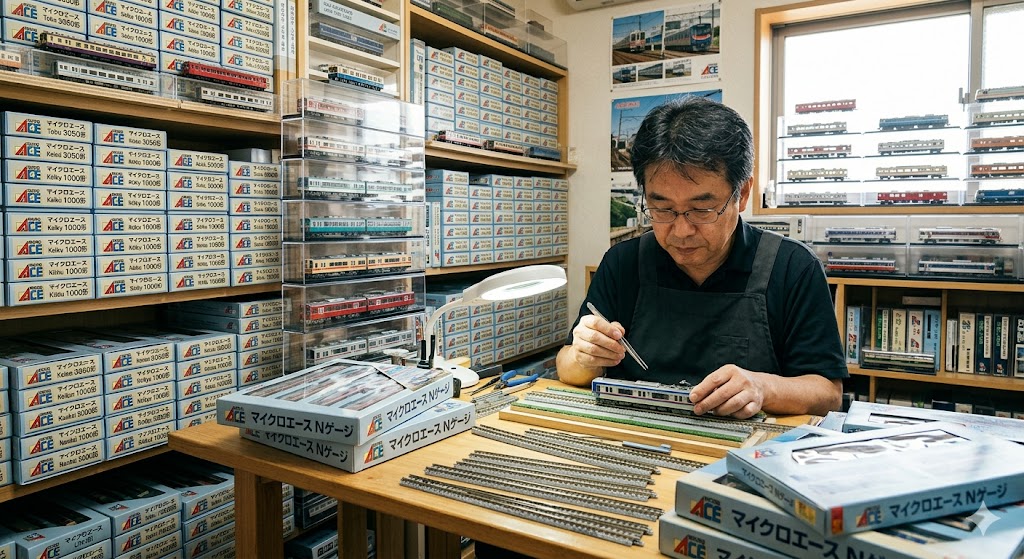
Micro Ace traces its lineage through Arii Manufacturing (known for plastic model kits) and Shinano Micro, entering the N Gauge market in earnest during the late 1990s. The brand carved out a niche by producing vehicles that major manufacturers were unable or unwilling to tackle.
What Micro Ace covers:
- KiHa 54 diesel railcars for remote Hokkaido lines
- Express-type diesel cars from the JNR era
- Private railway rolling stock from Keisei, Keikyu, Nankai, and other operators
- Unusual formations and limited-run regional trains
Many Micro Ace products are limited production items. Once a run sells out, re-release cycles can stretch for years. This scarcity drives premium pricing on the secondhand market – discontinued sets regularly command multiples of their original price on platforms like ebay.
For overseas collectors searching for rare Japanese prototypes, Micro Ace represents some of the most compelling selling opportunities and collecting challenges in the hobby.
Greenmax: Kits and Finished Models for the Creative Hobbyist

Greenmax has been producing structure kits and vehicle models since the mid-1970s. The brand uniquely serves both the builder who wants to create something personal and the collector who prefers ready-to-run convenience.
Product categories include:
- Unpainted kits – Bare plastic bodies for users who enjoy painting and assembly
- Painted kits – Pre-decorated but requiring assembly, a middle-ground option
- Finished models – Display-ready and running-capable straight from the box
Greenmax excels with metropolitan private railway prototypes: Tokyu, Odakyu, Seibu, Meitetsu, and others. If you’re after a specific suburban commuter train version from Tokyo or Nagoya, Greenmax likely has it.
Other Japanese N Gauge Manufacturers and Brands
Beyond the major four, Japan’s N Gauge ecosystem includes numerous smaller competitors:
- MODEMO (Hasegawa) – Limited-production tramcars and private railway vehicles; the Meitetsu Mo 780 and Odakyu RSE 20000 are standout releases
- Tramway (TORM.) – Focused on steam locomotives and freight rolling stock with fine detailing
- MODELS IMON – Import products and original accessories for advanced hobbyists
- Tenshodo – Brass and high-end plastic models with sound systems; the Ginza main store has operated for over 140 years
- Kawai Shokai – Produced N Gauge freight cars (Wam 80000, Chiki series) before the brand ceased operations; items are now collector’s pieces
- Railway Collection (Tomytec) – Affordable display models that can be motorized with separately sold running parts, expanding the play possibilities of N Gauge
At Discovery Japan Mall, we aim to curate selections from these brands, focusing on genuine Japanese domestic products.
N Gauge Standards and the Difference Between “N Gauge” and “Nokia N-Gage”
The gauge for N Scale models is standardized at 9 mm. N Gauge represents a modeling scale of 1:160 (with Japanese conventional lines at 1/150). Power supply is DC two-rail, typically 12V, and DCC-compatible software and controllers are increasingly available.
Don’t Confuse It With the Nokia N-Gage Game System
When people search “n gage,” they sometimes land on information about a completely different product: the nokia n gage. This was a gaming device and cell phone hybrid released by nokia in October 2003, designed and manufactured in finland. The device combined a game system with tri band GSM phone functionality in a single form factor that critics and users alike quickly nicknamed the taco phone due to its awkward shape for making calls. Many users found the N-Gage’s design awkward for phone calls – you had to hold it sideways against your ear, with the screen facing outward and other buttons pressed against your cheek.
The original N-Gage ran on Symbian, an operating system also used by other nokia handhelds, powered by a 104 MHz ARM CPU. The N-Gage features a 2.1 inch TFT display with a resolution of 176 x 208 pixels. It supported Bluetooth to connect with other devices for multiplayer gaming, and featured a game slot that accepted MMC cards. However, users reported frustration with changing games requiring battery removal – you had to pull the battery out just to swap a card, a design flaw that drew widespread comment across the press.
Nokia positioned the device to compete against the sony playstation Portable and Nintendo’s game boy Advance. The results were disastrous: the N-Gage was outsold by the Game Boy Advance 100 to 1 initially. Nokia claimed 400,000 N-Gage sales in the first two weeks, but ultimately Nokia sold only one-third of expected N-Gage units. The N-Gage received a 3.3 out of 5 star rating. Users criticized the N-Gage for poor graphics and slow performance compared to dedicated console handhelds. Nokia admitted the N-Gage failed to meet sales expectations, a failure the company tried to address with a redesigned version.
The n gage qd was released on May 26, 2004, featuring a revised form factor that made phone calls less awkward. However, the N-Gage QD removed MP3 playback and FM radio features, leaving some users disappointed. The qd also lacked a camera, unlike emerging smartphones from apple and other manufacturers that would soon reshape the phone world.
The game library included 58 full titles across the platform. Among them were ports of tony hawk’s Pro Skater and tomb raider, which some considered good games but couldn’t match what was available on the game boy Advance or playstation. Two titles were not released in North America. Payload was only available via the digital N-Gage store (through the n gage arena online service where users could chat and account for scores), Snakes was given out as a free file, and virtua cop – originally developed by sega – was cancelled before release. Despite spending heavily on ads, Nokia was unable to change games perception in the market.
N-Gage was discontinued in Western markets in February 2006. Nokia shipped over 2 million N-Gage decks by 2007, but by then the launch had long been considered a failure. If you’re talking about this device today, you might find one for sale on ebay, or see a person reviewing it in a nostalgic video on youtube – often as a curiosity from april or november 2003 press coverage, or a july post about failed tech. By june of that year, even before the official launch, industry analysts were already making the comment that nokia had failed to account for how quickly the market for dedicated handhelds was shrinking as smartphones emerged.
Here’s a quick comparison to keep things clear:
- N Gauge (model railroad) – 9mm track gauge, 1/150–1/160 scale, DC-powered hobby for building layouts and running miniature trains
- N-Gage (Nokia) – A 2003 cell phone/game console hybrid running Symbian, discontinued in 2006; a band of gaming and phone functions that ultimately failed in sales against dedicated gaming devices
If you’re reading this post, you’re almost certainly here for the trains, but fans of Japanese craftsmanship often also explore Seiko watches on Discovery Japan Mall.
Major N Gauge Retail Stores in Japan
For anyone visiting or living in Japan, these physical stores offer hands-on access to N Gauge products:
- Popondetta – Chain with locations in Tokyo Akihabara and Osaka Nipponbashi; strong in used and consignment selling, with in-store trial running layouts
- TamTam – Multi-city chain specializing in used models; competitive price range and rare item inventory
- Yodobashi Camera – Major electronics retailer with dedicated railway model sections; carries KATO and TOMIX starter sets with demos, alongside a broad selection of new Japanese-brand watches
- Bic Camera – Similar to Yodobashi, with accessible N Gauge sections in major city locations
- KATO Direct Stores – Showrooms in Tokyo and Kyoto with Unitrack layout displays and repair services
- Tenshodo Ginza Main Store – The premier destination for brass models and high-end collectors; a january visit during New Year sales is especially worthwhile
- Mandarake (Model Railway Section) – Secondhand and vintage items from discontinued manufacturers
Purchasing N Gauge Online: Discovery Japan Mall’s Role
For overseas buyers, accessing Japan’s N Gauge ecosystem can be challenging. The Discovery Japan Mall new and trending items section bridges this gap by offering authentic products from KATO, TOMIX, Micro Ace, Greenmax, and other Japanese brands with international shipping.
- Search by scale (select “N”) or enter specific vehicle type keywords
- All items are genuine Japanese domestic products with quality verification
- Precision models are packed with cushioning materials and shipped with tracking numbers
- Limited-edition and re-release items are monitored to keep inventory current
Getting Started with N Gauge: Basic Steps
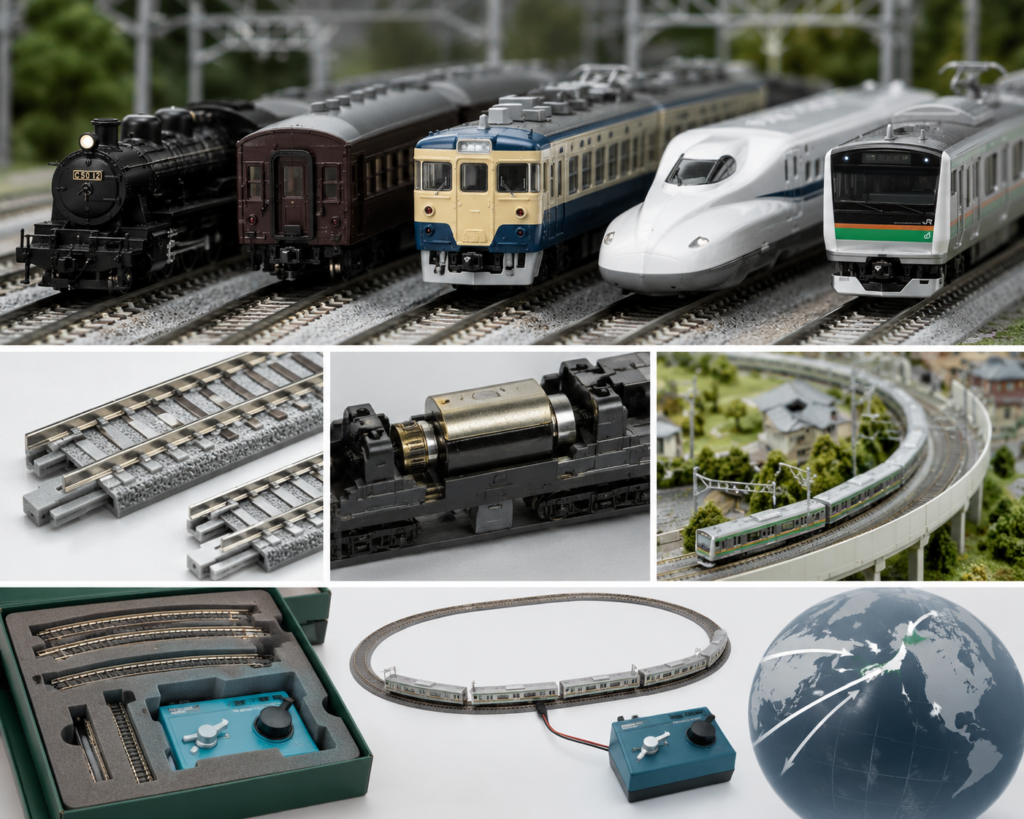
If you’re new to the hobby, here’s what you need:
- Starter set – KATO’s E233 Series Start Set or TOMIX’s 313 Series Introductory Set include track, power pack, and one train
- Additional track – Expand your oval into passing loops or figure-eights
- Power pack/controller – Included in starter sets; upgradeable later
- One train set – Your starter set includes this; add more as your collection grows
Layout planning can start as small as a single desk. Modular approaches let you build section by section. Maintenance basics include rail cleaning with dedicated cleaning cars and periodic motor lubrication.
Advanced Enjoyment: Expanding Your Japanese N Gauge Hobby
For experienced users, the hobby opens into creative territory:
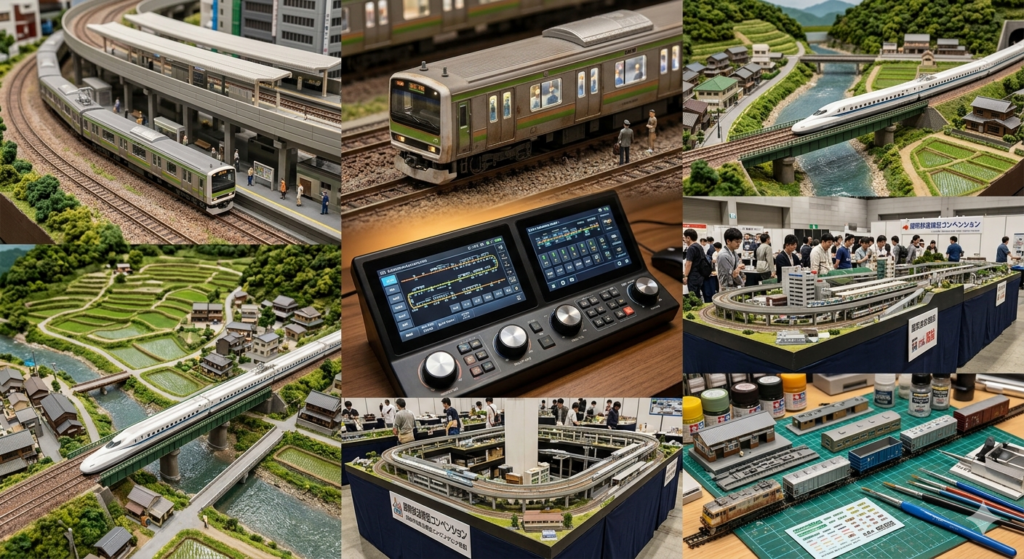
- Layout themes – Recreate the Yamanote Line loop, Tokaido Main Line countryside, or a rural branch line with station and rice paddies
- Detail upgrades – Install interior LED lighting, swap couplers for realistic operation, apply weathering to rolling stock
- Digital control – DCC software integration for independent multi-train operation
- Community participation – The JAM International Railway Model Convention and regional exhibitions showcase ambitious layouts and inspire new ideas
- Scratch-building – Combine Greenmax kits with aftermarket accessories to produce one-of-a-kind consists
Bringing Japan’s Railroad World to Your Fingertips
Japanese N Gauge offers an unmatched combination of prototype variety, manufacturing precision, and brand competition. From KATO’s rock-solid Unitrack system to Micro Ace’s rare diesel railcars, from Greenmax’s customizable kits to Tenshodo’s brass masterpieces, the ecosystem serves every level of interest.
To recap the essentials:
- Japan hosts more N Gauge manufacturers than any other country, each with distinct strengths
- Physical retail stores across Japan provide hands-on access and used-market finds
- Online purchasing through Discovery Japan Mall gives international fans access to genuine products
- This guide covers N Gauge for model railroading – not the nokia N-Gage gaming device from 2003
At Discovery Japan Mall, our mission is to deliver Japan’s finest N Gauge products to fans around the world. Whether you’re buying your first starter set, hunting for a discontinued Micro Ace limited edition.


Comments