- Introduction: Akira Toriyama and the World of Dragon Ball
- Early Life of Akira Toriyama (1955–1977)
- First Steps in Manga: Short Stories and Dr. Slump
- Creation and Evolution of Dragon Ball
- Dragon Ball Z: Saiyans, Frieza, and Beyond
- Dragon Ball Super and Toriyama’s Return
- Art Style and Creative Method
- Beyond Dragon Ball: Games, Short Stories, and Collaborations
- Sand Land and Late-Period Creativity
- Influence on Modern Manga and Global Pop Culture
- Awards, Honors, and Industry Recognition
- Personal Life, Inspirations, and Passing
- Legacy of Dragon Ball and Akira Toriyama’s Work
Introduction: Akira Toriyama and the World of Dragon Ball
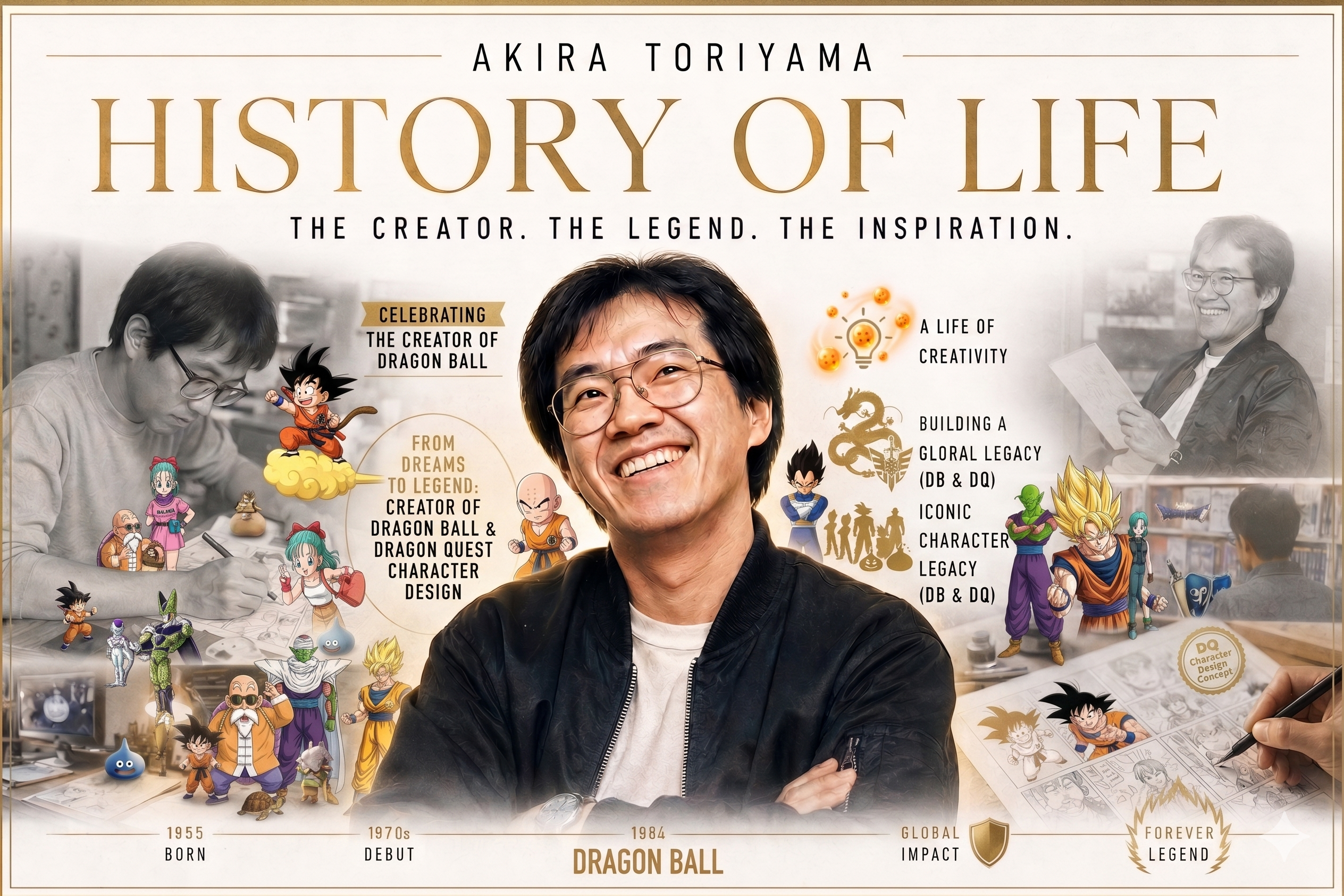
Few names in the manga industry carry as much weight as Akira Toriyama. Born in 1955 and active until his death in 2024, this Japanese manga artist single-handedly reshaped global pop culture through a body of work that spans comedy, adventure, martial arts, and science fiction. His most famous creation, Dragon Ball, became the cornerstone of an empire that includes Dragon Ball Z, Dragon Ball Super, and a constellation of films, video games, and merchandise that spans decades.
This article is for fans and newcomers interested in the life, works, and global impact of Akira Toriyama, with a special focus on the history of Dragon Ball.
Understanding Toriyama’s journey reveals how one creator transformed not only manga, but also global pop culture.
The Dragon Ball franchise tells the multi-decade story of Son Goku, a cheerful, battle-loving warrior whose journey from a wild mountain boy to a defender of the universe captivated audiences across every continent. Dragon Ball has sold over 360 million copies worldwide, making it one of the best-selling manga series in history. Its anime adaptations brought Japanese animation into living rooms from Tokyo to São Paulo to Los Angeles, turning an entire generation into lifelong fans.
At Discovery Japan Mall, international fans can find authentic Japanese editions, collectible figures, and artbooks that connect them directly to Toriyama’s work and the world he built.
Early Life of Akira Toriyama (1955–1977)
Akira Toriyama was born on April 5, 1955, in Kiyosu, Aichi Prefecture, Japan. He grew up during the country’s rapid post-war recovery, a period when Japan was rebuilding itself physically and culturally. Kiyosu sat within an industrial region, but Toriyama’s interests ran toward imagination rather than manufacturing.
From an early age, the young Akira loved to draw pictures of animals, vehicles, and robots-anything that caught his eye in the world around him. This habit of constant sketching would become the raw material for every character and machine he later designed. Two specific works left deep impressions on him during childhood: Disney’s One Hundred and One Dalmatians (1961), which dazzled him with its animation quality, and Osamu Tezuka’s Astro Boy manga series, which showed him what Japanese comics could achieve as a storytelling medium.
During his high school years, Toriyama participated informally in art clubs but was largely self-taught. He wasn’t a morning person-a trait he carried throughout his life-and his creative energy often flowed on his own terms. After graduating, he drifted through temporary jobs, none of which satisfied him. By his early twenties, he knew that his future lay in drawing, not factory work. These formative years planted the seeds for the humor, adventure, and character designs that would later define his successful career.
First Steps in Manga: Short Stories and Dr. Slump
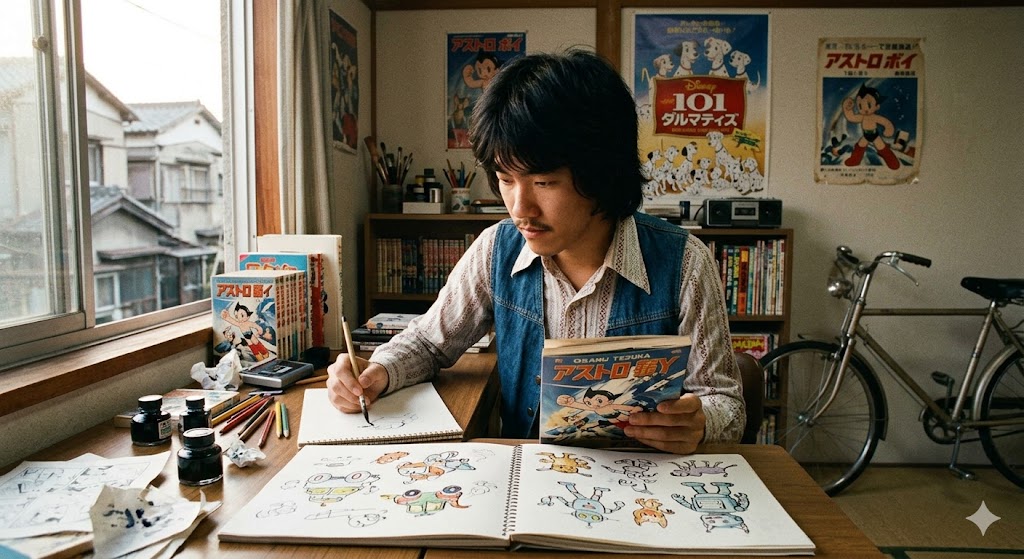
Toriyama entered the manga world through weekly Shōnen Jump contests in the late 1970s, submitting one shot manga pieces with the determination of someone who had nothing to fall back on. His first published work was Wonder Island, a two-part short story that appeared in Weekly Shonen Jump in late 1978. It placed last in the magazine’s reader polls-a humbling debut.
Undeterred, Toriyama produced a stream of short stories and one-shots over the next two years, including Wonder Island 2, Today’s Highlight Island, and Tomato the Cutesy Gumshoe. Most received low rankings. He estimated that he produced roughly 500 pages of rejected material before securing a serialization. His persistence, however, caught the attention of editor Kazuhiko Torishima, who became a crucial mentor. Torishima pushed Toriyama to sharpen his comedic timing, refine his pacing, and move beyond simple gag strips toward stories with real characters.
That guidance paid off when Dr. Slump launched in Weekly Shonen Jump in 1980. The comic series followed Arale, a quirky robot girl living in the absurd Penguin Village, and became a massive hit almost immediately. Key milestones of the Dr. Slump era include:
- Serialization run: 1980 to 1984 in Shonen Jump
- Sales: Over 35 million copies sold in Japan alone
- Recognition: Dr. Slump earned Toriyama the Shogakukan Manga Award in 1981
- Anime adaptation: A popular anime series brought Arale to television screens nationwide
Dr. Slump turned Toriyama into a rising star and proved he could sustain a long-running popular series. During this period, Toriyama founded Bird Studio, his personal production studio, which he used for all his manga and creative design work going forward.
Creation and Evolution of Dragon Ball
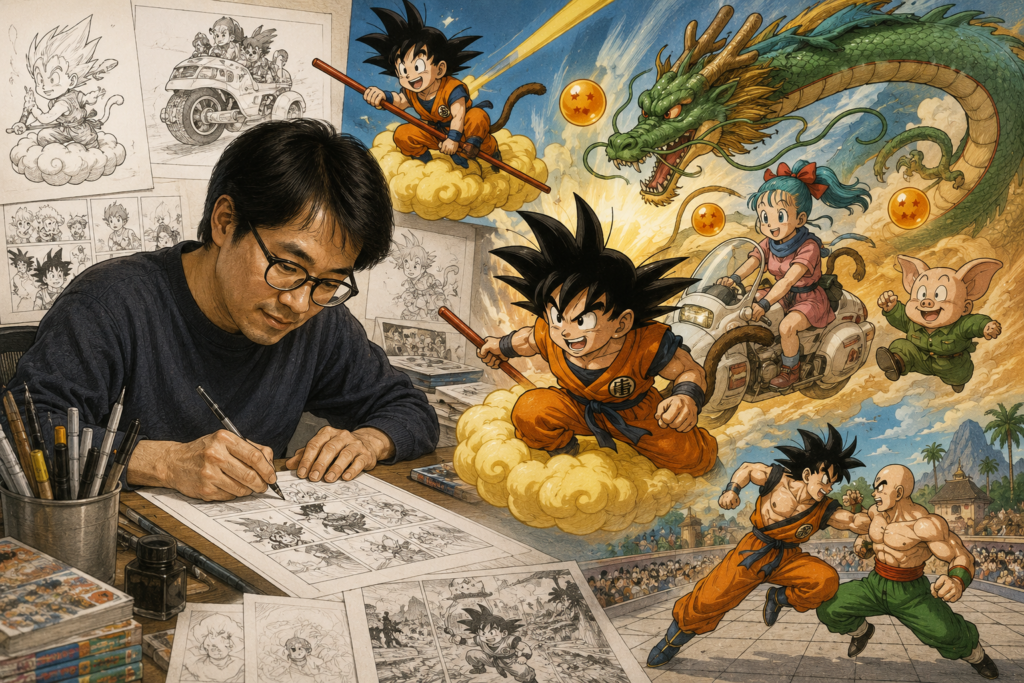
By the early 1980s, Toriyama wanted to push beyond pure gag comedy. He was drawn to kung fu films, Chinese mythology, and adventure stories with stakes higher than a punchline. In 1983, he published a one shot manga called Dragon Boy, a short work blending martial arts action with fantasy elements inspired by the Chinese novel Journey to the West. This prototype story planted the seed for what came next.
Toriyama was inspired by the Chinese novel Journey to the West when creating Dragon Ball.
Akira Toriyama created the Dragon Ball franchise in 1984, launching the manga series in Weekly Shōnen Jump in December of that year. The early story arc followed a young, tail-sporting boy named Goku who meets a brilliant teenager named Bulma. Together, they set out on a journey to collect seven magical Dragon Balls, each capable of summoning a dragon that grants wishes. The tone was light, comedic, and full of strange creatures and visual gags-classic Toriyama.
But as the series progressed, Toriyama transitioned Dragon Ball from comedy to martial arts storytelling. The Tenka’ichi Budōkai (World Martial Arts Tournament) arcs introduced structured combat, rival fighters, and a competitive intensity that gripped readers. Dragon Ball was serialized from 1984 to 1995, and over those eleven years, the story evolved from a whimsical adventure into one of the most intense battle manga ever published. Dragon Ball’s anime adaptations began airing in 1986, bringing the early adventures to television and expanding the audience dramatically.
Toriyama’s creative method was famously improvisational. He rarely plotted far ahead, preferring to invent new villains, transformations, and twists as they felt right. This loose planning gave Dragon Ball its signature energy-every chapter felt like a surprise.
Dragon Ball Z: Saiyans, Frieza, and Beyond
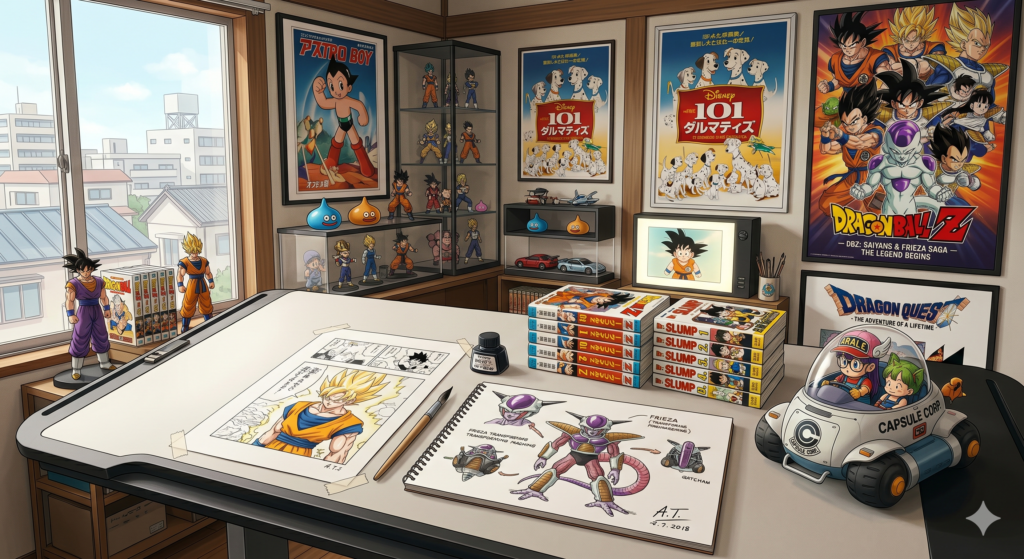
Dragon Ball Z is the anime title given to the later, more action-heavy portion of the manga. While the manga itself remained one continuous series with no title change, the anime split was a practical decision that reflected the dramatic tonal shift beginning with the Saiyan Saga. DBZ aired from 1989 to 1996, and its storylines became the most iconic in the Dragon Ball series.
The key story arcs of Dragon Ball Z include:
| Arc | Key Villains | Notable Moments |
|---|---|---|
| Saiyan Saga | Raditz, Vegeta, Nappa | Goku discovers his Saiyan heritage |
| Frieza Saga | Frieza | Super Saiyan Goku vs. Frieza on Namek |
| Android & Cell Sagas | Cell, Dr. Gero | Gohan’s Super Saiyan 2 transformation |
| Majin Buu Saga | Majin Buu | Goku’s Spirit Bomb; the final chapter of the original manga |
The Super Saiyan transformation became an iconic visual trope-golden hair, blazing aura, screaming power-up-that defined shōnen manga for a generation. Dragon Ball contributed to Shueisha’s record circulation of 6.53 million copies, a figure that reflected the series’ dominance over the manga industry in the early 1990s. Dragon Ball’s success boosted manga sales across the 80s and 90s, lifting the entire medium.
These arcs cemented Dragon Ball’s global popularity through TV broadcasts, VHS and DVD releases, and early video games. The main cast-Goku, Vegeta, Gohan, Piccolo, Krillin, and their friends-became household names. When the anime ended its original Z run in 1996, Dragon Ball GT aired as a continuation. Dragon Ball GT was not based on the manga and was produced without Toriyama’s direct story involvement, though he contributed some character designs. GT explored new territory but divided fans, many of whom considered it one of the franchise’s weaker spin offs.
A notable low point came when Hollywood attempted a live-action adaptation. Dragonball Evolution was released in 2009, with Justin Chatwin portraying Goku. Akira Toriyama served as a creative consultant for the film, but the production strayed far from the source material. Toriyama felt the script did not capture his series’ essence, and the film failed both critically and financially, reinforcing how difficult it is to translate manga’s visual language into Western cinema.
Dragon Ball Super and Toriyama’s Return
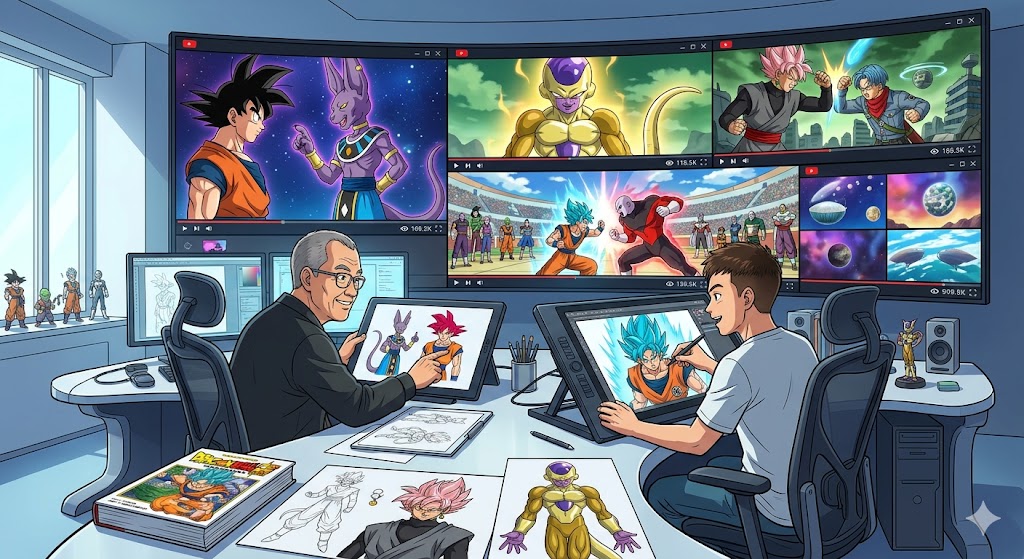
After years of spin offs and side projects, the Dragon Ball franchise roared back to life in the 2010s. Toriyama returned with hands-on involvement, writing original story and character designs for two theatrical films: Dragon Ball Z: Battle of Gods (2013) and Resurrection ‘F’ (2015). Both were a big hit commercially and introduced new elements-the God of Destruction Beerus, multiple universes, and power levels beyond anything seen in Z.
These films laid the foundation for Dragon Ball Super, which launched as both an anime series and a manga series. Key Dragon Ball Super arcs include:
- Super Saiyan God arc – Goku achieves divine power to face Beerus
- Golden Frieza arc – The tyrant returns, stronger than ever
- Universe 6 Tournament – Parallel universes and new fighters
- Goku Black / Future Trunks arc – Time travel, alternate timelines
- Tournament of Power – An all-universe battle royale for survival
Toriyama provided the original story concepts and character designs, while manga artist Toyotarou handled the illustration of the Dragon Ball Super manga series. This collaboration allowed Toriyama to guide the creative direction without shouldering the weekly drawing burden. Dragon Ball Super reintroduced Dragon Ball to a new generation of global fans, amplified by streaming platforms and social media, while keeping Son Goku firmly at the center of the story.
Art Style and Creative Method
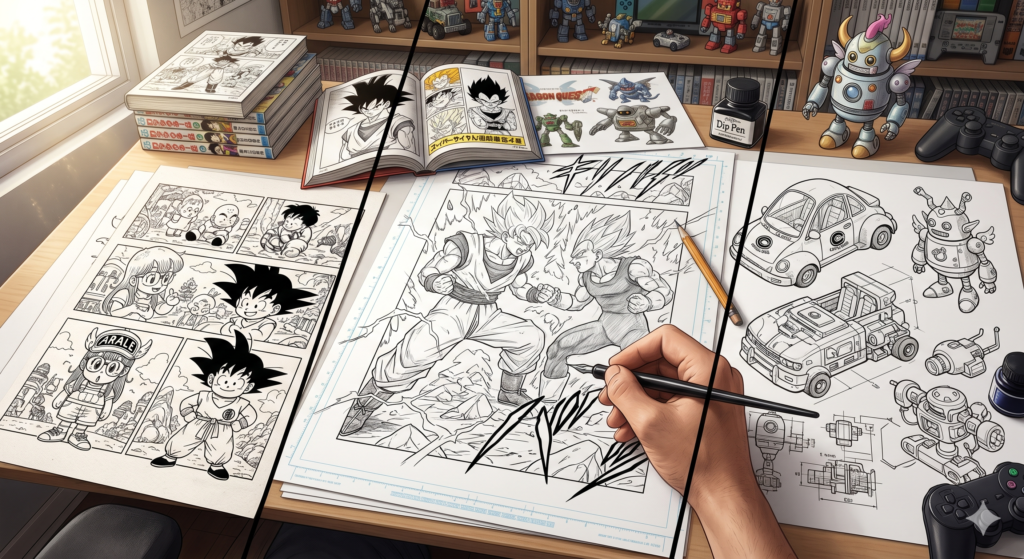
Akira Toriyama’s art style is one of the most instantly recognizable in the history of comics. His visual language shaped not just Dragon Ball but the entire aesthetic of modern manga.
In his early works-Dr. Slump and the first Dragon Ball chapters-Toriyama favored rounded, bubbly character designs with clean lines and exaggerated expressions. Faces were simple but enormously expressive, and backgrounds balanced detail with readability. Every panel prioritized clarity: you could always tell what was happening, who was talking, and where the energy was flowing.
As Dragon Ball moved into its more intense arcs in the late 1980s and 1990s, his art evolved. Musculature became more defined, edges sharpened, and action sequences grew more dynamic. The visual language of power-crackling auras, shattered landscapes, speed lines that bent the panel borders-became Toriyama’s signature. His art style influenced the design of modern shōnen characters, from spiky hair silhouettes to costume changes that signal power-ups.
Beyond characters, Toriyama was passionate about mechanical design. His vehicles, spaceships, capsule houses, and robots combined real-world engineering logic with playful fantasy. This love of machines surfaced constantly in Dragon Ball (Bulma’s gadgets, Capsule Corp technology) and carried over into his video games work.
His creative process was deceptively loose:
- He worked from rough story ideas rather than rigid outlines
- He responded to reader feedback and popularity polls in Shonen Jump
- He valued fun and surprise over strict continuity
- He drew at a remarkable pace, often completing pages faster than his peers
This instinctive approach gave Dragon Ball its kinetic, unpredictable energy-and it’s a key reason the series never felt formulaic even after hundreds of chapters.
Beyond Dragon Ball: Games, Short Stories, and Collaborations
Toriyama’s career extended far beyond Dragon Ball. His talent as a character designer made him one of the most sought-after visual creators in the anime industry and gaming world alike.
His most significant game collaboration began in 1986, when he became the character designer for the Dragon Quest role-playing game series. Toriyama redesigned the now-iconic Slime monster from a formless blob into a cheerful teardrop shape-a design decision that defined the franchise’s visual identity for decades. He also contributed character designs and art to the legendary RPG Chrono Trigger (1995), as well as Blue Dragon and numerous Dragon Ball video games.
Outside of long-running franchises, Toriyama produced a range of short stories and standalone works that showcased different sides of his creativity:
- Cowa! – A lighthearted monster adventure
- Kajika – A martial arts fantasy
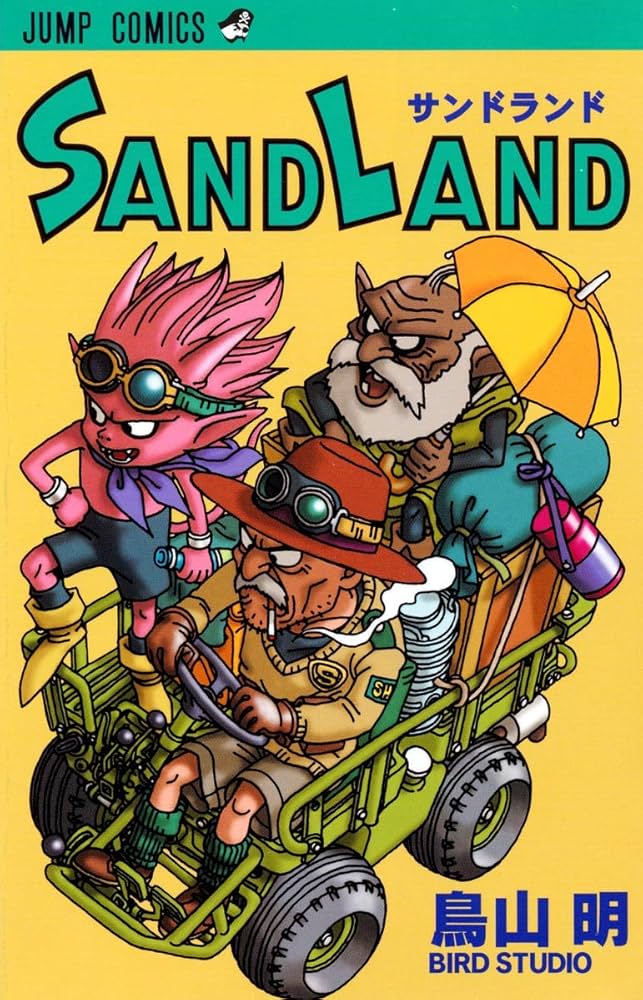
- Sand Land – A desert adventure with environmental themes
- Jaco the Galactic Patrolman – A comedic sci-fi prequel connected to Dragon Ball’s universe
He also pursued collaborations with other manga creators. His Cross Epoch crossover with Eiichiro Oda merged the worlds of Dragon Ball and One Piece, while Sachie-chan Good!! paired him with Masakazu Katsura. These projects revealed Toriyama’s playful generosity-he enjoyed working with friends and colleagues in the manga world.
At Discovery Japan Mall, fans who want to explore Toriyama’s work beyond Dragon Ball can find Japanese editions of these lesser-known titles, offering a window into the full range of his creative design.
Sand Land and Late-Period Creativity

Sand Land, originally serialized as a short manga in Weekly Shōnen Jump from May to August 2000, became a surprising focus of renewed attention in the 2020s. The story follows a demon prince named Beelzebub and an old sheriff as they cross a barren desert in search of water, tackling themes of environmental destruction and human greed.
In 2023–2024, Sand Land expanded into a multimedia project:
- Anime film – Released August 18, 2023, produced by Sunrise and Kamikaze Douga
- Anime series – Sand Land: The Series, 13 episodes on Disney+ and Hulu (March–May 2024)
- Video game – Released April 2024 by Bandai Namco for PS4, PS5, Xbox, and PC
Toriyama supervised key designs for these new projects and wrote new story arcs for the latter half of the series, designing new characters shortly before his passing. This burst of late-period creativity demonstrated that even at 68, Toriyama remained fully engaged with storytelling and visual invention.
Influence on Modern Manga and Global Pop Culture
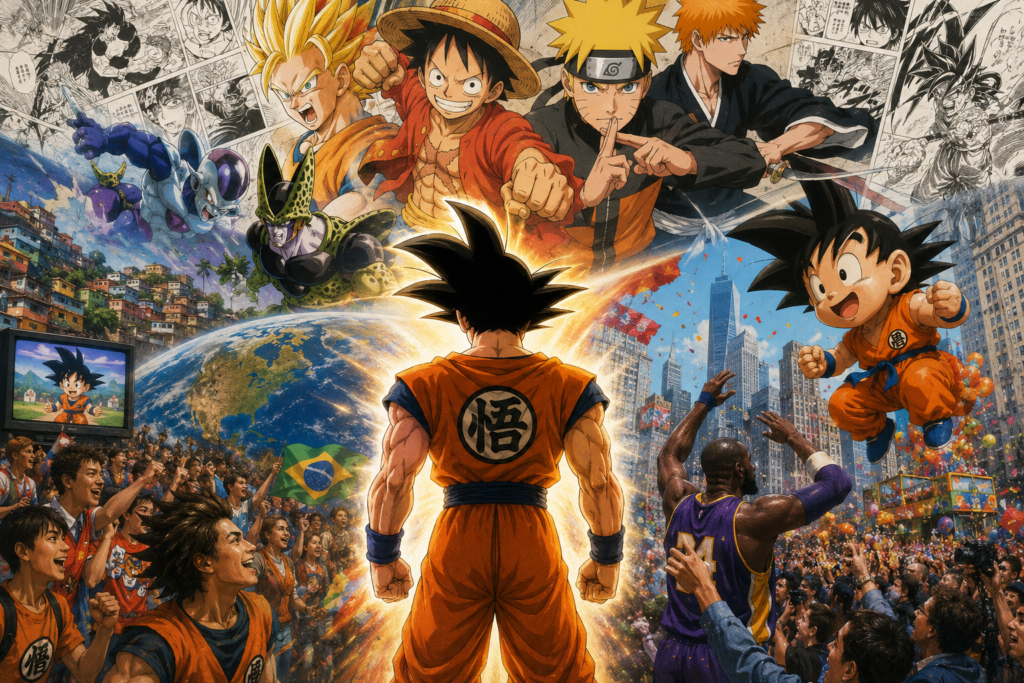
Alongside Osamu Tezuka, Akira Toriyama stands as one of the defining figures of modern manga. If Tezuka established the grammar of Japanese comics, Toriyama wrote its most popular dialect. Dragon Ball is considered the most influential shōnen manga ever created, and its structural DNA runs through virtually every battle manga that followed.
The template Toriyama established-training arcs, tournaments, escalating enemies, dramatic transformations, sacrifice, and resurrection-became the blueprint for the genre. Major creators have been explicit about this debt:
- Eiichiro Oda (One Piece) has called Toriyama his greatest inspiration
- Masashi Kishimoto (Naruto) modeled his early work directly on Dragon Ball’s pacing
- Tite Kubo (Bleach) cited Toriyama’s character design as foundational
Toriyama’s work influenced many manga artists, including Oda and Kishimoto, and his storytelling framework became the standard against which all shōnen battle manga is measured. Toriyama’s style influenced the modern shōnen battle genre so thoroughly that it’s difficult to imagine the category without him.
Dragon Ball served as a catalyst for popularizing Japanese animation in the West. In the 1990s, the anime series aired across Latin America, Europe, and the United States, introducing millions of viewers to Japanese storytelling for the first time. Dragon Ball references appear in Western media and culture regularly-from hip-hop lyrics to NBA celebrations. In 1999, Goku became the first anime character to appear in the Macy’s Thanksgiving Day Parade, a milestone that symbolized how deeply Dragon Ball had penetrated American pop culture.
Dragon Ball influenced the global popularity of anime and manga, and its commercial success-over 360 million copies sold-reshaped publishing, licensing, and merchandising across the entire anime industry.
Awards, Honors, and Industry Recognition
Toriyama received formal recognition throughout his life for contributions that reshaped culture and entertainment:
- 1981: Shogakukan Manga Award for Dr. Slump
- 2013: Special 40th Anniversary Festival Award at the Angoulême International Comics Festival
- 2019: Appointed Chevalier (Knight) of the Ordre des Arts et des Lettres by the French government, a lifetime achievement award recognizing his artistic impact
- 2019: Nominated for the Will Eisner Hall of Fame
After his death in March 2024, tributes poured in from publishers, animation studios, and fellow creators worldwide. Mangaka including Eiichiro Oda, Masashi Kishimoto, Tite Kubo, and Kohei Horikoshi published personal statements honoring the man whose iconic manga had shaped their careers and their lives.
Personal Life, Inspirations, and Passing
Behind the legendary body of work was a quiet, private man who preferred drawing to public appearances. Toriyama married fellow manga artist Yoshimi Katō on May 2, 1982. She occasionally assisted him on Dr. Slump during tight deadlines. They had two children-son Sasuke (born 1987) and daughter Kikka (born 1990)-and lived in his home studio in Kiyosu, far from Tokyo’s publishing hub.
Toriyama’s hobbies reflected his creative interests: he collected cars and motorcycles, built model kits, and kept an assortment of pets including cats, dogs, birds, and lizards. Several of his pets inspired characters in his work (the cat-like God of Destruction Beerus, for instance). His love for machines showed up constantly in Dragon Ball’s capsule vehicles and spacecraft, as well as in his game art.
Famously shy, Toriyama used a robot avatar to represent himself in interviews and author portraits starting around 1980-a playful solution that perfectly captured his humor. He avoided public events whenever possible, letting his art speak for him.
His key creative influences reveal the cross-cultural roots of Dragon Ball:
- Osamu Tezuka’s Astro Boy – showed him what manga could be at a young age
- Jackie Chan’s and Bruce Lee’s martial arts films – shaped Dragon Ball’s combat choreography
- The Chinese classic Journey to the West – provided the foundational story structure and characters for early Dragon Ball
- Disney animation – impressed him with visual quality and storytelling ambition
- Science fiction films – fed his love of aliens, spaceships, and other worlds
Toriyama died on March 1, 2024, at age 68, from an acute subdural hematoma. His passing was announced publicly on March 8 by Bird Studio. The immediate, worldwide outpouring of grief confirmed what fans already knew: this was not just a manga artist who had died, but a creator who had shaped the imaginations of hundreds of millions of people across multiple generations.

Legacy of Dragon Ball and Akira Toriyama’s Work
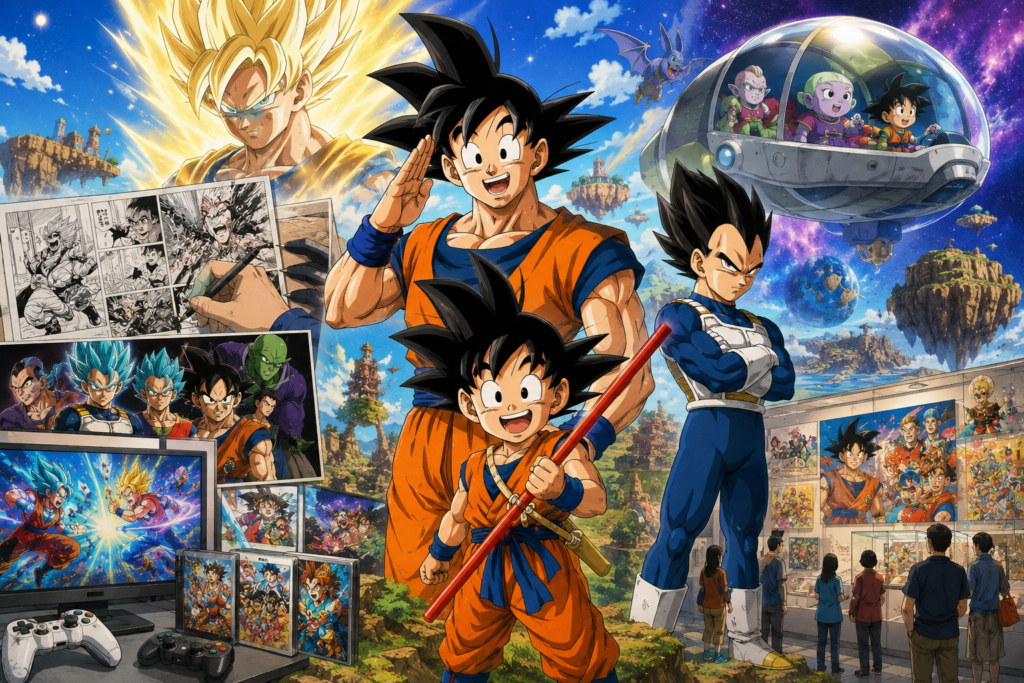
Akira Toriyama’s creations continue to grow even after his death. The Dragon Ball franchise remains one of the most active properties in entertainment:
- Dragon Ball Super manga – Ongoing, with new story arcs illustrated by Toyotarou
- Dragon Ball Daima – A new anime series expanding the universe with fresh storylines
- Films and games – New projects in development through 2027, some featuring character designs Toriyama completed before his passing
- Retrospective exhibitions and publications – Anniversary events celebrating four decades of Dragon Ball
Son Goku has become a global symbol of perseverance, optimism, and the joy of self-improvement. From a wild-haired boy searching for dragon balls to a warrior defending entire universes, his journey mirrors the aspirations of fans who grew up alongside him. Multiple generations-children of the 1980s, the 1990s, the 2000s, and the 2020s-have found something meaningful in his story.
Toriyama’s work is now studied in academic discussions of visual culture, narrative structure, and the globalization of Japanese media. Research institutions in Japan are compiling legacy documents analyzing how Dragon Ball reshaped global perceptions of the manga industry and the art of sequential storytelling.
Toriyama’s works sold over 360 million copies worldwide, a figure that only begins to capture his impact. The real measure is in the countless artists who picked up a pen because of him, the fans who learned about determination from Goku, and the industries-anime, gaming, merchandise-that exist in their current form because of what he built.
At Discovery Japan Mall, we’re proud to connect international fans with official Japanese editions, collectible figures, artbooks like the Dragon Ball Daizenshū, and modern manga influenced by Toriyama’s legacy. These aren’t just products-they’re pieces of a story that changed the world.
Akira Toriyama’s world-from Dr. Slump to Dragon Ball to Dragon Quest-will keep inspiring readers, artists, and gamers for generations to come. Whether you’re revisiting a beloved comic series or discovering it for the first time, the spirit of adventure, humor, and heart that Akira Toriyama poured into every page is waiting for you.


Comments