Yes. You don’t need a plane ticket, a hotel reservation, or even a packed suitcase. All you need is a screen, a warm drink, and two days free. Studio Ghibli is the renowned Japanese animation studio founded in 1985, and its hand-drawn films can take you to Japan this weekend in a way that might feel more real than you’d expect.
For Studio Ghibli fans, Japan lovers, curious travelers, collectors, and anyone drawn to Japanese architecture, nature, and storytelling, this is a practical way to experience the country through film. Ahead, you’ll move through Ghibli’s most evocative movies, the landscapes and everyday details behind them, themed weekend watch ideas, authentic finds from Discovery Japan Mall, and simple ways to bring that feeling of Japan into daily life—because these stories do more than entertain: they offer comfort, emotional depth, and a vivid sense of place even when you cannot travel.
- Why Overseas Fans Feel “So Japanese” in Studio Ghibli Worlds
- Studio Ghibli as Your Shortcut Japan Trip (No Plane Ticket Needed)
- Japanese Landscapes Inside Ghibli: From Totoro’s Fields to Mononoke’s Forests
- Japanese Architecture and Everyday Life Hiding in Plain Sight
- Why Ghibli Worlds Heal Tired Hearts: Nature, Food, and Quiet Time
- Plan a Ghibli-Themed Weekend “Trip to Japan” at Home
- Bringing Ghibli’s Japan Into Your Room: Decor, Collectibles, and Daily Rituals
- From Screen to Shelf: Studio Ghibli Figures, Model Kits, and Scale Model Kits
- How Discovery Japan Mall Connects You to Ghibli’s Japan
Why Overseas Fans Feel “So Japanese” in Studio Ghibli Worlds
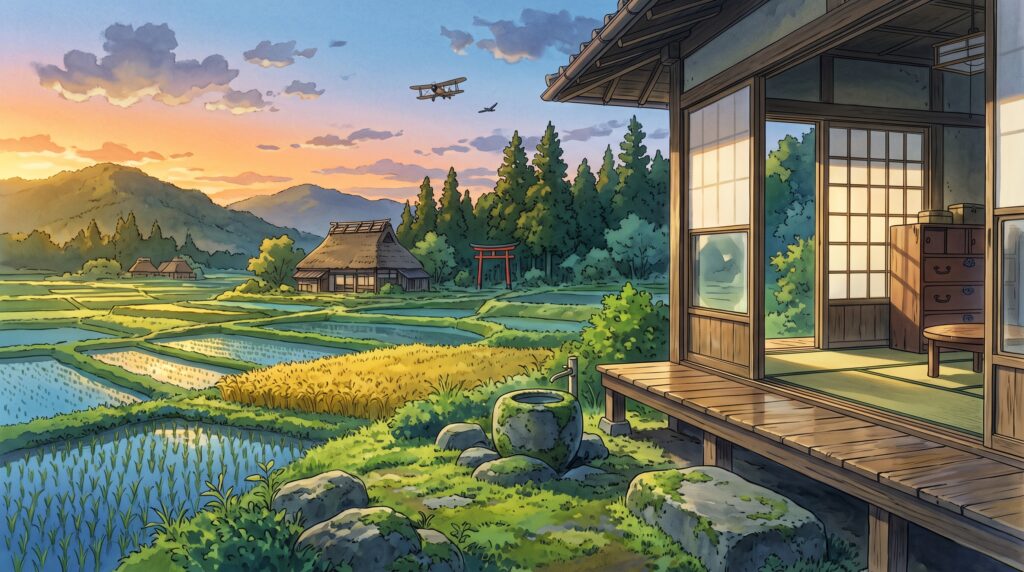
If you’ve ever watched a Ghibli film and felt an ache for a place you’ve never been, you’re not alone. Fans across the world – from Canada to Australia to New Zealand – describe the same sensation: a deep, almost physical longing for the Japan they see in these movies. Rice paddies glowing gold at dusk. A red torii gate half-hidden by cedars. Tatami rooms where afternoon light pools on the floor. These aren’t random details. They’re the reason Ghibli feels like Japan, even for people who’ve never stepped off a plane at Narita.
Director Hayao Miyazaki – now Honorary Chairman of the company – built these worlds from memory. Born in Tokyo in 1941, he grew up during wartime and postwar reconstruction, absorbing rural landscapes, train stations, bathhouses, and neighborhood shrines. His family manufactured aircraft parts, and that childhood fascination with flight and machinery echoes in nearly every film. These aren’t invented aesthetics. They’re remembered ones.
“Ghibli doesn’t just draw Japan. It lets you feel Japan – the quiet, the moss, the creak of wooden planks, straw roofs at dusk.”
The name “Ghibli” itself refers to a hot desert wind in Italian, chosen by Miyazaki to signal a new force in animation. Alongside co-founder Isao Takahata and producer Toshio Suzuki (now chairman), Miyazaki launched the studio in 1985 after the success of Nausicaa of the Valley of the Wind, the company’s first major creative achievement. The studio’s first feature was Castle in the Sky in 1986, and it has since produced over 20 feature films – all known for hand-drawn animation and emotional storytelling, most created using watercolor paints. These films appeal to both children and adults, which is part of why their vision of Japan reaches so many people for the first time.
Studio Ghibli as Your Shortcut Japan Trip (No Plane Ticket Needed)
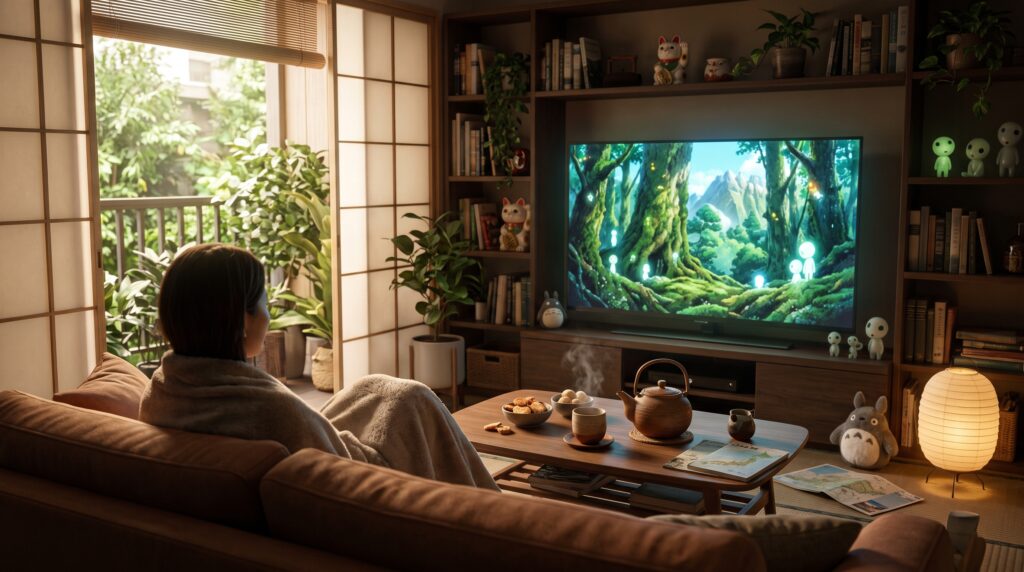
Real travel to Japan means long flights, layover fatigue, crowded itineraries, and serious cost. A Ghibli weekend means pressing play, brewing hojicha tea, and visiting different regions of Japan from your sofa – at your own pace.
Here’s a simple framework for your weekend itinerary:
- Friday night: My Neighbor Totoro – rural Japan, fireflies, rain, and wonder
- Saturday afternoon: Spirited Away – traditional architecture, bathhouse culture, spirit world
- Sunday morning: Princess Mononoke – ancient forests, sacred mountains, wild gods
Pair each viewing with Japanese snacks and a figure or two from Discovery Japan Mall’s, and your living room becomes a small corner of Japan.
Japanese Landscapes Inside Ghibli: From Totoro’s Fields to Mononoke’s Forests
Ghibli backgrounds aren’t generic fantasy worlds. They’re drawn from specific locations across Japan, sketched on-site by artists who walked those roads and studied those rooflines.
My Neighbor Totoro is rooted in the Sayama Hills of Saitama Prefecture, where Miyazaki lived in the 1960s. The narrow farm roads, rice paddies, bus stops under summer rain, and forest shrines all echo real 1950s–60s rural life outside Tokyo. The Totoro no Mori Foundation was established in 1991 to protect these landscapes as cultural and ecological heritage – 56 plots of land maintained by volunteers as of 2022.
Princess Mononoke, released in Japan on July 12, 1997, reflects the misty ancient forests of Yakushima Island and Shirakami-Sanchi. Ghibli films often explore themes of environmentalism and the human condition, and this film marks the peak of that creation – moss-covered stones, sacred rivers, a world where nature fights back. The film blends magical realism with ordinary life in ways that make fantasy feel documentarian.
Ponyo draws on the seaside town of Tomonoura in the Seto Inland Sea, where Miyazaki stayed in 2004–05. And fans of From Up on Poppy Hill will recognize hillside cities reminiscent of Yokohama and Onomichi, where narrow alleys wind between old houses and harbors.
Japanese Architecture and Everyday Life Hiding in Plain Sight
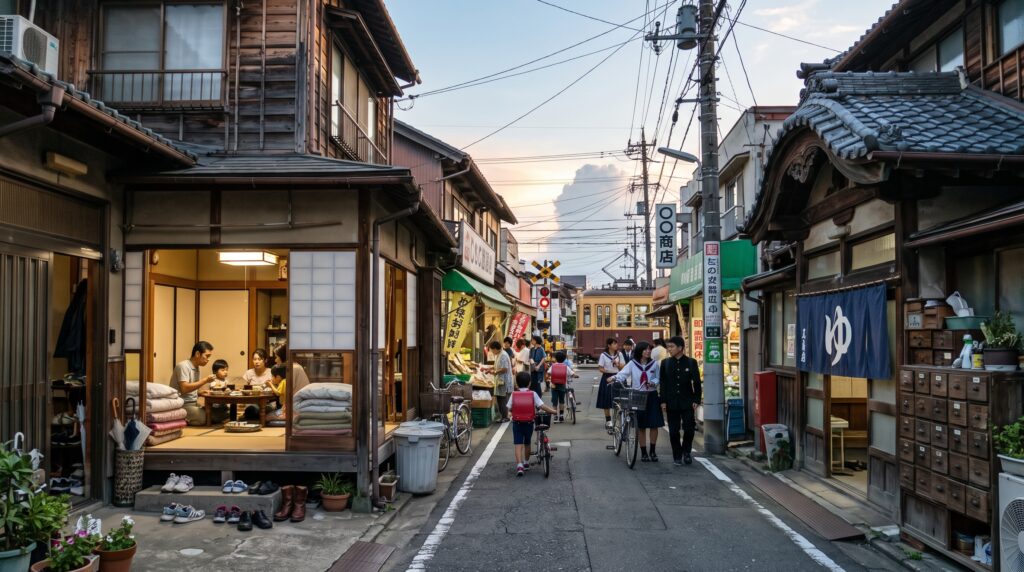
Watch enough Ghibli and you’ll start to “read” Japanese streets the way a traveler does – noticing the genkan where shoes come off, the sliding shoji screens, the low chabudai table where a family eats together.
Spirited Away won an Academy Award for Best Animated Feature in 2003, and much of its visual power comes from architecture. The bathhouse draws on Dōgo Onsen Honkan in Ehime Prefecture and the Edo-Tokyo Open Air Architectural Museum in Koganei, where a 1929 Showa-era bathhouse and a stationery shop’s wall of wooden drawers became Kamaji’s boiler room. Computer animation techniques are used sparingly in Ghibli films; most of what you see is painted by hand, and the art style features bright colors and whimsical aesthetics that make Chihiro’s world feel both impossible and deeply familiar.
The studio explores complex themes such as growing up and personal identity, but it also teaches through small details. Here’s what to watch for:
- Tatami mats and futons – visible in Totoro, Kiki’s Delivery Service, and Arrietty
- Noren curtains over doorways – especially in Spirited Away’s bathhouse corridors
- School uniforms and randoseru backpacks – common in films set in modern Japan
- Shotengai shopping streets – the witch Kiki walks through one in her delivery service
- Trains and tram lines – the ferry-train across water in Spirited Away, regional trains in Kiki’s Delivery Service
Why Ghibli Worlds Heal Tired Hearts: Nature, Food, and Quiet Time
Ghibli films feature deep emotional narratives often grounded in reality, yet they feel like rest for the mind. Three elements explain why.
Nature as a living presence. Miyazaki studied the work of ethnobotanist Nakao Sasuke, connecting ancient forest ecology to Japanese cultural identity. In his films, forests breathe, rivers speak, insects hum. This isn’t decoration – it’s animism woven into every frame. The idea that nature has its own spirit runs through Mononoke, Totoro, and even the wind that lifts model plane gliders in The Wind Rises.
Food as ritual. The famous ramen scene in Spirited Away. Breakfast in Totoro – rice, miso soup, grilled fish. The bread and soups in Kiki’s Delivery Service. These moments embody mottainai (waste nothing) and ichigo ichie (treasure each encounter). They save space for the audience to simply breathe, the way a quiet Sunday morning playing in the background can turn your living room into its own peaceful world.
Plan a Ghibli-Themed Weekend “Trip to Japan” at Home
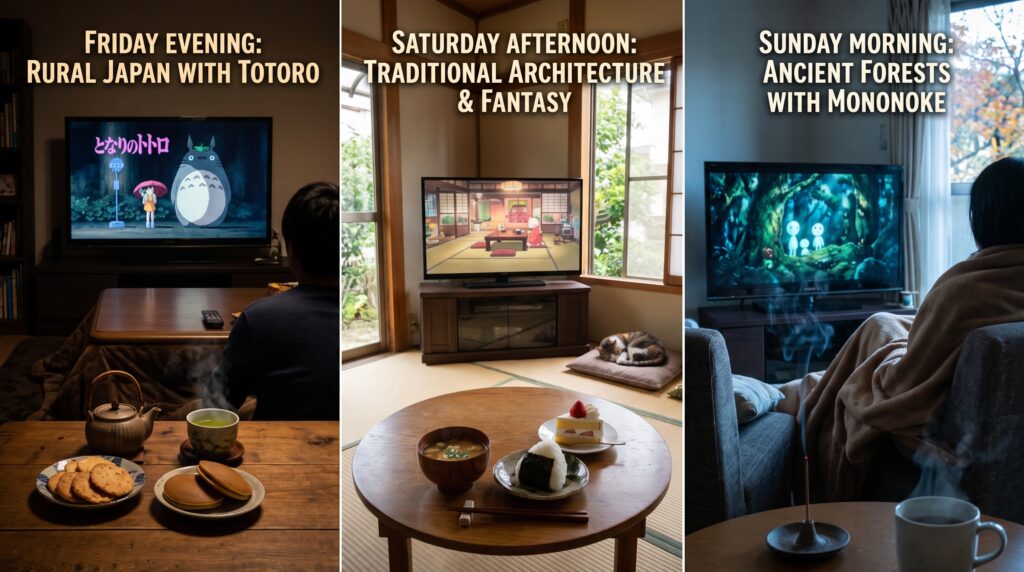
Here are your plans for a concrete weekend itinerary. Toho distributes most Studio Ghibli films theatrically in Japan, while Walt Disney Studios acquired worldwide distribution rights in 1996 and GKIDS acquired North American theatrical rights in 2011 – so finding these titles on disc or streaming is straightforward from most countries.
- Friday evening: Rural Japan with Totoro. Brew green tea or hojicha. Prepare senbei rice crackers and dorayaki. Dim the lights and let the film carry you into Saitama’s countryside.
- Saturday afternoon: Traditional architecture with Spirited Away. Make instant miso soup and onigiri if you can. Open a window – the outdoor sounds mirror the film’s ambient world. Follow it with Howl’s Moving Castle for a European-Japanese fantasy contrast, or The Cat Returns if you want something lighter. Cats, castles, and cake – a good afternoon.
- Sunday morning: Ancient forests with Princess Mononoke. Light incense if you have it. Follow with When Marnie Was There or The Secret World of Arrietty for a quieter close. If friends are joining, try a Martin Scorsese approach: watch the films you’ve never seen. September through November is a particularly atmospheric season for this kind of weekend – cool air, warm blankets, tea steam.
For those watching Ghibli for the first time, William Anderson’s English-language writing on Miyazaki provides helpful context on each title, and pairing films with J-POP CDs and DVDs from Japan or browsing a larger J-POP CD and DVD catalog can deepen that sense of era and atmosphere.
Bringing Ghibli’s Japan Into Your Room: Decor, Collectibles, and Daily Rituals
- Totoro corner: A Big Totoro plush beside a potted fern, with a Totoro wall clock nearby
- Kiki’s shelf: A Jiji plush toy next to a small bread basket and dried flowers
- Spirited Away display: A Paper Theater cube of Aburaya on a bookshelf with a paper lantern, paired with a Seiko Nano Universe collaboration watch for a subtle everyday connection
- Mononoke atmosphere: A 150-piece Mononoke mini puzzle framed on the wall, surrounded by plants
- Daily accessories: A SEIKO ALBA Totoro watch or a Kiki’s Delivery Service Jiji Design watch for everyday wear if you want something less character-themed
From Screen to Shelf: Studio Ghibli Figures, Model Kits, and Scale Model Kits
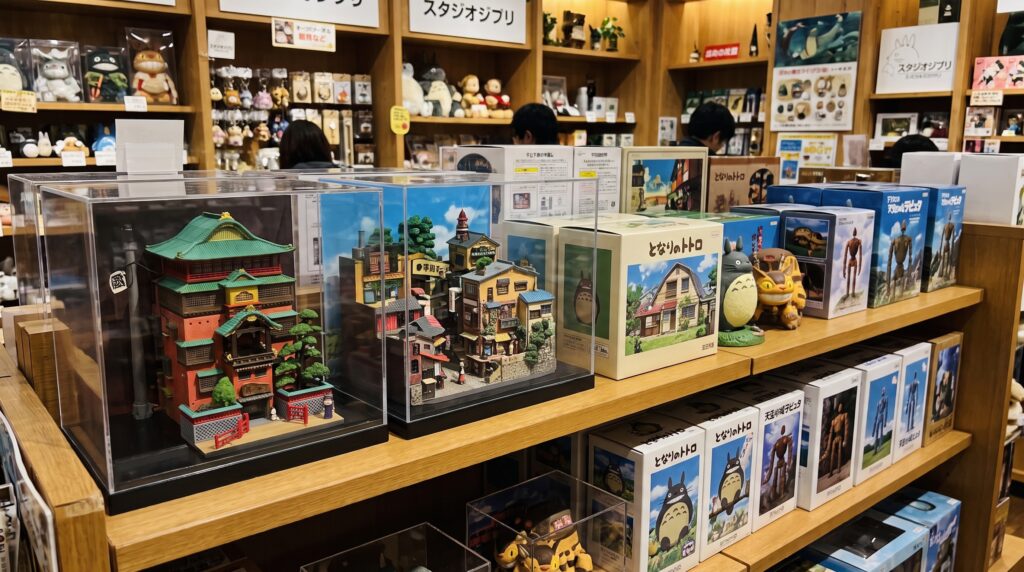
Watching a Ghibli film is step one. Building or displaying something physical from that world is step two – and it changes how a movie lives in your memory.
Studio Ghibli model kits and scale model kits let you reconstruct scenes at 1/150 scale with remarkable quality. The Spirited Away Mysterious Town paper craft series recreates the bathhouse district building by building, while the Clock Tower kit captures one of the film’s most recognizable structures. A Castle in the Sky robot soldier plastic model brings Laputa’s guardian to your desk – no decals required for the paper craft kits, though plastic models may include them.
These aren’t just toys. Each kit becomes a hands-on project, with assembly and painting turning miniature architecture into your own piece of Japan – a manga-inspired adaptation of real-world structures rendered small enough to carry in your hands. Display them in a glass case, on a workspace, or integrated into a larger collection alongside Nausicaa jigsaw puzzles and Spirited Away figure sets, extends that sense of playful, character-driven everyday life.
Discovery Japan Mall curates these kits and models directly from Japan, including limited editions, new releases, and hot items that remain in stock long after domestic release.
How Discovery Japan Mall Connects You to Ghibli’s Japan
Discovery Japan Mall exists as a bridge between overseas fans and authentic Japanese products. When you order a Ghibli figure, a Totoro plush, or a Spirited Away diorama kit from the brand, it ships directly from Japan – the same country you’re watching on screen.
The lineup includes detailed character figures, from forest spirits in Princess Mononoke to No-Face and Chihiro from Spirited Away, plus puzzles that recreate iconic scenes like the oil house bathhouse at night. Whether you’re building a collection for the first time or adding one more piece to a shelf that already tells a story, these items sell the feeling of being closer to the world Miyazaki built.
Complete your Ghibli weekend by choosing one physical piece from the collection. A figure on your desk. A kit you assemble over a Sunday afternoon. A puzzle you frame and hang. It turns a temporary trip into lasting daily joy – a reminder that Japan isn’t just a place on a map. It’s a feeling you can save and return to, any time you want, and Discovery Japan Mall’s makes it easy to find something that fits your space.

Comments