- Why Not Just Use a Machine?
- What Exactly Is Edo Kiriko?
- From Edo to Today: A Brief History of Edo Kiriko
- Why Is Every Edo Kiriko Glass Handmade?
- The Step-by-Step Making of Edo Kiriko
- The Skill Behind the Beauty: What Makes Cutting So Difficult?
- Colored Glass, Patterns, and Everyday Uses: How to Enjoy Edo Kiriko
- Choosing the Right Edo Kiriko Sake Set for You
- Bringing a Piece of Kimoto Glass Tokyo Craftsmanship Home
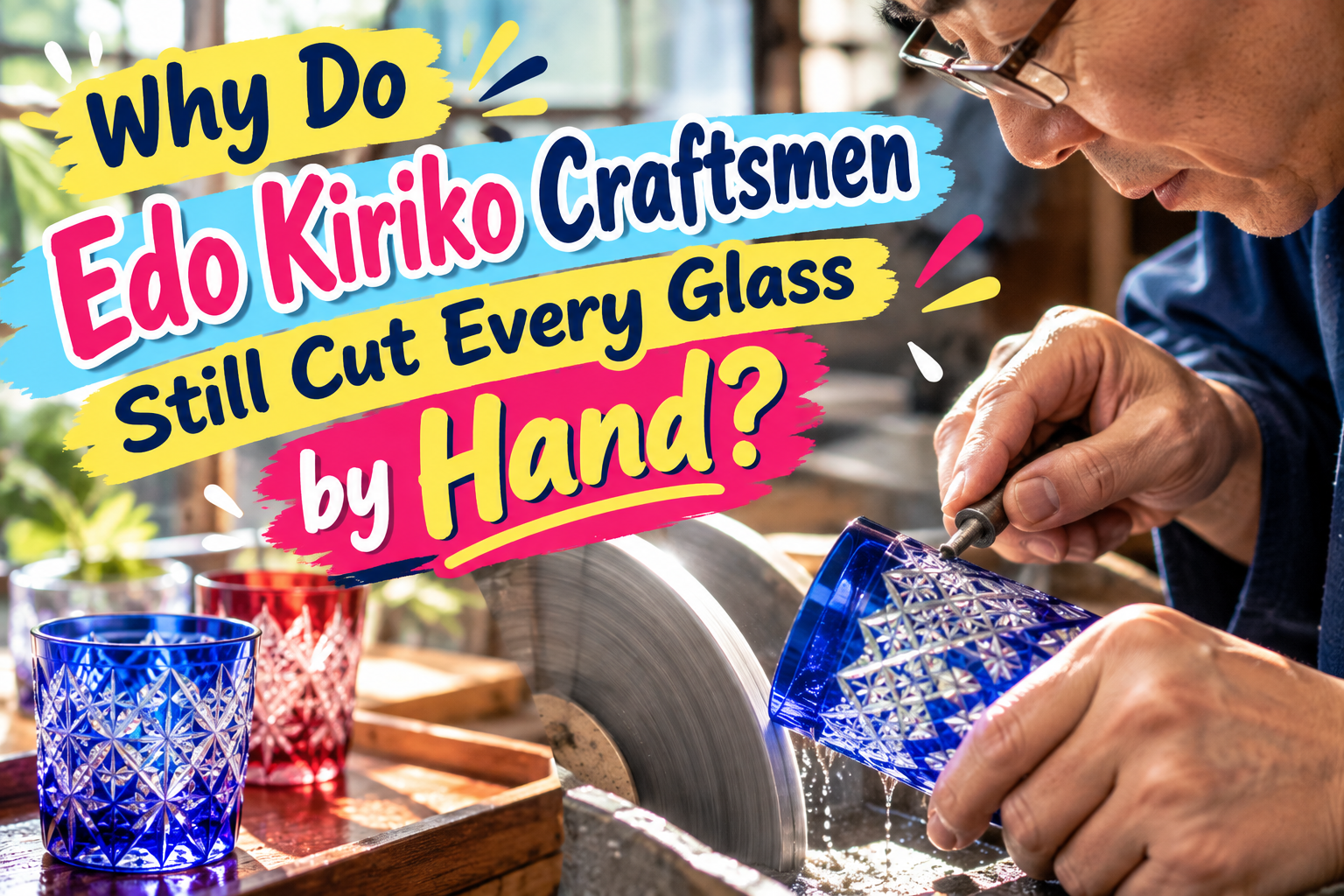
Why Not Just Use a Machine?
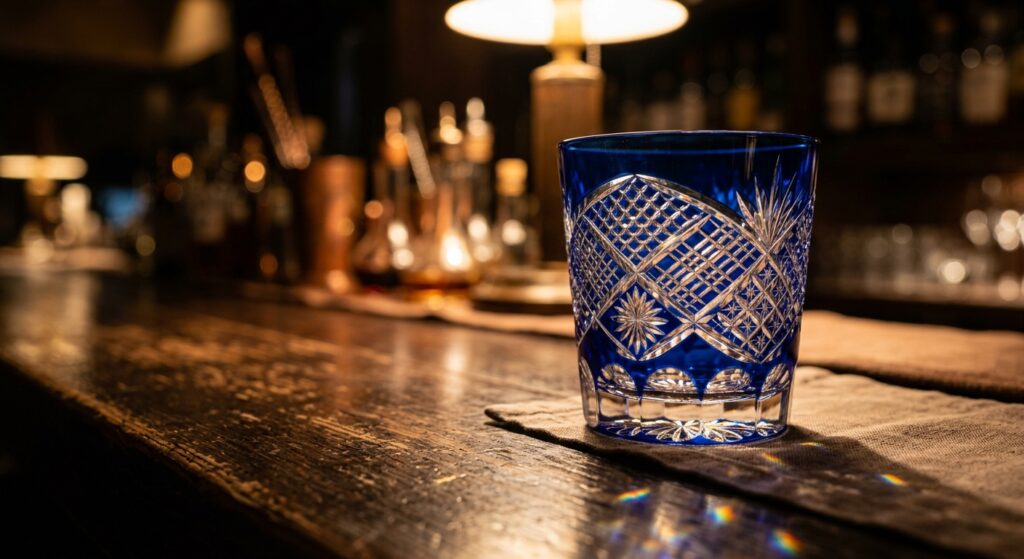
Picture a dimly lit bar in New York or London. A whiskey glass sits on the counter, catching the amber light. Its surface is covered in precise geometric cuts that scatter tiny rainbows across the wood. It looks like it could be any piece of decorative glassware—until you learn it is Edo Kiriko, a traditional Japanese craft of hand-cut glass that began in Tokyo in the Edo period, and that a single craftsman spent hours cutting every line, every facet, and every angle by hand.
That difference is exactly why collectors, enthusiasts, and buyers looking for authentic Japanese craftsmanship pay attention to it. In a world where machines can produce glassware by the thousands, Edo Kiriko shows what hand-cut work can still achieve: sharp contrasts in layered colored glass, intricate geometric and nature-inspired patterns, and a brilliance that comes from individual technique rather than uniform factory output. If you are choosing a piece for use, display, or collection, knowing what makes it handmade and genuinely Japanese changes how you judge its value.
This article answers the practical questions behind that judgment. We walk through the history of Edo Kiriko, the cutting techniques and craftsmanship behind each piece, how it differs from machine-made glass, the traditional patterns and colors you will see, how to choose a piece, and how to check whether it is authentic—all from the perspective of Discovery Japan Mall, where we source directly from certified studios in Tokyo.
What Exactly Is Edo Kiriko?
Edo Kiriko is a traditional craft of cut glass that originated in Tokyo during the Edo period. Craftsmen use rotating wheels to cut intricate geometric and nature-inspired designs into the glass surface, transforming simple crystal or colored glass into sparkling works of art. Edo Kiriko glass originated in Tokyo during the Edo Period and remains rooted there today.
What makes it visually striking is the technique of layering. Artisans cut through a colored outer layer to reveal a clear inner layer of glass, producing sharp contrasts between deep ruby reds, cobalt blues, or emerald greens and the transparent crystal beneath. Edo Kiriko is characterized by bold geometric patterns on glass-stars, lattice, radiating lines-that catch and scatter light in ways that flat or printed designs never can.
It is important not to confuse Edo Kiriko with “Edo glass,” which refers to the blown glass tradition in Tokyo. Edo Kiriko is specifically the decoration: the cutting, the patterns, the facets applied to those blown forms. The craft involves hand-cutting intricate geometric and nature-inspired designs that require years of training to execute consistently.
Edo Kiriko was recognized as a National Traditional Craft in 2002 by Japan’s Ministry of Economy, Trade and Industry. It was also designated a Traditional Craft of Tokyo back in 1985 and was further recognized as a Traditional Craft in 2014. The craft has even received the Grand Prize in the 5th Tokyo’s Traditional Handcrafts Challenge Award, underscoring its continued excellence and popularity among both makers and collectors.
From Edo to Today: A Brief History of Edo Kiriko
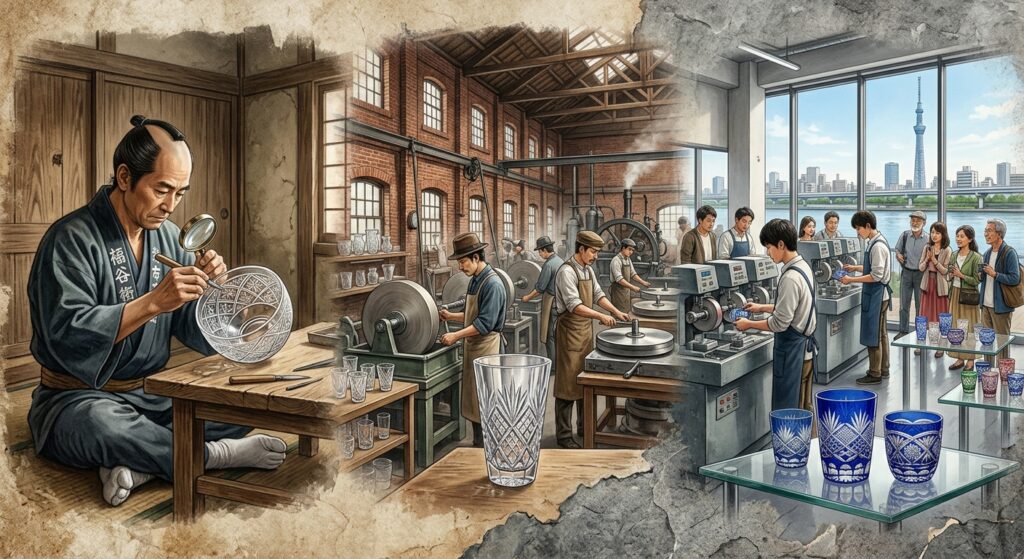
Edo Kiriko techniques date back to the Edo period, with the craft’s origins traced to around 1834. Kagaya Kyūbei, a glass merchant in Ōdenmacho, Edo, had learned glass-cutting methods in Osaka and began engraving patterns on imported glassware. These early pieces used transparent or lightly tinted glass with simple lines and faceted cuts-everyday tableware like cups and bowls, produced in Japan as part of the craft’s early development in the country rather than luxury display. A related but distinct tradition is Satsuma Kiriko from Kyushu, known for overlaying colored glass designs and more delicate design elements than Edo Kiriko.
During the Meiji period, Western techniques greatly influenced Edo Kiriko craftsmanship. The Japanese government established factories like the Shinagawa Glass Works in 1873, bringing European tools and expertise to Tokyo. Diamond grinding wheels, metal discs, and crystal glass became more widely available. As industrial glass manufacture expanded, Edo Kiriko was increasingly produced with sharper, deeper, and more refined cuts. Edo Kiriko reflects the marriage of imported techniques and local aesthetic values-Western industrial precision fused with Japanese design sensibility.
The 20th century brought devastation. Earthquakes and wartime firebombing destroyed many workshops across Tokyo. Yet small family studios preserved the core methods, and after World War II, demand for luxury tableware and gifts fueled a revival. New collaborations between artisans and designers expanded the craft’s reach. Today, eighty percent of Edo Kiriko manufacturing occurs in Koto and Sumida Wards in Tokyo, where the tradition continues in small, specialized workshops.
Why Is Every Edo Kiriko Glass Handmade?
The core answer is straightforward: the patterns depend on subtle human control of angle, pressure, and timing that machines still struggle to reproduce with the same depth and character.
Every glass blank is slightly different. Thickness varies. Hardness changes between batches. The curvature of a tumbler differs from a sake cup. A craftsman must constantly adjust to these tiny variations, reading the glass by feel and sound as the wheel meets the surface. No two blanks are perfectly identical, so no single machine setting works universally.
Consider angle alone. Placing the wheel even one or two degrees off changes how a facet refracts light. A pattern that should sparkle evenly can look unbalanced or dull if not corrected by eye and hand. Now multiply that across dozens of intersecting cuts on a single piece. Edo Kiriko is known for bold geometric patterns, and each motif-asanoha hemp-leaf, nanako fish-roe dots, basket weave-requires different cutting depths and sequences that craftsmen learn through years of practice.
The most critical factor is irreversibility. Once glass is cut, that cut cannot be erased. A groove too deep weakens the structure. A line too shallow disappears after polishing. This permanent consequence means every stroke carries risk. Machines can produce simple engravings on flat surfaces, but multi-layered, deep cuts on curved glassware at consistent artistic quality remain beyond reliable automation.
The Step-by-Step Making of Edo Kiriko
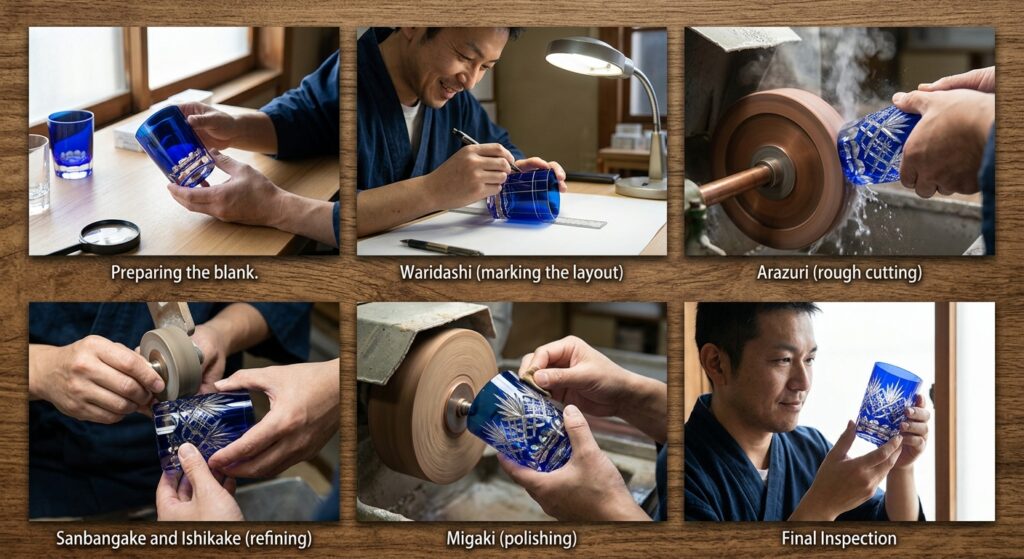
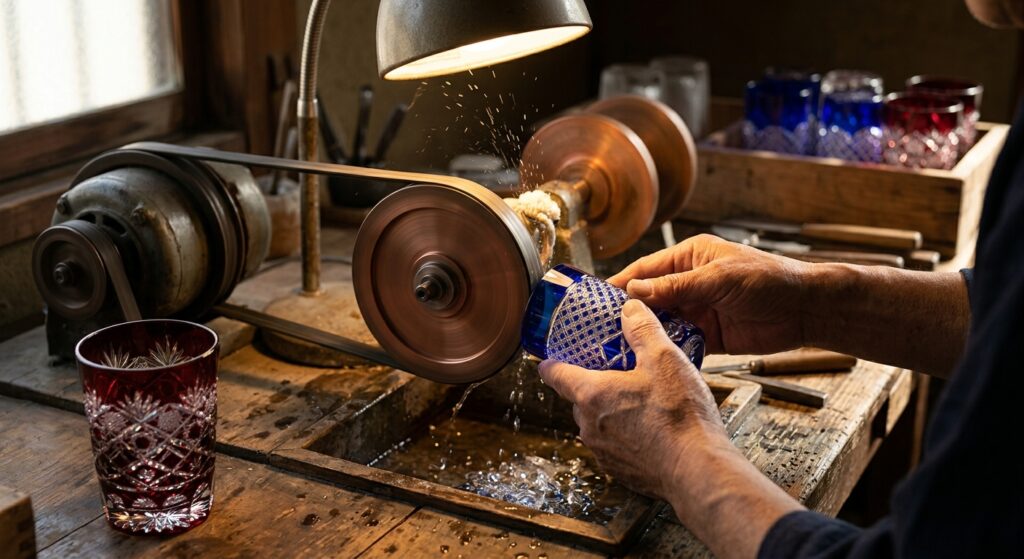
Imagine standing in a small workshop in Tokyo’s Koto Ward. The craftsman sits before a rotating wheel, a glass tumbler in his hands. Here is how each piece moves from blank to finished work, with every step done in the correct order.
Preparing the blank. The process starts with selecting a glass vessel-often double-layered, with a thin colored glass coating over clear crystal. The color, thickness, and shape of this blank determine everything that follows. Whether soda-lime or crystal, the material’s clarity and capacity to hold deep cuts must be assessed before any wheel touches it.
Waridashi (marking the layout). Waridashi marks the design layout directly on glass. Using ink or oil-based pens, the craftsman draws simple vertical and horizontal guide lines-no full pattern sketch. These marks serve as reference axes for balance. Even small misalignment at this stage leads to visible distortions in the finished piece.
Arazuri (rough cutting). Arazuri uses coarse garnet powder for initial carving. With a metal grinding wheel spinning and water flowing to control heat, the craftsman presses the glass against the wheel to cut the main grooves first. These “parent bones” establish the foundation of the pattern. Mistakes here are nearly impossible to correct.
Sanbangake and Ishikake (refining). Ishikake refines patterns using a whetstone disk. Finer wheels and natural or synthetic stones smooth rough edges, sharpen intersections, and adjust the depth of each line. The craftsman checks balance visually, rotating the piece to ensure the design reads consistently from every angle.
Migaki (polishing). Migaki restores transparency and shine to the glass. Using wooden, felt, or cork wheels with polishing powder-often cerium oxide-the craftsman buffs every facet until the surface regains its clarity. Final inspection checks light refraction, alignment of cuts, and tactile finish.
Throughout this entire process, the craftsman checks reflections and refractions of light by eye, not by digital sensors. The interplay between cut and uncut surfaces determines the piece’s brilliance-and only a trained human can judge that in real time.
The Skill Behind the Beauty: What Makes Cutting So Difficult?
The beauty of Edo Kiriko patterns-sharp stars, lattice grids, radiating lines-comes from invisible decisions made in fractions of a second.
Angle matters enormously. Tilting the glass or wheel slightly alters how each facet reflects light. A facet meant to catch overhead light and throw it sideways will simply go dark if the cut is angled wrong. The craftsman adjusts continuously, feeling vibration through his fingertips, watching the groove form in real time.
Pressure control is equally critical. Pressing too hard chips or cracks the glass. Too softly creates dull, shallow lines that vanish during the polishing stage. On overlay colored glass, cutting too deep removes the color entirely; too shallow leaves the pattern barely visible. The margin for error is measured in fractions of a millimeter.
Then there is the challenge of symmetry on a curved surface. A pattern that looks evenly spaced on a flat template distorts when wrapped around a cylinder. The craftsman must keep spacing consistent by trained sense of distance and rotation-no printed template, no laser guide.
The production process requires strict hand-cutting techniques and years of apprenticeship. Many artisans train for five to ten years under a master before they are trusted to cut complex patterns independently. Consider the nanako motif: tiny dots resembling fish eggs, each one the same size and evenly aligned across the surface. Cutting hundreds of identical dots freehand on a curved glass is not decorative indulgence-it is technical discipline at its most demanding.
Colored Glass, Patterns, and Everyday Uses: How to Enjoy Edo Kiriko
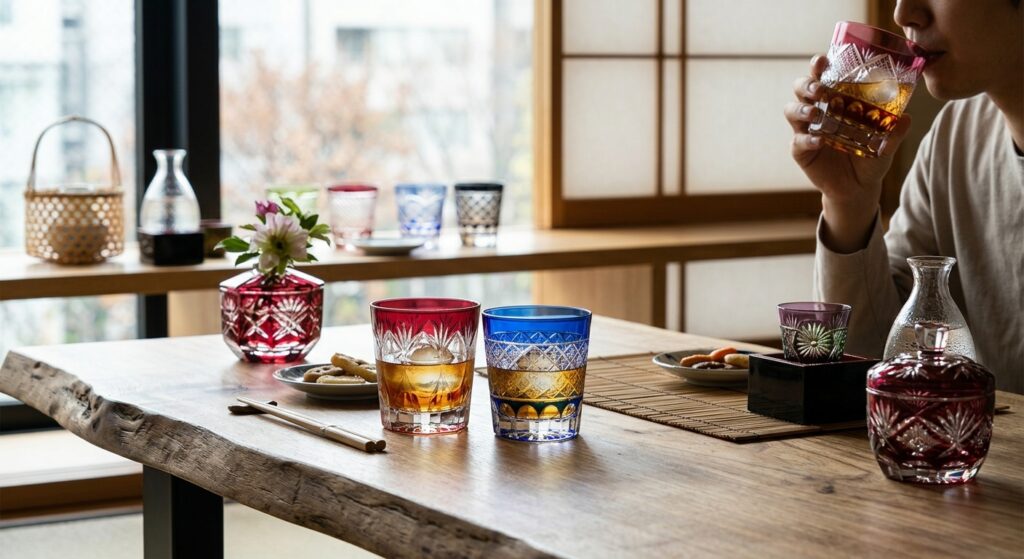
Edo Kiriko pieces often serve as everyday items like sake cups and glasses-not just display objects. Many people overseas now use them for whiskey, wine, tea, and cocktails.
Common overlay colors include ruby red, cobalt blue, emerald green, purple, and amber, each cut to reveal the clear crystal beneath. The contrast between the colored glass and the transparent interior is what gives each piece its dramatic sparkle.
Edo Kiriko utilizes various traditional patterns carrying specific cultural meanings. Key patterns include Nanako (tiny dots like fish eggs symbolizing abundance), Asanoha (hemp leaf representing growth and health), and Yarai (bamboo fence suggesting resilience and protection). Basket weave, known as kagome, represents strength and protection-a dynamic lattice that catches light from every direction. These motifs add layers of meaning to what might otherwise look like pure decoration.
How might you use Edo Kiriko at home? A Kagami Crystal Rock Glass with the Kikuhana pattern makes a striking whiskey or cocktail glass. A Kagami Crystal Sake Set with cloisonne and star crest brings tradition and elegance to a sake set for entertaining, and a product listing may also note the regular price, sale price, and whether it is in stock. For interior décor, a piece like the Kagami Gold Red Covered Vase in octagonal tiling serves as a sculptural accent in any room. Edo Kiriko brings Japanese detail to modern living without requiring a special occasion.
Choosing the Right Edo Kiriko Sake Set for You
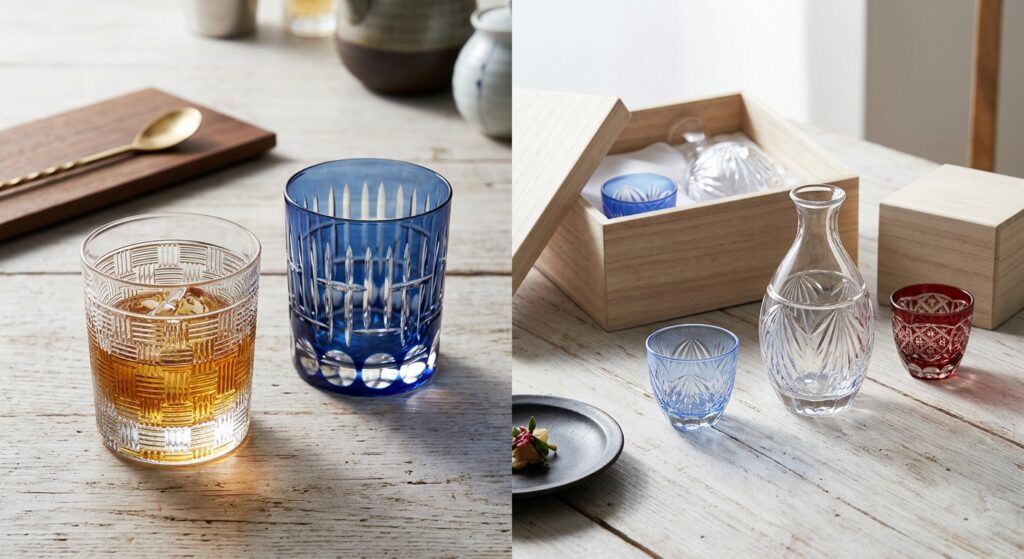
Selecting your first Edo Kiriko piece depends on how you plan to use it.
For whiskey or cocktails, look for double old-fashioned rocks glasses with robust designs like basket weave or bamboo fence motifs. These types of glasses have enough weight and capacity to hold spirits comfortably while showcasing deep, light-catching cuts. A piece like the Kagami Crystal On-The-Rocks Glass in Hydrangea Blue is a refined choice for a home bar.
For sake, consider small cold sake cups or a coordinated sake set. The Kagami Cold Sake Cup in Blue designed by traditional craftsman Akio Kimura offers an intimate drinking experience with delicate willow-like cuts. Many pieces ship in a paulownia or wooden box, making them ideal as gifts.
For color and mood, deep red creates a dramatic accent on any table. Cobalt blue brings a cool, calm atmosphere. Multicolored or amber pieces work well for celebratory settings. Studios like Kimoto Glass Tokyo and Kagami Crystal continue to push boundaries with new forms and patterns while respecting the craft’s heritage.
Discovery Japan Mall curates Edo Kiriko from respected makers across Tokyo’s Koto and Sumida Wards, shipping worldwide with protective packaging. Every item sold on our platform is made in Japan by trained craftsmen-view our full collection on the Discovery Japan Mall online marketplace to find the piece that suits your table and taste, or contact Discovery Japan Mall with questions about makers, availability, or choosing the right piece.
Bringing a Piece of Kimoto Glass Tokyo Craftsmanship Home
Edo Kiriko is still handmade because its value lies in the craftsman’s control of angle, pressure, and pattern-something machines cannot replicate with the same depth and individuality. Behind every sparkling finish is years of training, irreversible decisions on fragile glass, and a tradition passed down since the Edo period through generations of artisans in Tokyo, much like the dedication behind the latest arrivals featured on Discovery Japan Mall.
The next time you see a cut glass catching light-whether in a bar, a friend’s home, or on Discovery Japan Mall or browsing the new and best-selling watches on Discovery Japan Mall-look closer. Those facets carry the traces of a human hand, each one a deliberate choice that no algorithm can fully reproduce. If that craftsmanship resonates with you, explore our Edo Kiriko collection. It is the most direct way to bring a piece of Tokyo’s living history to your own table.

Comments