
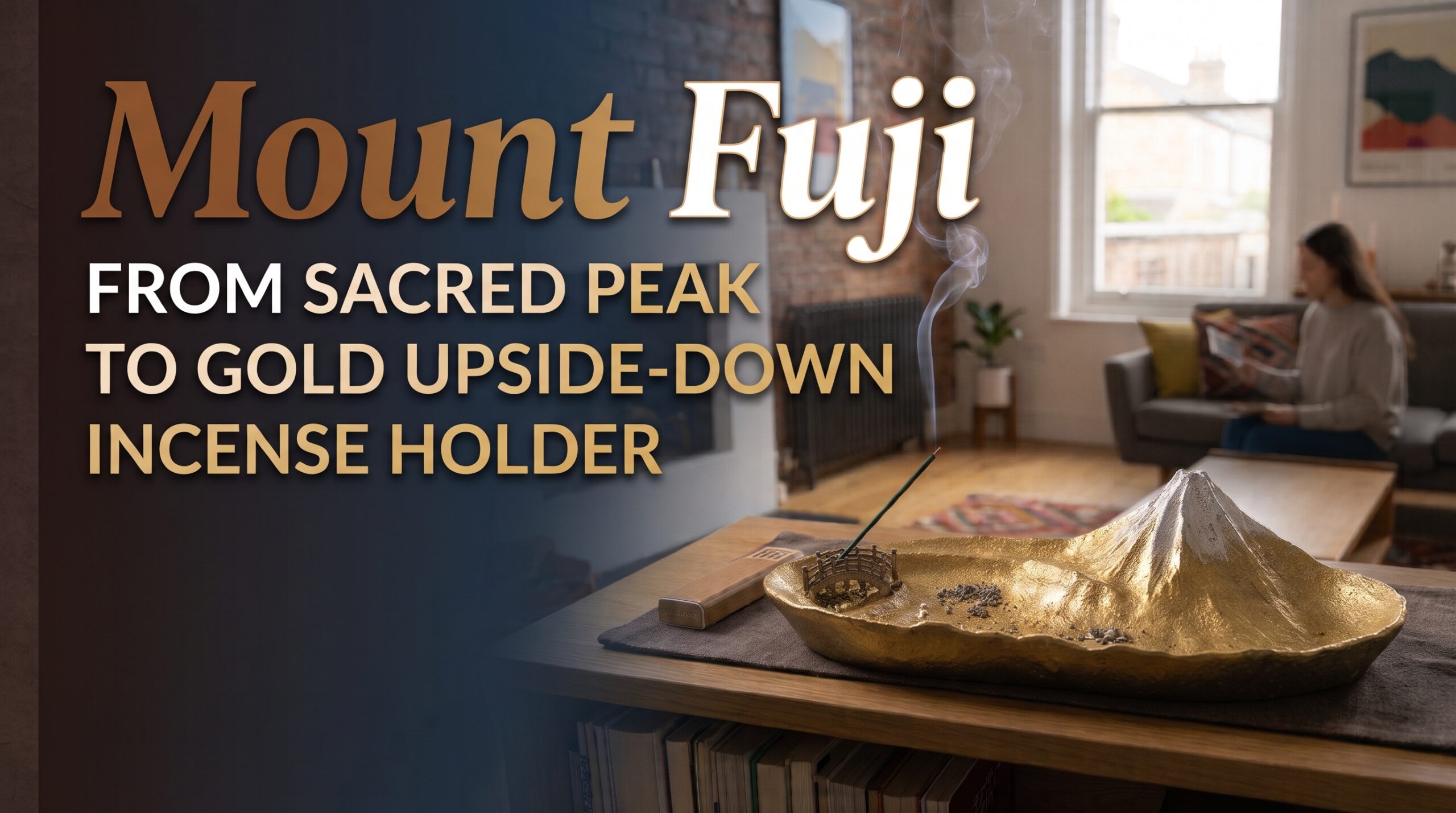
Mount Fuji is Japan’s highest mountain at 3,776.24 m, rising between Shizuoka and Yamanashi prefectures, and on clear days its snowcapped cone is visible from Tokyo more than 100 kilometers away. Recognized on the World Heritage List on June 22, 2013 as a sacred place and source of artistic inspiration, Fuji remains one of Japan’s clearest national symbols for travelers planning a visit, hikers considering a climb, and readers interested in Japanese art, spirituality, and design.
This guide explains Mount Fuji’s history, geography, climate, and cultural role in Japan, including its religious meaning, climbing routes, seasons, and safety basics. It also connects Fuji’s heritage to everyday Japanese lifestyle culture through the Gold Upside-Down Mount Fuji Incense Holder, a modern incense holder inspired by this iconic peak and available at Discovery Japan Mall.
Here is what you will learn:
- Key facts about Mount Fuji’s formation, volcanic activity, and spiritual significance
- The story of Aokigahara forest, Fuji’s lakes, and summit climate
- Practical fuji climbing info: routes, seasons, and safety
- How Japanese incense culture connects to a gold Mount Fuji incense holder you can use at home
- Gold Upside-Down Mount Fuji Incense Holder (Discovery Japan Mall)
- How to Use and Style a Mount Fuji Incense Holder at Home
- Incense Culture in Japan and the Role of the Incense Holder
- Visiting Mount Fuji and Bringing Its Spirit Home
- Spiritual Site, Cultural Icon and Geographical Wonder
- Fuji in Religion, Myth and Pilgrimage
- Mount Fuji in Art, Culture and Popular Imagination
- Geography, Climate and Aokigahara Forest
- Fuji Climbing: Routes, Seasons and Safety
Gold Upside-Down Mount Fuji Incense Holder (Discovery Japan Mall)
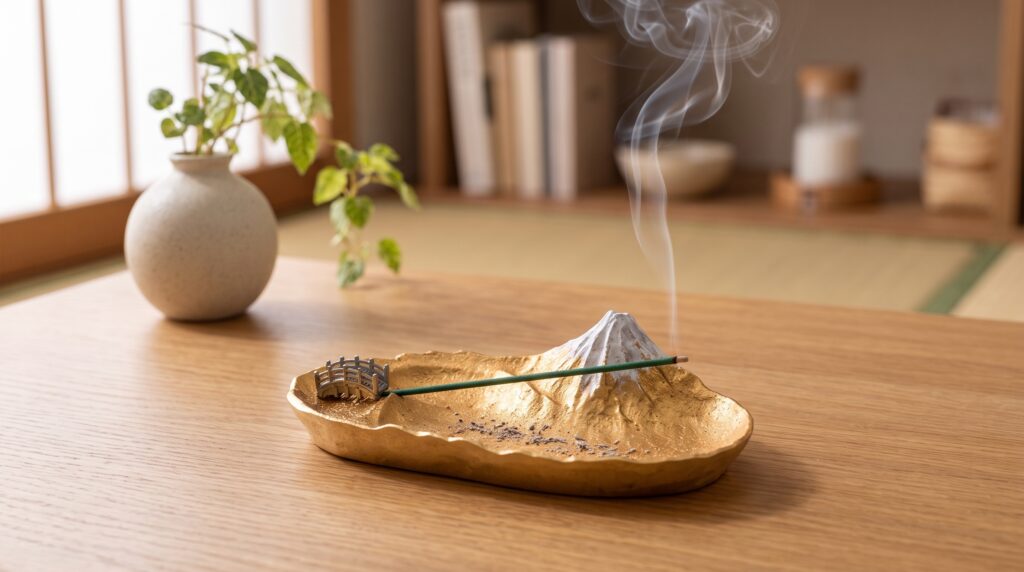
The Gold Upside-Down Mount Fuji Incense Holder is a standout object in Discovery Japan Mall’s latest arrivals collection, designed for use with standard incense sticks and crafted to work as both functional holder and room accent.
Its core concept is simple and striking: the familiar Fuji silhouette is inverted, with the peak pointing downward, finished in a bold gold tone that contrasts with traditional blue-and-white Fuji motifs. The compact size makes it perfect for desks, shelves, or bedside tables. A dedicated hole holds a single stick firmly, and a small area at the base is designed to catch ash cleanly.
The upside-down design is a playful, modern reimagining – suggesting reflection, inversion of perspective, or the idea of “bringing heaven down into your room.” Despite the unconventional form, the piece still honors the mountain’s heritage and presence.
The product is available through Discovery Japan Mall’s watch and lifestyle selection, which focuses on authentic, Japan-inspired lifestyle goods that provide real cultural connection.
How to Use and Style a Mount Fuji Incense Holder at Home
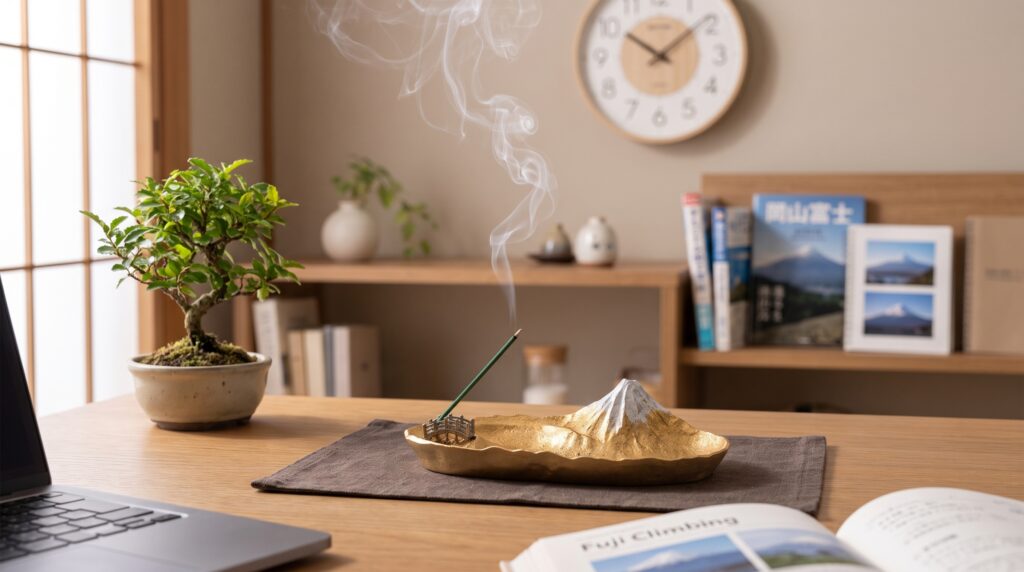
Here is a quick guide to making the most of your Gold Upside-Down Mount Fuji Incense Holder in any modern interior.
Basic usage steps:
- Place the incense holder on a heat-resistant, level surface
- Insert a standard incense stick firmly into the holder’s hole
- Light the end of the stick and gently blow out the flame so it begins to smoke
- Ensure ash will fall onto the built-in tray or a protective mat beneath
- Never leave burning incense unattended
Styling ideas:
- Pair the gold Fuji holder with minimalist wooden shelves, a tatami-inspired mat, or alongside a small bonsai for a compact “mini Japan corner”
- Set it on your desk during work-from-home breaks, yoga sessions, or evening reading, and play quiet music alongside a Japanese Rhythm wall clock for a coordinated look
- Use it while watching videos of Fuji or planning a future fuji climbing trip – let the visual and aroma work together
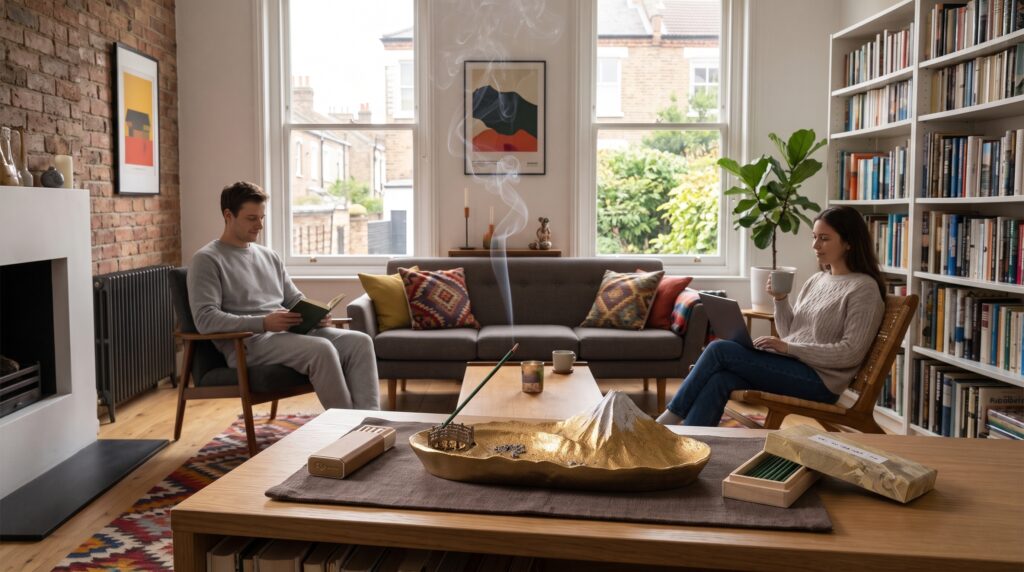
- Add guests to the experience by placing it in a shared living space where its gold color and unique shape become a conversation piece
Incense Culture in Japan and the Role of the Incense Holder
Japan’s incense tradition stretches back centuries, introduced through Buddhism in the 6th century. From Zen temple ceremonies to the refined art of kōdō – combining scent, ritual, and philosophical reflection – incense has been part of daily life, meditation, and culture across the country.
An incense holder serves a practical and aesthetic purpose:
- It provides safe support for standard incense sticks, keeping the stick stable as it burns
- It catches all the ash, protecting your table and furniture
- It stabilizes the burn based on the type of incense being used, whether stick or cone, so it doesn’t tip over
Japanese holders come in many materials – ceramic, metal, lacquer, stone – and styles range from simple trays to sculptural designs shaped like mountains, animals, or seasonal motifs. Many are designed with a small hole or groove sized for standard incense sticks. Items like a horizontal incense burner show the breadth of Japanese holder design.
Mount Fuji-shaped holders add a layer of symbolism: they bring sacred nature and calm into your space, combining function with the kind of quiet beauty that defines Japanese aesthetics.
Visiting Mount Fuji and Bringing Its Spirit Home
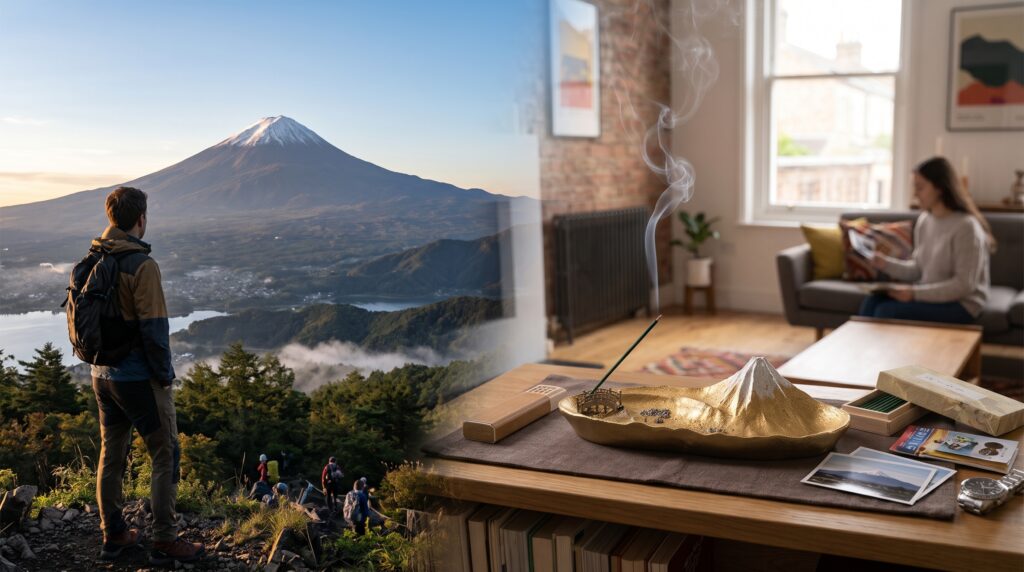
Mount Fuji is both a real mountain you can visit and a motif you can live with daily. Whether you are viewing sunrise over the summit from Yamanashi, hiking around the Fuji Five Lakes, exploring the area near Aokigahara forest with a guide, or bathing in hot springs at the foothills, the experience stays with you.
But not everyone can visit frequently. That is where Fuji-themed items like the Gold Upside-Down Mount Fuji Incense Holder come in – a tangible way to keep the mountain’s calm presence nearby, on your table, in your space, any day of the year. It is a small object that carries the weight of a world of meaning.
Discovery Japan Mall’s role is to carefully select Japan-made or Japan-inspired goods that reflect authentic culture, design, and everyday usability, from lifestyle accents to Seiko watches that showcase Japanese craftsmanship. If this article caught your attention, explore their incense holder lineup and other Mount Fuji–themed items to find the piece that fits your life – no cart pressure, just good design rooted in real Japanese heritage.
Spiritual Site, Cultural Icon and Geographical Wonder
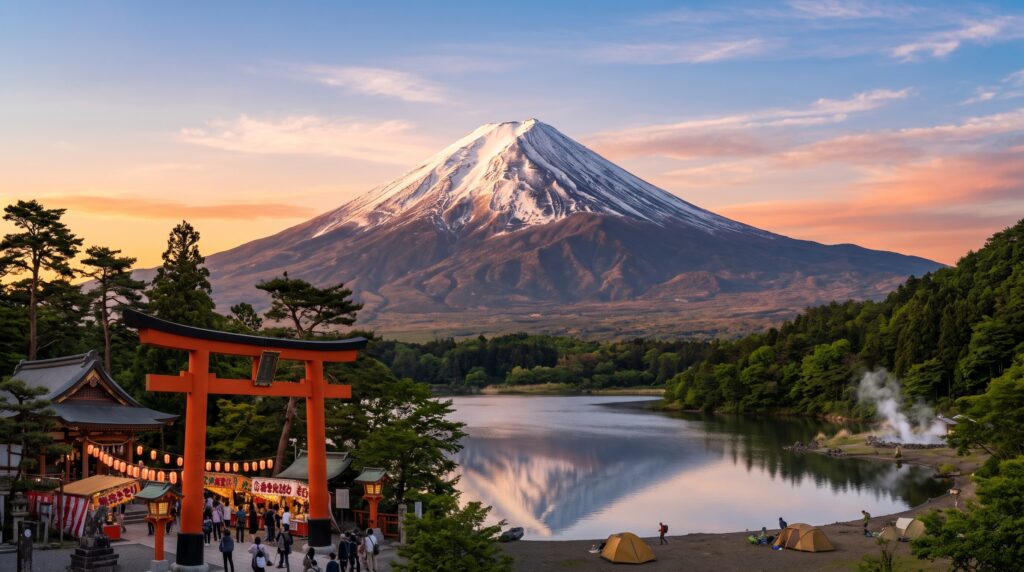
Mount Fuji is a spiritual site, a cultural icon, and a geographical wonder all at once. It has shaped Japanese life for centuries, combining nature, worship, and art in one place.
- Fuji is an active stratovolcano, a type of volcano built from layered lava and ash. Its last eruption occurred in 1707 during the Hōei event, which showered ash as far as Edo (modern-day Tokyo).
- It sits at the junction of three tectonic plates – Eurasian, Philippine Sea, and North American – making its formation geologically unique.
- The surrounding area includes five lakes, hot springs, and dense forests shaped by ancient lava flows.
- Mount Fuji has been a sacred site since ancient times, referenced in Japan’s earliest poetry collections and featured in seasonal shrine festivals.
Today, people visit the mountain for hiking, camping, hot spring bathing, and sightseeing. Its perfect cone remains shorthand for Japan itself across the world.
Fuji in Religion, Myth and Pilgrimage
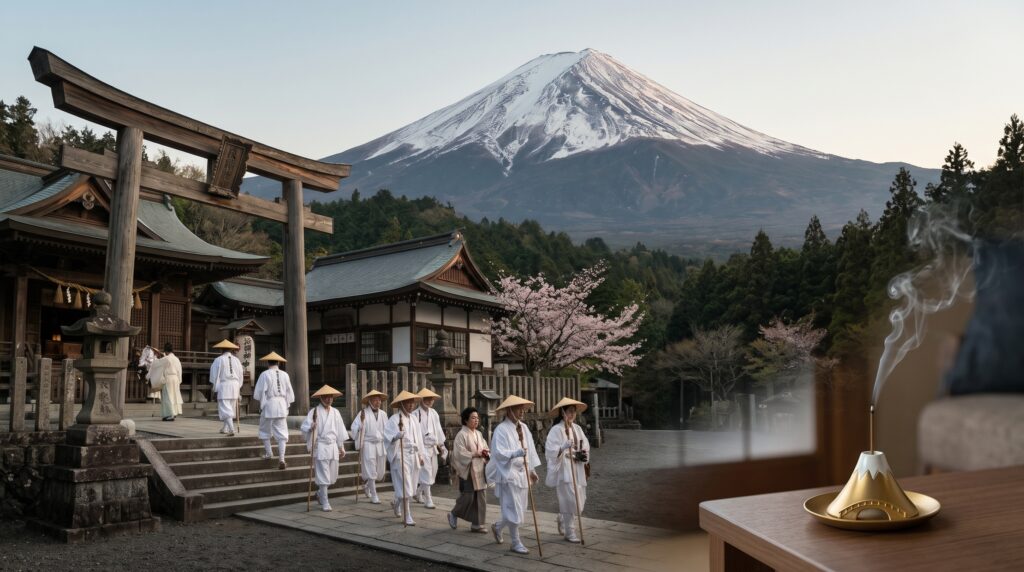
Mountain worship runs deep in Japanese culture, and Fuji sits at the center of this tradition. For centuries, Shinto and Buddhist practices have overlapped around the peak, with shrines, rituals, and pilgrimage paths crafted into the landscape.
Fuji is an object of worship tied to specific historical figures and movements:
- Hasegawa Kakugyō summited Mount Fuji over 100 times and founded the Fuji-kō movement – an Edo period cult centered around Mount Fuji that organized group pilgrimages for purification.
- Shinto beliefs associate Mount Fuji with the goddess Konohanasakuya-hime, the blossom deity linked to life, beauty, and volcanic calm. Shrines like Asama Shrine at the foothills were built to appease the volcano.
- For centuries, women were prohibited from reaching the summit. The first woman to summit Mount Fuji was Tatsu Takayama in 1832, though the official ban was not lifted until 1872.
Pilgrimage was a journey of purification – from shrine gates through forest to crater rim. That same desire for calm and connection to nature lives on today in simple home rituals, like lighting your favorite incense at a Mount Fuji incense holder and letting the smoke carry your thoughts upward.
Mount Fuji in Art, Culture and Popular Imagination
Mount Fuji has inspired countless works of art, literature, and music, and it has been a popular subject in Japanese art since 1600.
The most iconic works include Katsushika Hokusai’s “Thirty-Six Views of Mount Fuji” and “One Hundred Views of Mount Fuji,” which explored the peak from dozens of vantage points and seasons. You can enjoy a piece of this legacy at home with a Hokusai Great Wave jigsaw puzzle. Utagawa Hiroshige also portrayed Fuji extensively, and these woodblock prints influenced Western artists like Vincent van Gogh and composers like Claude Debussy, who drew artistic inspiration from their composition and color.
Geography, Climate and Aokigahara Forest
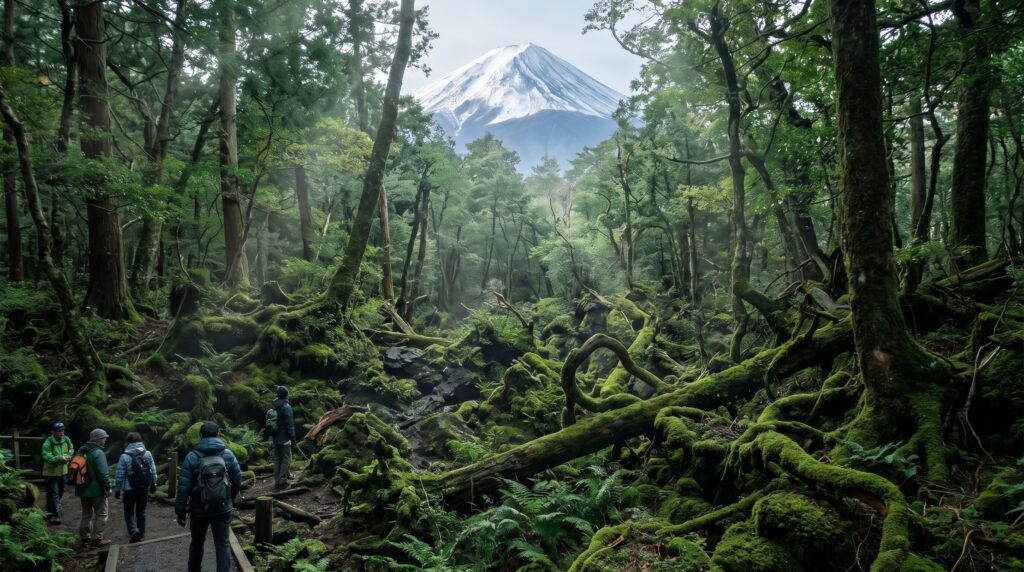
Mount Fuji is located near the Pacific coast of Honshu, within Fuji-Hakone-Izu National Park. Mount Fuji is surrounded by five lakes – Kawaguchi, Yamanaka, Saiko, Shoji, and Motosu – fed by snowmelt and subterranean springs flowing through porous lava.
- The peak of Mount Fuji offers the best views during late autumn and winter, when the air is crisp and the sun lights up the snowcap against blue sky.
- Summit conditions are harsh year-round: sub-zero temperatures, strong winds, and tundra-like terrain above the treeline at roughly 2,500 m.
- Recent observations have noted the snowcap appearing unusually late, consistent with broader climate shifts in the area.
At Fuji’s northwest base lies the Aokigahara forest, a dense 30-square-kilometer woodland formed by lava flows from the Jōgan eruption of 864 CE. The forest is famous for its silence, moss-covered lava, and cave systems including the Narusawa Ice Cave and Fugaku Wind Cave. While the area carries a somber reputation tied to ghost stories and folklore, it is first and foremost a place of extraordinary natural beauty. Conservation of its caves, vegetation, and ecosystems remains an ongoing priority.
Fuji Climbing: Routes, Seasons and Safety
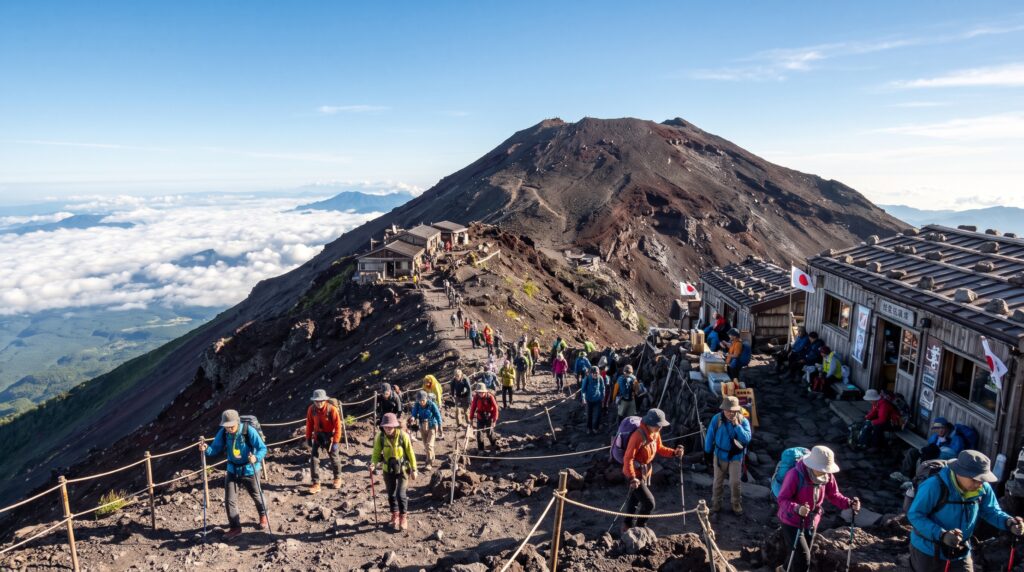
The official climbing season for Mount Fuji is from early July to early September, with the most popular climbing period being July to August. Around 200,000 to 300,000 people climb Mount Fuji every summer – approximately 300,000 people climbed Mount Fuji in 2009 alone. Climbing from October to May is discouraged due to cold weather, closed huts, and dangerous trail conditions.
The four major routes are Yoshida, Subashiri, Gotemba, and Fujinomiya. Each starts at a “fifth station” partway up the mountain:
| Route | Start Elevation | Key Feature |
|---|---|---|
| Yoshida Trail | ~2,305 m | Most popular, best sunrise views, most huts |
| Fujinomiya | ~2,400 m | Shortest but steepest ascent |
| Subashiri | ~2,000 m | Quieter, forested lower section |
| Gotemba | ~1,440 m | Longest climb, fewest facilities |
Recent overtourism measures include a mandatory ¥2,000 fee and daily caps of about 4,000 climbers on the Yoshida trail, with gates to prevent rushed “bullet climbing.” Similar policies are planned for trails on the Shizuoka side. Always bring proper gear, check official trail information before your trip, and never climb outside the set season when huts are closed and conditions turn dangerous.

Comments