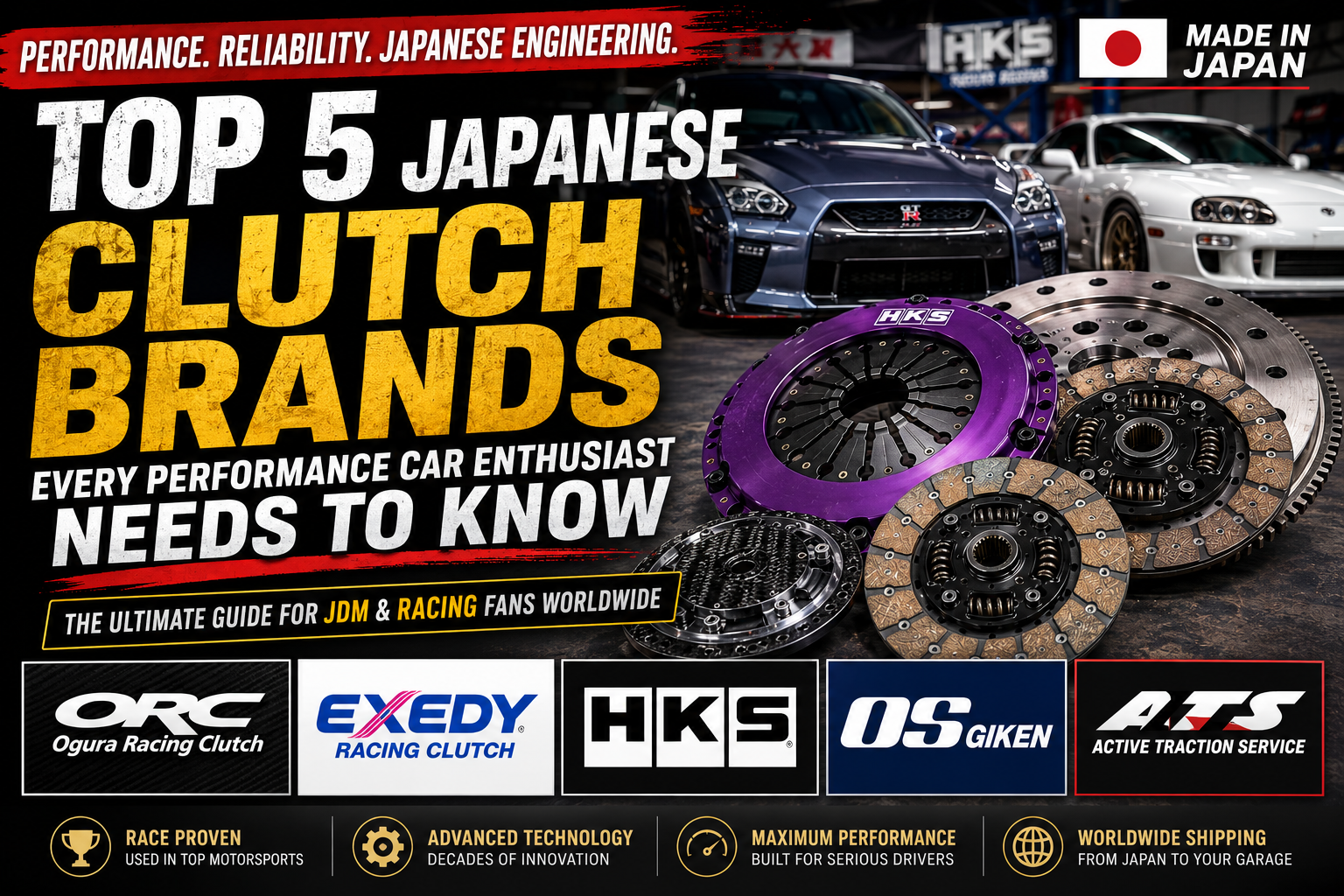
If you’ve ever watched a GT500 car launch off the line at Fuji Speedway and wondered how the drivetrain survives that kind of abuse lap after lap — the answer, more often than not, starts with a Japanese clutch. The same country that gave the world the Skyline GT-R, the Toyota Supra, and the Mazda RX-7 also quietly became a leading center of high-performance clutch engineering. And performance tuners around the world are only just starting to catch on.
Whether you’re building a 600-horsepower EVO for time attack, hunting for a streetable upgrade for your daily-driven STI, or simply trying to understand what separates a $150 OEM replacement from a $2,000 carbon twin-plate, this guide is for you. We’re breaking down the five most important Japanese clutch brands — where they came from, what makes their technology remarkable, and which one is right for your build.
- Why Japanese Clutch Brands Dominate Performance Motorsport (And What Tuners Around the World Are Discovering)
- What to Know Before You Upgrade Your Clutch (Street vs. Sport vs. Race — and Why It Matters)
- Brand #1 – ORC (Ogura Racing Clutch / 小倉クラッチ)
- Brand #2 – EXEDY (エクセディ)
- Brand #3 – HKS (エッチ・ケー・エス)
- Brand #4 – OS Giken (オーエスギケン)
- Brand #5 – ATS (エーティーエス)
- Brand Comparison: Which Japanese Clutch Brand Is Right for You?
- How to Order Japanese Clutch Parts from Anywhere in the World
- Frequently Asked Questions (FAQ)
- What is the best Japanese clutch brand for street use?
- What is the difference between a single-plate and multi-plate clutch?
- Are Japanese clutch brands better than European brands?
- Can I order Japanese clutch parts from outside Japan?
- What clutch should I use for a 500hp+ build?
- Is a carbon clutch streetable?
- What does OEM replacement vs. performance clutch mean?
- Do I need a new flywheel when upgrading to a twin-plate clutch?
- Final Thoughts: Upgrade Your Clutch, Upgrade Your Drive
Why Japanese Clutch Brands Dominate Performance Motorsport (And What Tuners Around the World Are Discovering)
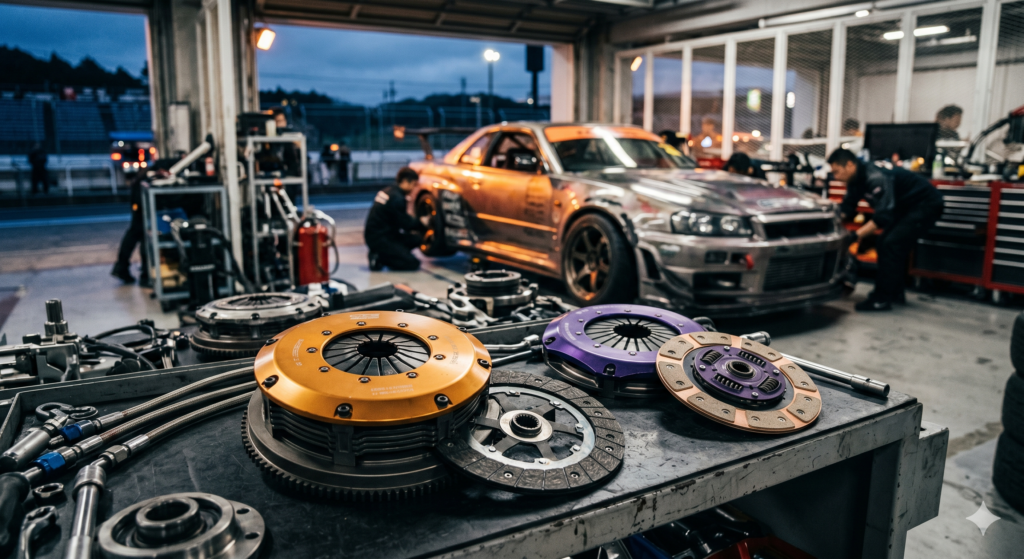
It’s easy to assume that European manufacturers lead the way in performance clutch technology — after all, brands like Sachs and AP Racing have deep Formula 1 heritage. But spend any time in the world of Japanese motorsport, and a different picture emerges. The D1 Grand Prix, Japan’s elite professional drift series, runs almost exclusively on Japanese performance clutch hardware. The Super GT series — one of Japan’s most technically demanding touring car championships — does the same. Time attack culture, which was born in Japan at circuits like Tsukuba and Suzuka, has produced some of the most demanding clutch test environments anywhere in motorsport.
The reason Japanese clutch technology is so advanced comes down to a combination of factors that go beyond engineering. Japanese manufacturers are deeply engaged with the concept of monozukuri — the art and philosophy of making things — which drives an approach to component development that prioritizes refinement over generations rather than quick-to-market iteration. Many of the Japanese clutch brands covered in this guide have been iterating on their core technology for 30, 40, even 50 years. That accumulated expertise shows in the product.
There’s also the unique demands of the Japanese performance car ecosystem. The turbocharged platforms that became icons — the RB26DETT in the GT-R, the 2JZ-GTE in the Supra, the 4G63 in the Lancer Evolution — produce massive low-end torque that can quickly overwhelm ordinary clutches. Japanese clutch engineers had to solve these problems first, because their home market demanded it. Understanding how automotive clutches work at a fundamental level makes it clear just how sophisticated the solutions these brands developed really are.
Today, thanks to cross-border e-commerce, enthusiasts worldwide can order the same clutch hardware that Japanese pro racers and serious tuners have relied on for decades — directly from Japan, shipped to your door. Let’s meet the brands.
What to Know Before You Upgrade Your Clutch (Street vs. Sport vs. Race — and Why It Matters)
Before diving into the brands, it’s worth understanding the landscape. Not all Japanese performance clutch upgrades are equal — and choosing the wrong category for your use case can make your car significantly harder to drive without delivering any meaningful performance benefit.
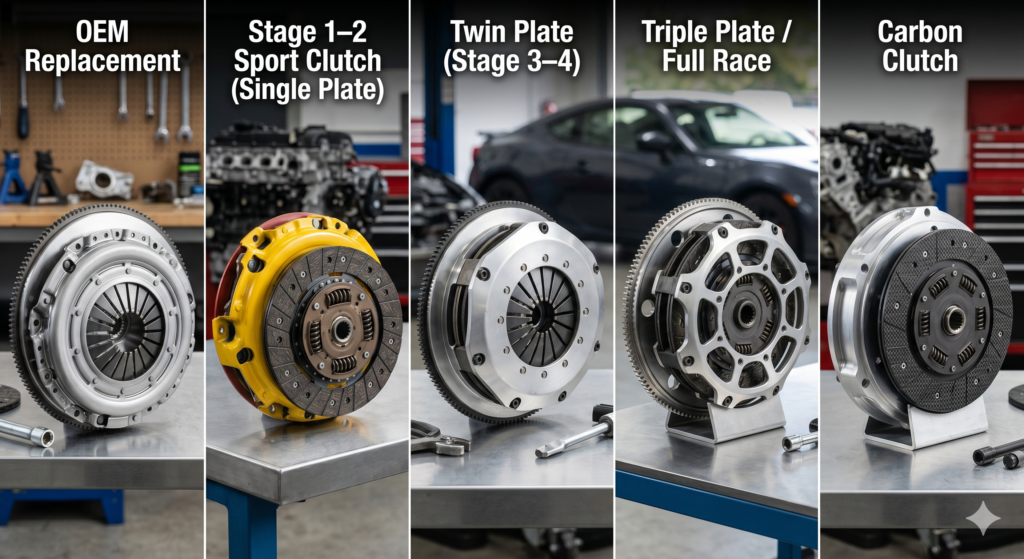
- OEM Replacement: A direct swap for your factory clutch using higher-quality materials. Better durability and slightly improved torque capacity, but stock pedal feel and engagement behavior. Ideal for high-mileage cars or builds that are lightly modified.
- Stage 1–2 Sport Clutch (Single Plate): Upgraded clutch disc and pressure plate with higher clamping force. Noticeably firmer pedal, quicker engagement, rated for 300–500hp depending on disc material. Good street manners with meaningfully better track capability. The sweet spot for most enthusiasts.
- Twin Plate (Stage 3–4): Two clutch discs on a shared flywheel, dramatically increasing torque capacity while allowing a smaller, lighter overall package. Pedal feel is heavier and engagement is more abrupt. Best for seriously modified cars used for track days, time attack, or performance street driving.
- Triple Plate / Full Race: Three discs, maximum torque capacity (often 1,000–1,500hp+), minimal drivetrain inertia. Not recommended for street use — engagement is extremely abrupt and half clutch behavior is unforgiving. Built for professional motorsport and drag racing.
- Carbon Clutch: Discs made from carbon fiber rather than metal or organic material. Dramatically lighter (reducing rotational inertia), heat-resistant to extreme temperatures, and — in the best Japanese designs — surprisingly smooth-engaging for a racing clutch. More on this when we cover ATS.
With that framework in mind, here are the five Japanese clutch brands you need to know.
Brand #1 – ORC (Ogura Racing Clutch / 小倉クラッチ)
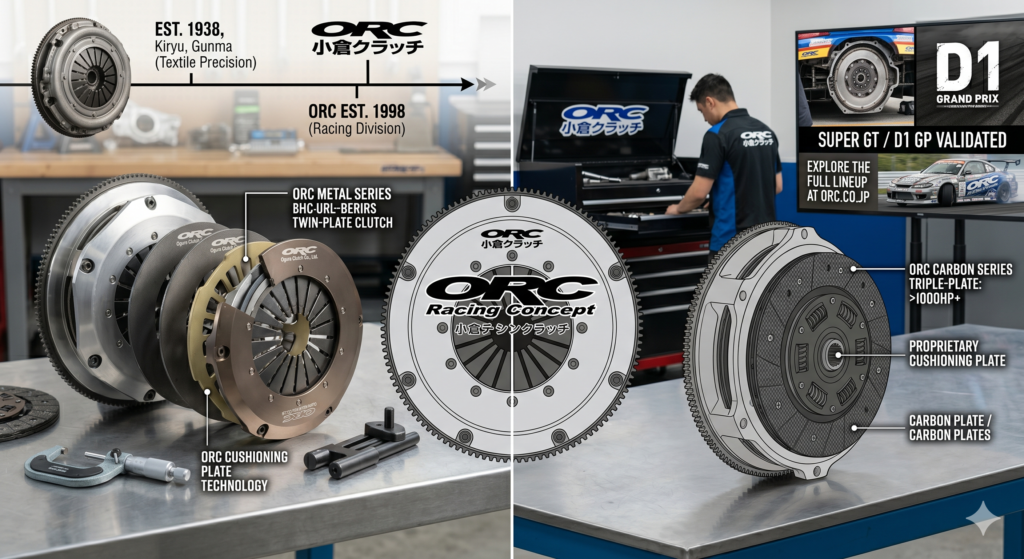
Most performance enthusiasts know the name ORC from race paddocks and drift events — but the story of Ogura Racing Clutch goes back much further than motorsport. The parent company, Ogura Clutch Co., Ltd., was founded in 1938 in Kiryu, Gunma Prefecture — the same region of Japan known for its precision textile machinery industry. Ogura’s core business for decades was electromagnetic clutches for industrial equipment: the kind of clutch that controls a factory robot arm or a precision printing press. That background in exacting, repeatable clutch engagement isn’t just corporate history — it’s the engineering DNA that makes ORC products remarkable.
The ORC racing division was established in 1998, and from the beginning it targeted the highest levels of Japanese motorsport. Today, ORC clutches are trusted by competitors in Super GT, the D1 Grand Prix professional drift series, and JGTC, and their technology has been validated in some of the most demanding environments in Japanese racing. You can explore their full lineup on the ORC official website.
What sets ORC apart technically is their proprietary cushioning plate technology. Most high-clamping clutches — twin and triple plate setups in particular — have a notorious problem: the engagement point is brutal. The clutch snaps in and out with little of the progressive feel that makes a car driveable in traffic or at slow speeds. ORC’s cushioning plate engineering absorbs that snap, giving their high-capacity clutches a surprisingly manageable engagement characteristic even at high clamp loads. Their triple-disc kits are rated to 1,000hp+ while remaining more streetable than comparable competitors.
The ORC lineup runs from the Light Series (street, OEM-replacement-class engagement) through the Carbon Series (sport/track), Metal Series (race), and the pinnacle Racing Concept lineup for professional circuit use. The SE Clutch and N1 Clutch are purpose-built for specific race series regulations.
Browse ORC clutch parts on Discovery Japan Mall →
Brand #2 – EXEDY (エクセディ)
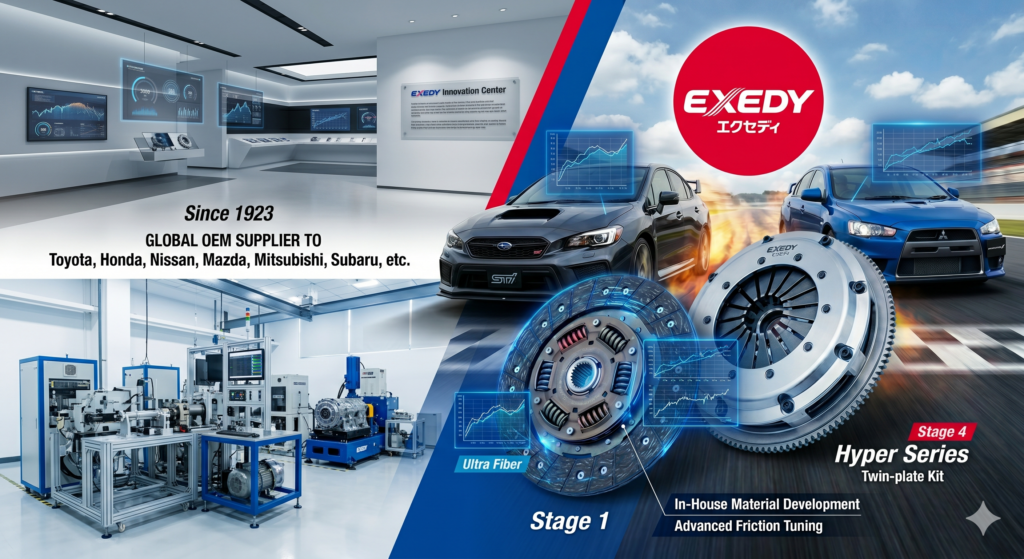
If ORC is the specialist, EXEDY is the titan. Founded in 1923 as Daikin Clutch and rebranded as EXEDY in 1996, this Osaka-based company is one of the largest clutch manufacturers on the planet — and one of the most consequential for anyone building a Japanese performance car. EXEDY is an OEM supplier to Toyota, Honda, Nissan, Mazda, Mitsubishi, and Subaru, among others, meaning there’s a strong chance an EXEDY unit was already in your car when it rolled off the assembly line. Their performance aftermarket builds on that same manufacturing foundation, which is why their quality-to-price ratio is consistently exceptional. Explore the full racing lineup on the EXEDY Racing Clutch official site.
What makes EXEDY remarkable isn’t just scale — it’s their commitment to developing their own materials from scratch. Their Ultra Fiber disc material is engineered and tested in-house, resulting in friction characteristics that are carefully tuned for each vehicle application rather than generic. Their patented disc spring dampers — the center section of the clutch disc that absorbs engine vibration — are designed to suppress drivetrain noise and protect transmissions from shock torque, a critical feature for high-boost turbo builds where power spikes can be violent.
The EXEDY performance lineup is organized by stage: from Stage 1 (OEM-quality replacement with improved durability) through Stage 4 (full race, twin/triple plate) and the dedicated Hyper Series for high-power builds. The Safari Tuff line addresses off-road and 4WD applications. EXEDY products are also stocked by regional distributors in many countries, though ordering direct from Japan via Discovery Japan Mall often provides access to Japan-market-only specifications.
For the majority of enthusiasts building JDM-platform cars — an EVO, an STI, a 350Z, an S2000 — EXEDY is the first name to reach for. The breadth of fitment coverage, the reliability of the OEM-grade manufacturing, and the clear stage progression make it the most accessible entry point into serious Japanese performance clutch upgrades.
Browse EXEDY clutch parts on Discovery Japan Mall →
Brand #3 – HKS (エッチ・ケー・エス)
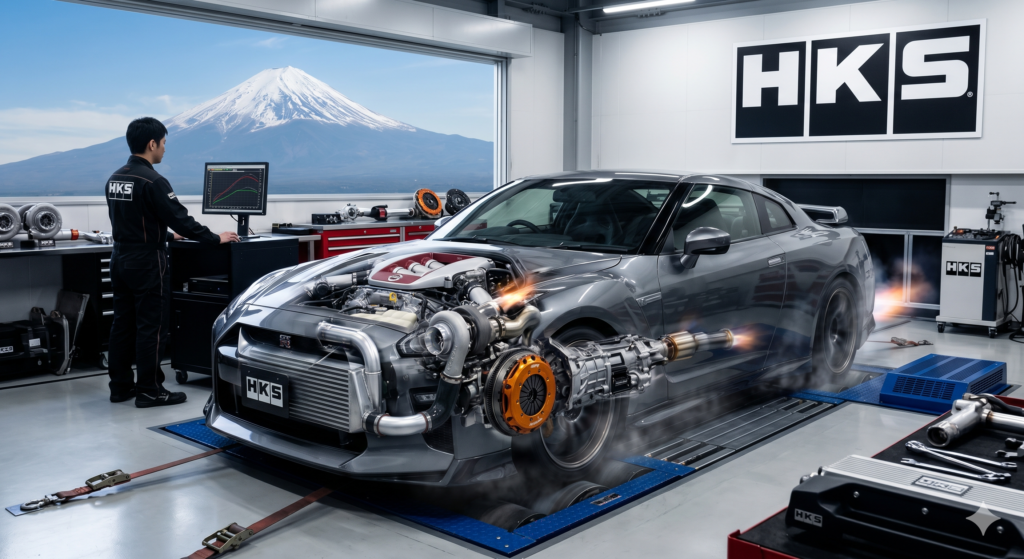
In October 1973, two engineers — Hiroyuki Hasegawa (a former Yamaha engineer) and Goichi Kitagawa — started a company in a dairy-farming shed at the foot of Mount Fuji with a simple and audacious goal: build performance parts that major OEM manufacturers could not, or would not, produce. The company’s name, HKS, came from the initials of its founders and their early financial backer, Sigma Automotive. Within a year, Hasegawa had designed Japan’s first aftermarket turbocharger for a passenger car. He never looked back.
Today HKS is one of the most widely recognized names in the global JDM aftermarket — known for turbo kits, exhaust systems, electronic boost controllers, and suspension. But their powertrain division produces a clutch line that is specifically engineered to complement HKS’s own turbo and engine upgrade ecosystem, and this context matters considerably. When you’re running an HKS turbo kit that pushes your GT-R or Supra to 600hp+, the clutch that works best isn’t a generic high-clamp unit — it’s one that was developed with exactly those power characteristics in mind. You can see the full powertrain lineup on the HKS official website.
The HKS clutch lineup centers on the LA Clutch Series. The LA Clutch Single is a single-plate unit for street and sport use, offering meaningfully improved torque capacity and shift feel over OEM without sacrificing daily driveability. The LA Clutch Twin steps up to twin-plate territory, rated for approximately 700ps, and is where HKS’s most significant engineering innovations are concentrated.
The key differentiators are the MG Composite Disc material — a proprietary friction compound that reduces the judder (vibration at low-speed engagement) that plagues many high-clamp clutches — and the Pivot Ring, a unique component integrated into the pressure plate that preserves the progressive partial-engagement feel of a single-plate clutch even in a twin-plate setup. This means you can modulate the clutch smoothly in traffic, on a slope, or during a slow-speed drift entry — a genuine engineering achievement in the twin-plate category. The lightweight diaphragm spring design further keeps pedal effort manageable despite high clamping loads.
Browse Japanese clutch parts on Discovery Japan Mall →
Brand #4 – OS Giken (オーエスギケン)
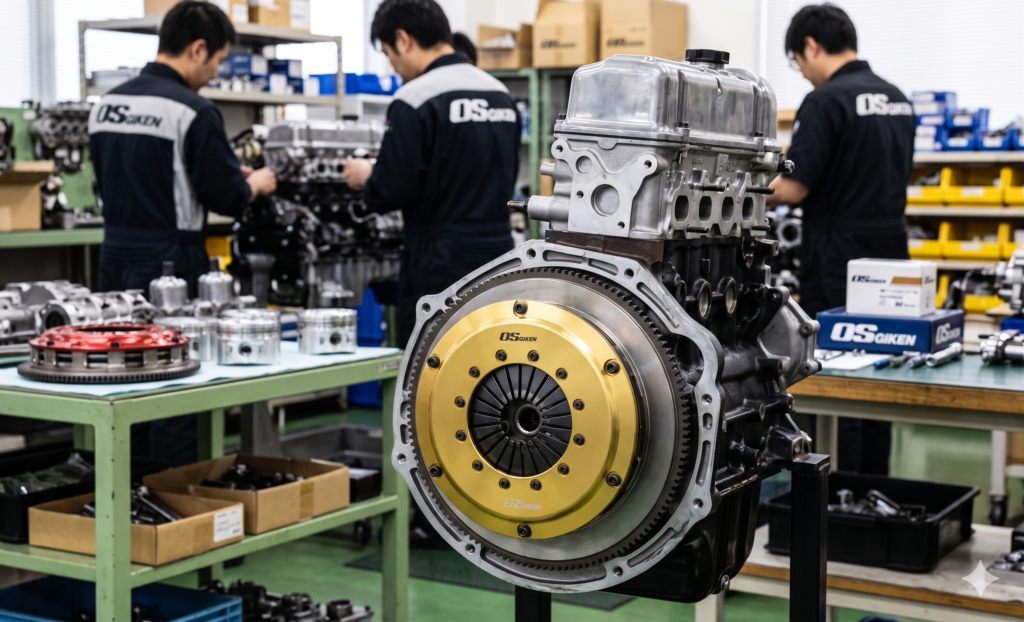
Some of the best engineering in the world comes from necessity. In the early 1970s, a machinist and racing enthusiast named Yukinori Okazaki was building race engines in Okayama — powerful enough that no available clutch on the market could handle the torque his motors were producing. Rather than settle for a compromise, Okazaki designed his own. That problem-solving instinct became the founding philosophy of OS Giken (Okayama Seisakusho, established 1974), and the clutch line that debuted in 1983 reflected a radical departure from conventional design thinking.
OS Giken clutches are distinguished by their philosophy of doing more with less. Where most manufacturers respond to higher torque demands by increasing disc diameter and adding more clamping force, OS Giken went the opposite direction: smaller diameter discs, lighter assembly weight, and a focus on reducing rotational inertia. The result is a clutch that rev-matches faster, shifts quicker, and puts less stress on the transmission — because there’s simply less mass spinning in the drivetrain. The billet aluminum covers further reduce weight without compromising rigidity. You can learn more at OS Giken USA.
The product lineup includes the TC Series (twin-plate, the core performance line), the STR Series, and the TS Series for specific applications. OS Giken has built an almost cult-like following in the time attack and circuit racing communities — their clutches appear in a remarkable number of record-setting lap times at Tsukuba Circuit and Fuji Speedway, where reducing drivetrain inertia pays measurable dividends in corner exit acceleration and rev response.
It’s worth noting that OS Giken is not a one-product company. The same engineering philosophy that produced their clutches also gave rise to the well-regarded OS Super Lock LSD — recognized among enthusiasts as a highly capable limited-slip differential for Japanese sports cars — as well as close-ratio gear kits and sequential gearboxes. Buying an OS Giken clutch puts you in the ecosystem of one of the most technically focused drivetrain specialists in Japan.
Browse OS Giken clutch parts on Discovery Japan Mall →
Brand #5 – ATS (エーティーエス)
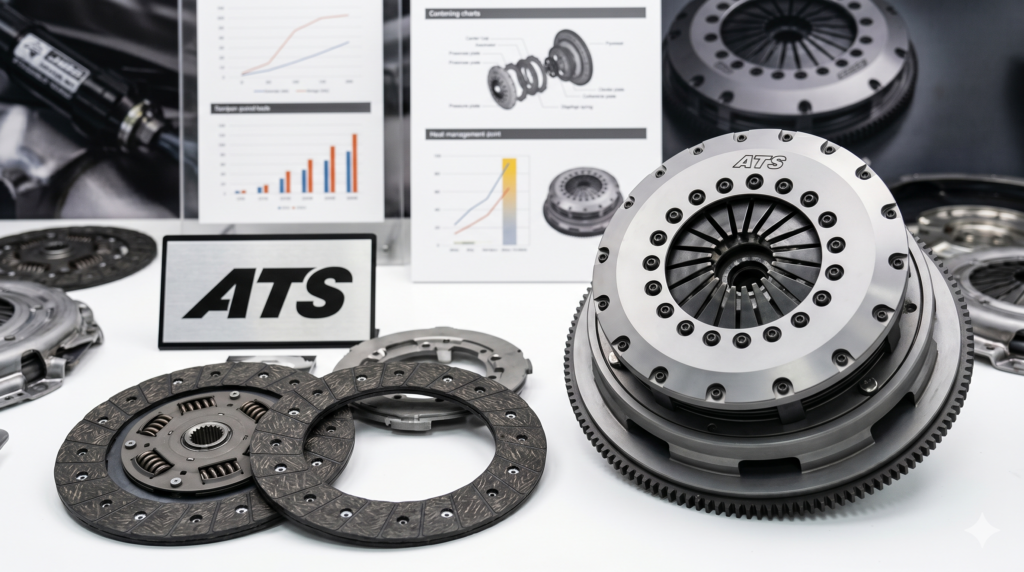
Carbon fiber clutch discs sound like an obvious idea in retrospect — carbon is lighter than steel, handles heat better, and has a high friction coefficient. The problem is that carbon is also brutally unforgiving in engagement: conventional carbon clutches either grip or they don’t, with almost no progressive feel in between, making them genuinely dangerous to use on public roads. For decades, carbon clutches were strictly for professional racing, full stop.
ATS (Active Traction Service), founded in 1986 in Kyoto, changed that. Through years of materials research, ATS developed an original disc manufacturing method they call non-mesh random-weaving — a way of layering carbon fiber that produces a disc with genuinely progressive engagement characteristics. The result was the first carbon clutch that a skilled driver could actually use in normal traffic without stalling on every hill start. You can browse the full ATS clutch lineup to see the range for yourself.
The numbers behind ATS discs are extraordinary. Each carbon disc weighs only 400 grams — compared to 1–2kg for a comparable metal disc — which produces a measurable reduction in drivetrain inertia and a noticeably quicker engine rev response. Heat resistance reaches 2,000°C, making ATS discs highly resistant to the kind of thermal degradation that destroys conventional clutches under sustained circuit use. And durability is quoted at over three times that of a comparable metal disc.
The ATS lineup progresses from the Carbon Twin Spec I (up to 650hp, progressive street-friendly engagement) through the Carbon Twin Spec II (up to 800hp) and the Carbon Triple (up to 1,500hp for maximum-effort builds). Their unique Double Action Pull Type design uses long and short release arms that create a two-step movement when the pedal is pressed — first fully disengaging the clutch, then controlling the half-clutch range — which makes high-clamp race setups dramatically easier to modulate at low speed. ATS clutches are particularly popular on RX-7, GT-R, and Supra builds, as well as any high-power rotary application where heat management is critical.
Browse Japanese clutch parts on Discovery Japan Mall →
Brand Comparison: Which Japanese Clutch Brand Is Right for You?
| Brand | Founded | Known For | Entry Product | Top-End Product | Best For | Browse on DJM |
|---|---|---|---|---|---|---|
| ORC | 1938 / Racing div. 1998 | Super GT & D1GP heritage, cushioning plate tech | Light Series (street) | Racing Concept / Triple 1,000hp+ | Drift & circuit racers wanting street-usable high capacity | Shop → |
| EXEDY | 1923 | OEM-grade quality, widest fitment coverage | Stage 1 OEM Replacement | Hyper Series Twin / Triple | Street builds to serious track use; best all-rounder | Shop → |
| HKS | 1973 | MG Composite Disc, turbo-platform engineering | LA Clutch Single | LA Clutch Twin (~700ps) | Turbo builds (GT-R, Supra, EVO); HKS ecosystem users | Shop → |
| OS Giken | 1974 / Clutch 1983 | Low inertia philosophy, time attack cult classic | TC Series Twin | STR / TS Series | Time attack & circuit; engineers and lap-time chasers | Shop → |
| ATS | 1986 | Carbon disc pioneer, Double Action mechanism | Carbon Twin Spec I (650hp) | Carbon Triple (1,500hp) | High-power rotary & turbo builds; heat-critical applications | Shop → |
How to Order Japanese Clutch Parts from Anywhere in the World
The good news for enthusiasts everywhere is that ordering authentic Japanese performance clutch parts from Japan has never been easier. Cross-border e-commerce has eliminated most of the friction that once made direct importing complicated, and retailers like Discovery Japan Mall handle the logistics, customs documentation, and international shipping so you don’t have to.
Here’s what to know before you order:
- Confirm your vehicle specification before ordering: Japanese-market cars often have different transmission variants from their export-market equivalents. Before purchasing, verify whether your car is push-type or pull-type clutch, confirm the flywheel bolt pattern, and check whether you need an updated release bearing or fork. Reputable sellers will specify compatibility details; if they don’t, ask before buying.
- Japan-spec only parts: Some clutch kits — particularly from OS Giken, ORC, and ATS — are manufactured specifically for Japanese domestic market (JDM) vehicles. If you’re running a JDM-spec engine swap (RB26, 2JZ, 4G63T), this is actually an advantage: you’ll have access to the full Japan-market fitment range rather than being limited to what local distributors stock.
- Shipping time and costs: Most Japanese automotive parts ship via EMS, FedEx, or DHL and arrive worldwide within 7–14 business days depending on destination. Clutch kits are moderately heavy; shipping costs vary by weight and destination but are typically included in the listed price at established retailers. Customs duties vary by country — check your local import regulations for automotive parts.
- Authenticity: Buy from established retailers with clear sourcing. Counterfeit performance clutch parts do exist, particularly for popular EXEDY fitments. Discovery Japan Mall sources directly from Japanese distributors and manufacturers, so authenticity is not a concern.
- Installation: Performance clutch installation requires proper tools and experience. If you’re not comfortable doing the job yourself, have the clutch fitted by a shop familiar with your platform. Some twin and triple plate clutches also require a matching lightweight flywheel, which may need to be ordered separately.
For the latest news and product releases from the brands covered here, the global JDM media community at Speedhunters covers Japanese motorsport and performance culture in depth and is a great companion resource for understanding how these brands perform in real-world competition.
Frequently Asked Questions (FAQ)
What is the best Japanese clutch brand for street use?
The best Japanese clutch brand for street use is generally EXEDY for most drivers, thanks to their Stage 1 and Stage 2 kits that improve durability and torque capacity while preserving OEM-level pedal feel and driveability. HKS’s LA Clutch Single is also an excellent street option for turbocharged platforms specifically. Browse EXEDY clutch kits on Discovery Japan Mall to find the right fitment for your car.
What is the difference between a single-plate and multi-plate clutch?
A single-plate clutch uses one clutch disc between the flywheel and pressure plate, providing smooth, progressive engagement suitable for street use. A multi-plate clutch (twin or triple) uses two or three discs, increasing torque capacity and reducing drivetrain inertia, but with a more abrupt engagement point. Multi-plate units are ideal for track, drift, and drag use where high horsepower and fast shifts matter more than everyday comfort.
Are Japanese clutch brands better than European brands?
Japanese clutch brands are considered by many performance enthusiasts to be superior for JDM platform applications — particularly turbocharged Japanese engines — because they were engineered specifically for those vehicles’ torque characteristics and power delivery. European brands like Sachs and AP Racing excel in Formula-based and European touring car applications. For a GT-R, Supra, EVO, or STI build, the best Japanese clutch brands are generally better matched to those platforms than equivalent European products, having been engineered specifically for their power and torque characteristics.
Can I order Japanese clutch parts from outside Japan?
Yes, you can order authentic Japanese clutch parts from anywhere in the world through cross-border e-commerce retailers. Discovery Japan Mall ships performance clutch parts from Japan to customers globally, typically arriving within 7–14 business days depending on destination. For Japan-exclusive specifications — particularly for JDM-spec engine swaps — ordering directly from Japan gives you access to fitments that local distributors often don’t stock.
What clutch should I use for a 500hp+ build?
For a 500hp+ build, a twin-plate Japanese performance clutch is the recommended minimum. EXEDY’s Hyper Twin, ORC’s Carbon Series twin, or HKS’s LA Clutch Twin are all appropriate starting points depending on your platform and use case. If the car is primarily street-driven, prioritize a unit with progressive half-clutch behavior. For track-only builds above 800hp, ATS Carbon Twin Spec II or a triple-plate from ORC or ATS is the correct choice.
Is a carbon clutch streetable?
A carbon clutch is streetable if it uses advanced disc manufacturing technology — particularly ATS’s non-mesh random-weaving method. Conventional carbon clutches have extremely abrupt engagement that makes slow-speed driving extremely difficult. ATS Carbon Twin units are specifically engineered to provide progressive pedal feel and manageable half clutch behavior in traffic, making them one of the few carbon options genuinely suitable for daily or performance street driving.
What does OEM replacement vs. performance clutch mean?
An OEM replacement clutch is a like-for-like substitute for the factory unit — same engagement feel, same torque capacity, but fresher materials. A performance clutch uses upgraded clutch disc materials, higher clamping force, and sometimes a revised pressure plate design to handle more torque and abuse than the original. The difference matters most when your engine has been modified beyond factory output — at that point, an OEM replacement will slip or wear prematurely under load.
Do I need a new flywheel when upgrading to a twin-plate clutch?
In most cases, yes. Twin-plate and triple-plate clutch kits from Japanese clutch brands like OS Giken, ORC, and ATS are typically sold as complete kits including a matched lightweight flywheel. The flywheel is integral to the clutch geometry and cannot be substituted with the factory unit in most multi-plate setups. Budget for the flywheel as part of the total upgrade cost — it also provides the additional benefit of reduced rotational mass and quicker engine response.
Final Thoughts: Upgrade Your Clutch, Upgrade Your Drive
The clutch is the most intimate connection between driver and drivetrain — the component that translates every input, every launch, every downshift into mechanical reality. It’s also one of the most consequential upgrades you can make to a performance car, and one of the most frequently underestimated. A properly matched Japanese performance clutch doesn’t just handle more power — it transforms how the car communicates with you, sharpens your inputs, and in the case of the best carbon and multi-plate options, genuinely changes what the car is capable of at the limit.
The five Japanese clutch brands covered in this guide — ORC, EXEDY, HKS, OS Giken, and ATS — each represent a distinct philosophy and target a distinct type of driver. EXEDY for the enthusiast who wants OEM-grade quality with a meaningful performance step. ORC for the motorsport devotee who wants competition-proven technology in a street-usable package. HKS for the turbo builder who wants every component to work as a system. OS Giken for the time-attack devotee who believes in the physics of less weight and less inertia. ATS for the builder who wants carbon technology without sacrificing the ability to drive to the circuit under their own power.
All of them are available to enthusiasts worldwide right now, shipped directly from Japan. You don’t need to know someone who knows someone in Osaka. You just need to know where to look.
Comments