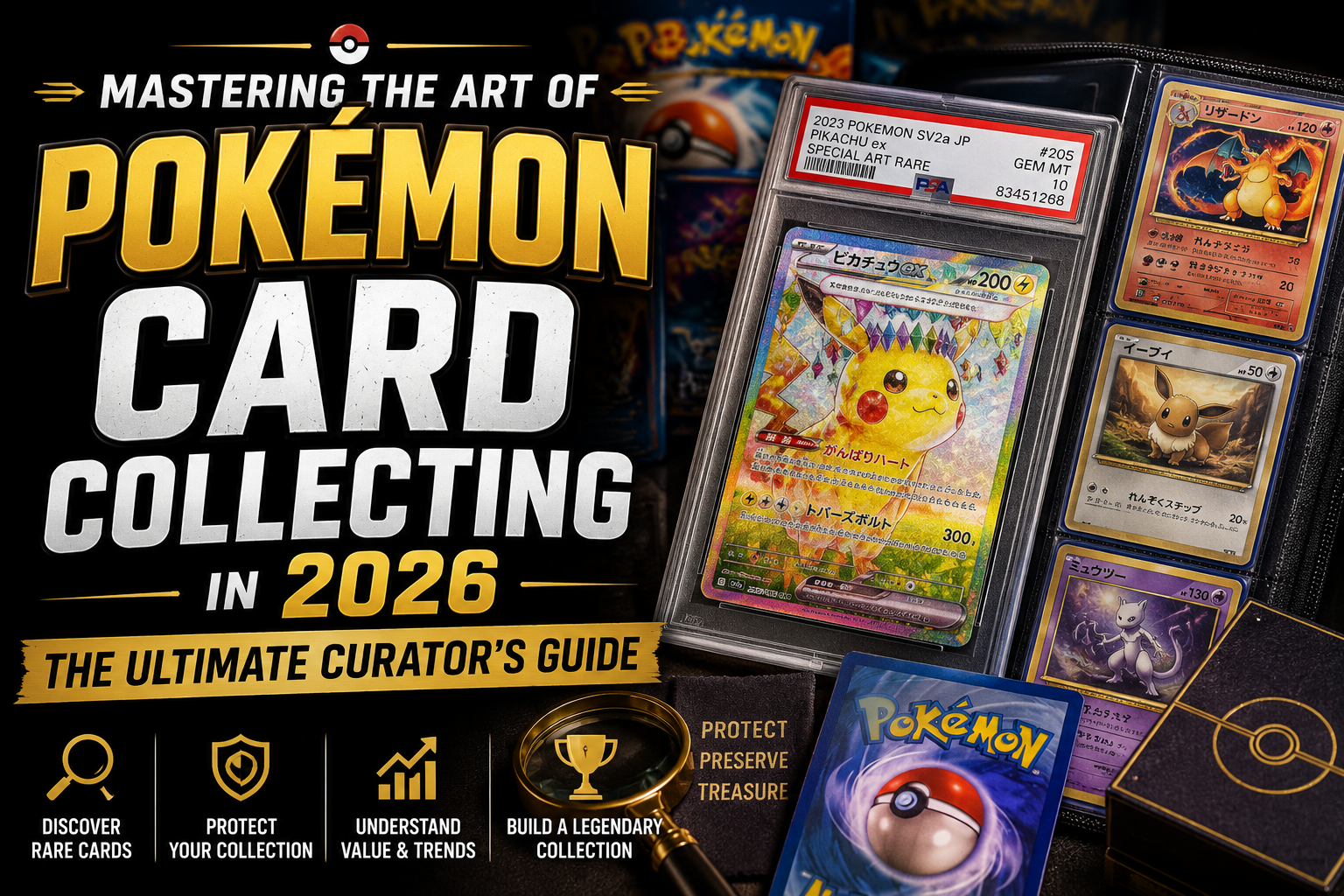
Many fans find themselves drawn back to the world of Pokémon, only to realize the hobby has grown into a complex global market. If you want to know how to navigate this space without wasting resources, you need a plan.
When someone starts collecting Pokémon cards, they often feel overwhelmed by the massive amount of information out there. It is a common trap to start buying and acquiring cards without any real sense or logic, spending money unnecessarily along the way. This often leads to regret and can even cause people to give up on the hobby entirely before they have really started.
But what if you approached your collection like a curator rather than just a consumer?
Collecting should be something you enjoy, or else you will eventually abandon it. To make it last, you need structure and routines. This guide is designed to help you move beyond the “Gotta Catch ‘Em All” mentality and show you how to collect Pokémon cards effectively in 2026. Whether you are a returning fan or a complete newcomer, these strategies will help you build a collection with a unique identity and lasting value.
- What does it mean to collect Pokémon cards effectively?
- The “one month rule”: Why you should study before you buy
- Establishing your collection’s identity and finding your niche
- Mastering the logistics: Protection and tracking
- Sourcing from the source: Why Japanese Pokémon cards are a master’s choice
- Mastering your journey as a Pokémon collector
- Frequently Asked Questions
- What is the first step in learning how to collect Pokémon cards effectively?
- How does the “one month rule” help you collect Pokémon cards effectively?
- Why is card protection so important when learning how to collect Pokémon cards effectively?
- Can professional grading help you collect Pokémon cards effectively?
- Is sourcing Japanese cards part of how to collect Pokémon cards effectively?
What does it mean to collect Pokémon cards effectively?
Effective collecting is the difference between owning a pile of cards and curating a museum-quality collection. In the early days of the hobby, most people just wanted to fill a binder with every card in a set. While that is still a valid goal, the landscape has changed. Today, there are tens of thousands of unique cards, multiple languages, and a complex market of graded vs. ungraded items.
How to collect Pokémon cards effectively starts with understanding your specific interests. If you try to buy everything, you will likely end up with a random assortment that lacks meaning. Instead, master collectors focus on niches.
Here are the primary styles used to build a collection with intent:
- Master set collecting: This involves gathering every single card in a specific expansion, from the commons to the rarest secret rares.
- Species collecting: You focus on a specific Pokémon, like Charizard or Pikachu. Some collectors aim for every single version of that Pokémon ever printed.
- Era or gimmick collecting: You might target the vintage Wizards of the Coast (WotC) era or look for specific card types like Gold Star or Crystal cards.
- Sealed collecting: This approach focuses on keeping products in their original packaging. Sealed booster boxes and Elite Trainer Boxes (ETBs) often double as great display pieces and investment items.
The “one month rule”: Why you should study before you buy
If you want to know how to collect Pokémon cards effectively, the first thing you should do is put your wallet aside. It sounds counterintuitive, but the first 2-4 weeks of your journey should be dedicated solely to studying the hobby. This initial moment of excitement is when it is easiest to make costly mistakes.
You will see “shiny objects” everywhere. YouTubers will talk about the next big card, and marketplaces will show you countdown timers for limited releases. It is easy to feel like you want it all. But by pausing, you allow the mere exposure effect to wear off. This psychological bias makes us prefer things just because we see them often. By waiting, you can tell if you actually love a card or if you are just caught up in the marketing hype.
This discipline is also your best defense against FOMO (Fear Of Missing Out). The Pokémon Company releases several main sets every year. When a new product first drops, prices often skyrocket due to initial demand. In reality, waiting a few weeks or months after a release usually allows prices to stabilize. This ensures you are not overpaying for cards that will be cheaper later.
Establishing your collection’s identity and finding your niche
Every collection should have what experienced collectors call a collection identity. This means your collection should feel homogeneous and uniquely yours. It should be a reflection of what brings you the most happiness.
Start by asking yourself: What do I want to see when I open my binder in 5 or 10 years?
Setting realistic goals is vital. If your annual income is $30,000 and you set a goal that costs $200,000, you are setting yourself up for frustration. Effective collecting means choosing attainable objectives that keep you motivated.
For many, this means finding a niche. While everyone chases the same high-value Charizards, you might find more joy in collecting cards by a specific artist or focusing on a less popular species. These niche paths are often more budget-friendly and allow you to build a complete, impressive set without competing with the entire global market.
Mastering the logistics: Protection and tracking
In the world of Pokémon cards, condition is everything. A single scratch or a bent corner can drop the value of a card by 50% or more. If you want to know how to collect Pokémon cards effectively, you must master the logistics of protection.
Professional collectors use a “triple-threat” approach to protection:
- Sleeves: Every valuable card should go into a penny sleeve immediately. These soft plastic sleeves prevent surface scratches.
- Binders: Use a side-loading binder with an elastic strap. Avoid top-loading ring binders, as the rings can “dent” the cards over time.
- Environment: Keep your collection away from direct sunlight and high humidity. High moisture can cause holographic cards to warp or “curl” [Source: https://www.elitefourum.com/t/guide-how-to-collect-pokemon-tcg/41982].
Step-by-step: How to submit cards for professional grading
Professional grading is the process of having a third-party company, like PSA (Professional Sports Authenticator), verify the authenticity and condition of your card. A high grade can significantly increase a card’s value and provides the best physical protection.
Here is how the process works:
- Prepare your card: Place the card in a soft “penny” sleeve and then into a semi-rigid card holder. Do not use toploaders for shipping to PSA as they are harder to remove cards from during processing.
- Complete the submission form: Log into your PSA account and fill out the online submission form. You will need to declare the value of each card for insurance purposes.
- Choose a service level: Select the tier that matches your card’s value and your desired turnaround time.
- Secure shipping: Pack your cards carefully between cardboard and bubble wrap inside a sturdy box. Ship them with tracking and insurance.
Understanding grading costs and value
The price of grading depends on the “declared value” of your card and how fast you want it back. Here is a breakdown of common PSA pricing tiers:
| Plan | Price (per card) | Max Insured Value | Est. Turnaround |
|---|---|---|---|
| Value Bulk | $24.99 | $500 | 95 Business Days |
| Value | $32.99 | $500 | 75 Business Days |
| Value Plus | $49.99 | $500 | 45 Business Days |
| Regular | $79.99 | $1,500 | 25 Business Days |
| Express | $149.00 | $2,500 | 20 Business Days |
For your rarest centerpieces, you can even opt for “Walk-Through” service at $599 per card for a 7-day turnaround.
Sourcing from the source: Why Japanese Pokémon cards are a master’s choice
Many serious collectors eventually turn their attention to Japanese cards. There are several reasons for this. First, the print quality of Japanese cards is often superior to their English counterparts, with better centering and more vibrant holographic patterns. Second, there are many unique Japanese-exclusive promos that never see an English release.
At Discovery Japan Mall, we specialize in providing access to these authentic, “made in Japan” products. Since we are based in Saitama, Japan, we have direct access to the latest expansions and limited-edition items that are difficult to find elsewhere.
If you are hunting for something truly rare that isn’t on our main store, our Marketplace proxy purchase service can help. We can help you navigate Japanese marketplaces to find that specific vintage card or limited-edition binder you need to complete your set.
While you are building your collection, you might also want to explore other high-quality Japanese hobbies. For example, our customers often enjoy the Bandai ONE PIECE Card Game, which features similarly impressive artwork and strategic depth. You can also find the latest tech for your collection, like the Pokémon GO Plus +, which helps you bridge the gap between physical and digital collecting.
Check out our new arrivals to see the latest sets from the Pokémon Trading Card Game.

As shown in the video, the most effective collectors are those who prioritize a long-term strategy over short-term hype. By following a strategic method, you can build a collection that you will be proud of for decades.
Mastering your journey as a Pokémon collector
Ultimately, there is no right or wrong way to collect Pokémon cards. The most effective way to collect is the one that makes you happy and fits within your life. Whether you are aiming for a full set of graded Base Set holos or just want to find every card of your favorite Pokémon, the joy is in the journey.
We are here to help you find the gems you’ve been looking for. Take your time, protect your investments, and most importantly, have fun building a collection that reflects your passion for the world of Pokémon.
Frequently Asked Questions
What is the first step in learning how to collect Pokémon cards effectively?
The first step is to establish your collecting goals and identity. Instead of buying every card you see, decide on a specific niche such as a favorite Pokémon species or a particular era and stick to it to build a more meaningful collection.
How does the “one month rule” help you collect Pokémon cards effectively?
The “one month rule” suggests putting your wallet aside for 2-4 weeks when you first start. This time allows you to study the hobby, learn about card values, and avoid making impulsive purchases driven by initial excitement or marketing hype.
Why is card protection so important when learning how to collect Pokémon cards effectively?
In collecting, card condition determines value. Effective collectors use penny sleeves and side-loading binders to protect cards from scratches and surface wear, and they keep their collections away from sunlight and humidity to prevent fading or warping.
Can professional grading help you collect Pokémon cards effectively?
Yes, professional grading by companies like PSA provides an objective assessment of a card’s condition. This can protect the card’s physical state in a sonically sealed case and significantly increase its market value if it achieves a high grade.
Is sourcing Japanese cards part of how to collect Pokémon cards effectively?
Many master collectors include Japanese cards in their strategy because they often feature superior print quality and unique artwork not found in English releases. Sourcing directly from Japan can also give you access to rare promos and limited sets.

Comments