Find the perfect reel to match your fishing style and target species!
1. Spinning Reels
Spinning reels are the most popular and versatile choice for anglers of all skill levels, especially beginners. They feature an open-face design with a spool that remains stationary while a line guide (bail) rotates around it to wind the line.
Pros: Easy to use, excellent for casting lightweight lures and baits, and virtually free of “backlash” (line tangles).
Cons: Less line control during the cast compared to baitcasting reels, and less twisting resistance under extremely heavy loads.
Key Parts of a Fishing Reel
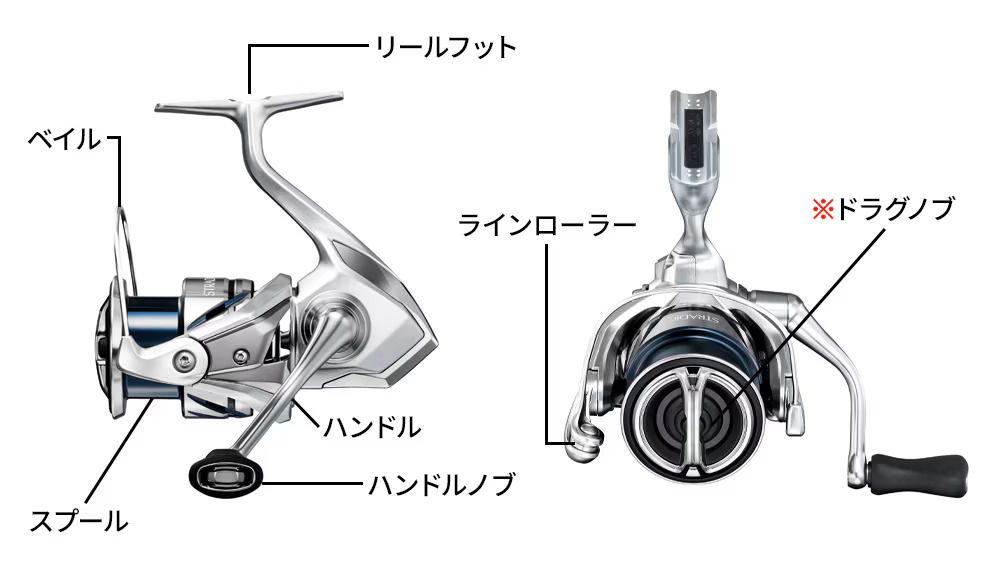
- Spool: Holds the fishing line.
- Bail: Flips open to cast, closes to retrieve.
- Reel Foot: The part attached to the rod’s reel seat.
- Line Roller: Guides the line smoothly onto the spool.
- Handle / Handle Knob: Turned to retrieve the line.
- Drag Knob: Adjusts the resistance when a fish pulls the line.
Understanding Spinning Reel Model Markings
When choosing a spinning reel, you will often see various letters attached to the model number (e.g., C3000HG, 2500S DH). These letters indicate specific spool types, handle configurations, and gear ratios. Use this reference to find the exact setup for your needs:
| Category | Code | Meaning & Specifications |
|---|---|---|
| Body Size | G | Standard Body |
| C | Compact Body (A smaller body frame paired with a larger spool size) | |
| Spool Type (S) | SSS | Special Super Shallow Spool |
| SS | Super Shallow Spool | |
| S | Shallow Spool | |
| M | Medium Deep Spool | |
| None | Standard Deep Spool | |
| Handle Type (DH) | None | Standard Single Handle |
| DH | Double Handle (Provides balanced rotation, highly preferred for Eging/Squid fishing) | |
| Gear Ratio (HG) | PG | Power Gear (Low gear ratio, maximum cranking power) |
| None | Normal Gear / Standard Speed | |
| HG | High Gear (Fast line retrieve) | |
| XG | Extra High Gear (Very fast line retrieve) | |
| XXG | Double Extra High Gear (Ultimate speed for specific techniques) |
2. Baitcasting Reels
Baitcasting reels sit on top of the rod and feature a rotating spool. They are highly favored by experienced anglers for their precision, accuracy, and power.
Pros: Superior casting accuracy, direct control over the line speed with your thumb, and stronger pulling power for heavy fish.
Cons: Requires practice to master. Improper thumbing of the spool can result in a bird’s nest (backlash).
Key Parts of a Baitcasting Reel
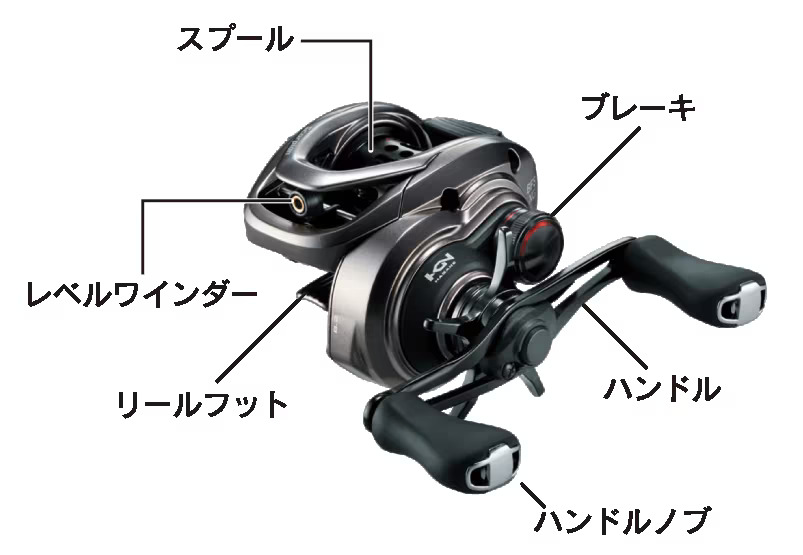
- Spool: Rotates during casting and retrieval.
- Level Winder: Guides the line evenly across the spool during retrieve.
- Reel Foot: Secures the reel to the top of the rod.
- Brake System: Controls spool speed to prevent backlash.
- Handle / Handle Knob: Turned to crank the line back in.
3. Electric Reels
Electric reels are specialized tools primarily used for deep-sea boat fishing. Powered by a battery, they automate the retrieval process, making it much easier to reel up heavy sinkers and large fish from extreme depths.
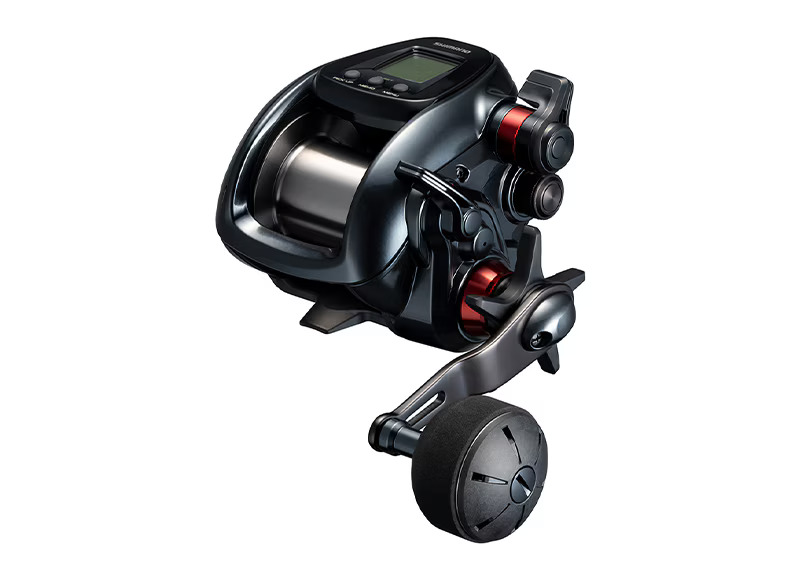
Electric Reel Size, Line Capacity, and Target Species Reference
Electric reels use a different sizing convention than standard spinning reels. Because they target heavy fish in deep water, matching the correct PE line rating (Go number) and spool capacity is critical. Below is the recommended chart for selecting your electric reel based on your target species:
| Model Size | Standard Line Capacity (PE Rating – Meters) | Recommended Target Species & Fishing Styles |
|---|---|---|
| 200 | PE 1 – 220m | Metal Sutte (Squid), Hairtail (Tachiuo) [Light Game], Japanese Horse Mackerel (Aji / Isaki) [Light Game] |
| 300 | PE 1.5 – 200m | Metal Sutte (Squid), Hairtail (Tachiuo), Sea Bream (Madai), Japanese Horse Mackerel (Aji / Isaki) [Light Game] |
| 600 | PE 2 – 300m | Hairtail (Tachiuo), Sea Bream (Madai), Japanese Horse Mackerel (Aji / Isaki), Flounder (Hirame), Inada / Hamachi (Young Yellowtail) |
| 800 | PE 3 – 300m | Hairtail (Tachiuo), Sea Bream (Madai), Japanese Horse Mackerel (Aji / Isaki), Flounder (Hirame), Inada / Hamachi (Young Yellowtail) |
| 1000 | PE 4 – 300m | Sea Bream (Madai), Japanese Horse Mackerel (Aji / Isaki), Flounder (Hirame), Inada / Hamachi (Young Yellowtail), Yellowtail / Amberjack (Buri / Hiramasa) |
| 2000 | PE 4 – 400m | Sea Bream (Madai), Flounder (Hirame), Yellowtail / Amberjack (Buri / Hiramasa), Common Squid, Mid-Deep Sea Game (Blackthroat Seaperch / Akamutsu) |
| 3000 | PE 6 – 300m | Sea Bream (Madai), Flounder (Hirame), Yellowtail / Amberjack (Buri / Hiramasa), Common Squid, Mid-Deep Sea Game (Blackthroat Seaperch / Akamutsu), Greater Amberjack (Kanpachi) |
| 4000 | PE 8 – 300m | Yellowtail / Amberjack (Buri / Hiramasa), Mid-Deep Sea Game (Blackthroat Seaperch / Akamutsu), Greater Amberjack (Kanpachi) |
| 6000 | PE 8 – 600m | Greater Amberjack (Kanpachi), Yellowfin Tuna (Kihada), Giant Grouper (Kue / Moroko / Ara) |
| 9000 | PE 8 – 900m | Greater Amberjack (Kanpachi), Yellowfin Tuna (Kihada), Giant Grouper (Kue / Moroko / Ara), Deep-sea Bottom Fishing (Splendid Alfonsino / Kinmedai / Akamutsu) |
| 12000 | PE 8 – 1200m | Yellowfin Tuna (Kihada), Giant Grouper (Kue / Moroko / Ara), Deep-sea Bottom Fishing (Splendid Alfonsino / Kinmedai / Barred Knifejaw) |
4. How to Choose the Right Reel Size
Reel sizes are typically indicated by numbers (e.g., 2500, 4000 for spinning; 100, 200 for baitcasting). The right size depends on your target fish species, the thickness/length of the line you need, and the required power level.
Reel Size and Body Size (Power) Comparison
This table shows how reel model numbers correspond to the overall body size and pulling power for both spinning and baitcasting reels.
| Spinning Reels | Baitcasting Reels | ||
|---|---|---|---|
| Model No. (Line Capacity) | Body Size (Power) | Model No. (Line Capacity) | Body Size (Power) |
| 500 | Ultra-Compact | 30 / 50 / 70 | Small |
| 1000 / C2000 | Small | – | |
| C2500 / 2500 / C3000 | Compact & Versatile (Small) | 100 / 150 | Versatile (Small) |
| 3000 / 4000 / C5000 | Versatile (Medium) | 200 | Versatile (Medium) |
| 5000 / 6000 | Medium | 300 / 400 | Versatile (Large) |
| 8000 / 10000 / 14000 | Large | 1000 / 1500 | Medium |
| – | – | 2000 / 3000 | Large |
| 18000 / 20000 / 30000 | Extra Large | 4000 | Extra Large |
Reel Size, Target Species, and Recommended Line Guidelines
Unlike electric reels, standard spinning and baitcasting reels do not have a single fixed line requirement. However, matching your reel size with the correct line rating is essential for smooth casting and preventing line trouble. Below is a foundational guideline combining target species with Japanese Line Classes (Gou) and pound-test (lb) equivalents:
| Reel Size | Main Target Species | Recommended Nylon / Fluorocarbon | Recommended PE (Braided) Line |
|---|---|---|---|
| 1000 – 2000 | Horse Mackerel (Aji), Rockfish (Mebaru), Trout, etc. | Gou #1 – #2.5 (approx. 4lb – 10lb) | Gou #0.3 – #0.8 (approx. 6lb – 15lb) |
| 2500 – 3000 | Black Bass, Eging (Squid), Seabass, etc. | Gou #2.5 – #4 (approx. 10lb – 16lb) | Gou #0.8 – #1.5 (approx. 12lb – 25lb) |
| 4000 – 5000 | Surf Flatfish (Flounder), Medium-sized Blue Runners, etc. | Gou #4 – #5 (approx. 16lb – 20lb) | Gou #1.5 – #2.5 (approx. 25lb – 40lb) |
| 6000 and above | Offshore Boat Fishing, Large-sized Blue Runners, etc. | Gou #6 and above (approx. 24lb+) | Gou #3 – #6 (approx. 40lb – 80lb) |
Comprehensive Spinning Reel Size & Target Compatibility Matrix
The matrix below provides an expert breakdown of small-to-large spinning reels and their ideal fishing style suitability. Use this to ensure your reel matches your specific target technique.
| Fishing Style / Target | 500 / 1000 | C2000 | C2500 | 2500 / C3000 | 3000 / 4000 / C5000 | 4000 / 5000 / 6000 | 8000 / 10000 / 14000 | 18000 to 30000 |
|---|---|---|---|---|---|---|---|---|
| Horse Mackerel (Aji) | Excellent (◎) | Excellent (◎) | Good (〇) | Good (〇) | – | – | – | – |
| Rockfish (Mebaru) | Excellent (◎) | Excellent (◎) | Good (〇) | Good (〇) | – | – | – | – |
| Area / Stream Trout | Excellent (◎) | Excellent (◎) | Excellent (◎) | Good (〇) | – | – | – | – |
| Black Bass (Finesse) | – | Good (〇) | Excellent (◎) | Good (〇) | – | – | – | – |
| Black Bass (Versatile) | – | – | Good (〇) | Excellent (◎) | Good (〇) | – | – | – |
| Eging (Squid Fishing) | – | – | Good (〇) | Excellent (◎) | Good (〇) | – | – | – |
| Seabass Game | – | – | – | Good (〇) | Excellent (◎) | Good (〇) | – | – |
| Seawall / Pier Fishing | – | – | Good (〇) | Excellent (◎) | Excellent (◎) | Good (〇) | – | – |
| Large Trout (Lake/River) | – | – | Good (〇) | Excellent (◎) | Excellent (◎) | Good (〇) | – | – |
| Super Light Jigging (SLJ) | – | – | – | Good (〇) | Excellent (◎) | Good (〇) | – | – |
| Flatfish (Flounder/Flathead) | – | – | – | Good (〇) | Excellent (◎) | Excellent (◎) | – | – |
| Light Jigging | – | – | – | – | Excellent (◎) | Excellent (◎) | Good (〇) | – |
| Light Shore Jigging | – | – | – | – | Excellent (◎) | Excellent (◎) | Good (〇) | – |
| Black-fin Seabass (Hirasuzuki) | – | – | – | – | Good (〇) | Excellent (◎) | Excellent (◎) | – |
| Shore Jigging (Standard) | – | – | – | – | Good (〇) | Excellent (◎) | Excellent (◎) | – |
| Rock Shore (Large Blue Runners) | – | – | – | – | – | Good (〇) | Excellent (◎) | Excellent (◎) |
| Offshore Jigging | – | – | – | – | – | Good (〇) | Excellent (◎) | Excellent (◎) |
| Offshore Casting (Tuna, GT, Amberjack) | – | – | – | – | – | – | Good (〇) | Excellent (◎) |

Comments