
Arashi is one of the most successful pop groups in Japanese music history. Formed in 1999 by Johnny & Associates (now STARTO ENTERTAINMENT), this five-member idol group redefined what it means to be a Japanese idol in the modern age, blurring the line between mainstream pop artist and multi-platform entertainer across music, television, film, and philanthropy. This article is intended for fans of Japanese pop music, followers of idol culture, and anyone interested in Arashi’s impact on entertainment. Arashi’s influence on Japanese pop culture and the global music scene makes their story essential for understanding the evolution of modern idols.
Arashi consists of five members: Satoshi Ohno, Sho Sakurai, Masaki Aiba, Kazunari Ninomiya, and Jun Matsumoto.
- Quick Overview of Arashi and Their Place in Japanese Idol Culture
- Arashi and Japanese Idol Culture
- Formation, Debut Single “A・RA・SHI,” and Early Years (1999–2001)
- Switch to J Storm, Innovative Staging, and Building a Core Fanbase (2002–2006)
- Breakthrough Hits and “Love so sweet”: Arashi’s National Boom (2007–2010)
- Major Albums, Tours, and International Activities in Asia
- Discography Highlights and Signature Music Videos
- Members’ Individual Careers and Impact on Idol Culture
- Hiatus, New Corporate Structure, and Documentary Projects (2019–2026)
- Arashi in the Wider Landscape of Japanese Idols and Future Legacy
Quick Overview of Arashi and Their Place in Japanese Idol Culture

Arashi (嵐, meaning “Storm”) is a five-member Japanese idol group formed in 1999 and widely regarded as one of the most successful acts in Japanese music history. Satoshi Ohno, Sho Sakurai, Masaki Aiba, Kazunari Ninomiya, and Jun Matsumoto sold more than 58.8 million records, performed 595 concerts for over 17 million fans, and dominated the Oricon charts for more than two decades. Their dual identity as idols and chart-topping J-pop artists also made them a constant presence across variety shows, TV dramas, commercials, films, and major dome tours, helping explain why Arashi remains central to discussions of fan culture and entertainment in Japan.
For fans of Japanese pop music, followers of idol culture, and readers tracing Arashi’s place in entertainment history, each member brought a distinct strength to the group:
- Satoshi Ohno – Leader, main dancer, visual artist
- Sho Sakurai – Rapper, newscaster, political commentator
- Masaki Aiba – Variety TV personality, animal show host
- Kazunari Ninomiya – Film and drama actor, including Hollywood projects
- Jun Matsumoto – Drama star, concert staging innovator
This article covers their full career arc—focusing on Arashi the group, not other public figures with the same name—from debut to hiatus starting in 2020 and their farewell tour concluding in 2026, along with discography highlights, solo and cross-media activities, philanthropy, their role in Japanese idol culture, international reach, and the legacy they left on the entertainment industry.
| Key Fact | Detail |
|---|---|
| Debut | September 15, 1999 (Honolulu, Hawaii) |
| Agency | Johnny & Associates → STARTO ENTERTAINMENT |
| Signature Songs | “A・RA・SHI,” “Love so sweet,” “Happiness,” “Truth” |
| Major Tours | 5×10, 5×20, Arashi Live Tour series |
| Total Sales | 58.8 million+ copies |
Arashi and Japanese Idol Culture
Japanese idol culture centers on the concept of “growth you can support”-fans follow artists from their early days and invest emotionally in their development through voting, cheering, and attending handshake events. Idol culture generates approximately $1 billion annually in Japan, and idols appear in 50–70% of commercials broadcast nationwide. Johnny Kitagawa founded Johnny & Associates in 1962, establishing the first talent agency dedicated to male idols and shaping the blueprint that would produce groups like Arashi decades later.
Within this ecosystem, idol groups range from local idols performing in small venues to mainstream idols known as Chijo Idols, while underground idol acts (Chika Idols) cultivate dedicated niche followings. Idol groups like AKB48, which debuted in 2005 and became Japan’s national idol group, operate under a “meet your idol” concept with audition programs and fan elections. By 2019, over 3,000 female idol groups existed in Japan, and the Tokyo Idol Festival attracted over 80,000 spectators in 2017, with over 200 idol groups performing. The term “Chidol” emerged in the mid-1990s for child idols, and in 2017, over 10,000 teenage girls performed as idols in Japan-evidence of how deeply idol activities are woven into the entertainment business.
Arashi distinguished themselves from both niche underground idol acts and female idols by projecting a warm, approachable national image. Idols are marketed to cultivate emotional connections with fans, and idol fan culture fosters strong community ties. Fans actively participate in idols’ development through voting and cheering. Arashi leveraged this dynamic while crossing into territory usually reserved for singer-songwriter acts and serious actors-setting a standard for how male idols could dominate across various genres of entertainment.

Formation, Debut Single “A・RA・SHI,” and Early Years (1999–2001)

On September 15, 1999, Johnny Kitagawa announced Arashi aboard a cruise ship off Honolulu, Hawaii, selecting five Johnny’s Jr. trainees to form a new unit. The name “Arashi” was chosen to symbolize creating a storm in the entertainment world. Their debut single “A・RA・SHI,” released November 3, 1999, served as the theme song for the FIVB Volleyball Men’s World Cup in Japan. It quickly reached No. 1 on the Oricon singles chart with 557,430 first-week sales and eventually sold nearly one million copies.
Their first studio album, Arashi No.1 Ichigou, released in January 2001, debuted at No. 1 with approximately 267,220 first-week sales and remained their best selling album for nearly a decade. That same year, they launched their first nationwide concert tour across 26 performances in cities including Tokyo, Osaka, Sendai, and Fukuoka. Early TV drama roles and variety appearances began linking individual members to broader Japanese television fandom, establishing a pattern where the group’s music and their individual entertainment careers reinforced each other.
- Debut: September 15, 1999 (Honolulu)
- First single: “A・RA・SHI” – ~1 million copies
- First album: January 2001 – No. 1 debut
- First tour: 26 shows across Japan (2001)
Switch to J Storm, Innovative Staging, and Building a Core Fanbase (2002–2006)
In 2002, Arashi moved to J Storm, a label created by Johnny & Associates specifically for the group. Their first release under the new label, “A Day in Our Life,” was a drama theme song that debuted at No. 1 with roughly 226,480 first-week sales. However, the mid-2000s brought a dip in physical single sales-“Pikanchi Double” in 2004 sold only about 89,106 copies in its first week, one of their lowest figures.
The band compensated through consistent live performances and creative innovation. In 2005, Jun Matsumoto spearheaded the “Johnny’s Moving Stage,” a transparent platform that carried performers over the audience in dome venues. Arashi’s live concerts became known for elaborate staging and large-scale attendance, and this innovation influenced concert production across the Japanese entertainment industry. Variety programs, drama roles, and TV show exposure-such as Matsumoto appearing in Kimi wa Petto-gradually raised their profile even as chart dominance remained elusive.
Breakthrough Hits and “Love so sweet”: Arashi’s National Boom (2007–2010)
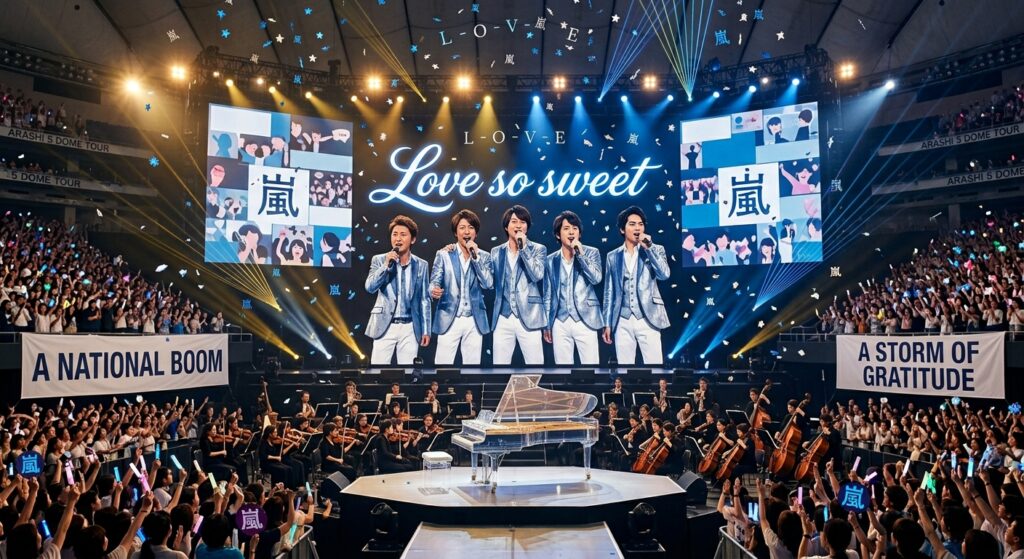
The turning point arrived in 2007 when “Love so sweet” became the theme for Hana Yori Dango 2, starring Jun Matsumoto.The single landed among the year’s top sellers and launched Arashi into the mainstream. Follow-up hits-“Happiness,” “One Love,” and “Truth/Kaze no Mukō e”-each saw first-week sales exceeding 300,000 copies. In 2008, Arashi became the first artist since 1989 to claim both the No. 1 and No. 2 positions on Oricon’s annual singles chart in the same year.
They achieved significant commercial success in the 2000s and 2010s, becoming Japan’s best-selling artist in both 2009 (¥14.46 billion in revenue) and 2010 (¥17.16 billion), and found success on both the charts and in the concert business. Their concert business generated exceptional revenue and fan engagement as they expanded to Tokyo Dome and launched the five-dome “Dream ‘A’ Live” tour. Their increasing presence as theme song providers for hit dramas cemented their status as the face of popular idol culture on Japanese television.
- “Love so sweet” (2007) – mainstream breakthrough
- “Truth/Kaze no Mukō e” + “One Love” – No. 1 and No. 2 annual singles (2008)
- Best-selling artist in Japan: 2009 and 2010 for consecutive years (a key year award marker in their career timeline)
Major Albums, Tours, and International Activities in Asia
Arashi’s international activities began taking shape with the 2006 album Arashic, their first released across multiple Asian territories including Hong Kong, South Korea, Taiwan, and Thailand. Their “Jet Storm” promotional trips saw the group visit Taiwan, Thailand, and South Korea in a single day for press events-an early model of Japanese idols engaging overseas media. They became the first Johnny’s group to hold individual concerts in South Korea, though a planned Bangkok concert was canceled due to political unrest.
Their anniversary tours grew in scale: the 5×10 tour in 2009–2010 and the massive 5×20 20th Anniversary Tour in 2019–2020, which drew approximately 2.43 million attendees across 50 dome shows. Their Arashi live tour productions set benchmarks for stage design and audience engagement that newer idol groups continue to reference.
- Arashic (2006) – first multi-territory Asian release
- “Jet Storm” – same-day visits to three countries
- 5×20 Tour – ~2.43 million total attendees
Discography Highlights and Signature Music Videos
Arashi released 17 studio albums during their active career, amassing over 400 released tracks across studio albums, compilations, and singles. Their music blends various genres including J-pop, hip-hop, and R&B. Key compilation albums like 5×10 All the BEST! 1999–2009 (~1.99 million copies) and 5×20 All the BEST!! 1999–2019 (~2.19 million copies) both crossed the million-copy threshold. Their 2019 compilation album was recognized as the global best selling album of that year.
Essential singles and albums include “A・RA・SHI,” “Love so sweet,” “Happiness,” “One Love,” “Truth,” “Calling/Breathless”, and the digital new song “Five.” Their music video style evolved from simple performance clips to large-scale narrative productions, standing in contrast with female idol groups like Perfume’s futurism or Momoiro Clover Z’s high-energy chaos. Concert DVDs and Blu-rays like the Arashi Live Tour 2013 LOVE and ARASHI LIVE TOUR 2017-2018 “untitled” consistently topped Oricon, with their Anniversary Tour full video release becoming the first male artist work to surpass one million units in cumulative video sales.
Members’ Individual Careers and Impact on Idol Culture

Each member carved out distinct entertainment careers beyond the group. Sho Sakurai became a newscaster on News Zero in 2006, covering Olympics broadcasts and election specials-an unprecedented role for a Japanese idol. His “Sakurap” style gave Arashi songs a distinctive lyrical identity. Kazunari Ninomiya earned international recognition through voice acting work and film roles including Clint Eastwood’s Letters from Iwo Jima, demonstrating that most idols can aspire to serious acting while maintaining idol status.
Satoshi Ohno’s Freestyle art exhibitions drew roughly 120,000 visitors, while Masaki Aiba became a beloved variety show and animal program host. Jun Matsumoto’s staging innovations and high-profile drama roles made him both a popular idol on screen and a behind-the-scenes creative force. Arashi made significant contributions to music, film, and advertisement in Japan; while some entertainers begin as a gravure idol before moving into acting or singing, Arashi expanded from the idol system through media work and performance, and their multi-field approach set expectations for how many idols-both male idols and female idols-now handle acting, media work, and stage plays alongside music.
Hiatus, New Corporate Structure, and Documentary Projects (2019–2026)
On January 27, 2019, Arashi announced that group activities would be suspended after December 31, 2020, using video to speak directly to fans on their official site. They launched a YouTube channel and released 16 studio albums and 256 songs to streaming platforms globally. The group paused their activities in 2020, concluding their active period with the Arashi 2020 online concert and “This Is Arashi” livestream.
COVID-19 disrupted planned international activities, but Arashi’s early adaptation to digital concerts influenced later idol live-stream formats. Their documentary Arashi’s Diary ~Voyage~ debuted worldwide on Netflix on December 31, 2019. In 2024, they established their own company, Arashi Inc., and signed a group agent contract with STARTO ENTERTAINMENT. The farewell tour ran through spring 2026, with the final concert on May 31, 2026, at Tokyo Dome. A new Amazon Prime Video documentary, 5: The Time Called Arashi, is slated for worldwide streaming from December 15, 2026. Across their career, they performed 595 concerts for more than 17 million audience members.
Arashi in the Wider Landscape of Japanese Idols and Future Legacy
Arashi’s model influenced the idol system and J-pop culture in Japan and across Asia. Compared to newer STARTO ENTERTAINMENT groups like Snow Man, King & Prince, and SixTONES-as well as influential girl group acts like Momoiro Clover Z (the most popular female idol group from 2013 to 2017) and Perfume-Arashi set the template for longevity, cross-media dominance, and controlled career transitions. New idols from audition programs now inherit expectations shaped by Arashi’s standard: professionalism, fan transparency, and willingness to embrace digital platforms. Arashi members expanded their influence through television appearances and variety shows that set benchmarks across the entertainment business for how both junior idols and established acts approach their careers.
Idols often participate in various entertainment forms beyond music-acting, hosting, voice actress work, appearing in photo books, and more. Idol groups can range from local to national levels, and many young girls and new genre performers continue entering the field each year. Arashi’s 27-year run demonstrated that an idol group can evolve alongside its audience, adapting from physical-only releases to global streaming without losing the emotional core that idol fans treasure. Idol culture fosters strong emotional ties between artist and audience, and Arashi exemplified that bond at the highest level.
- Set the template for multi-decade idol group careers
- Pioneered digital catalog releases among Japanese idols
- Influenced fan communication standards (transparent announcements, international content)
- Bridged traditional Japanese idol culture and contemporary global music fandom
Whether you’re a longtime fan or just beginning to explore J-pop, Arashi’s catalog remains one of the most rewarding deep dives in Japanese music. Browse authentic Arashi CDs, Blu-rays, and collectibles—including releases like Are you Happy? and 5×5 THE BEST SELECTION OF 2002←2004—at Discovery Japan Mall and experience the storm for yourself.


Comments