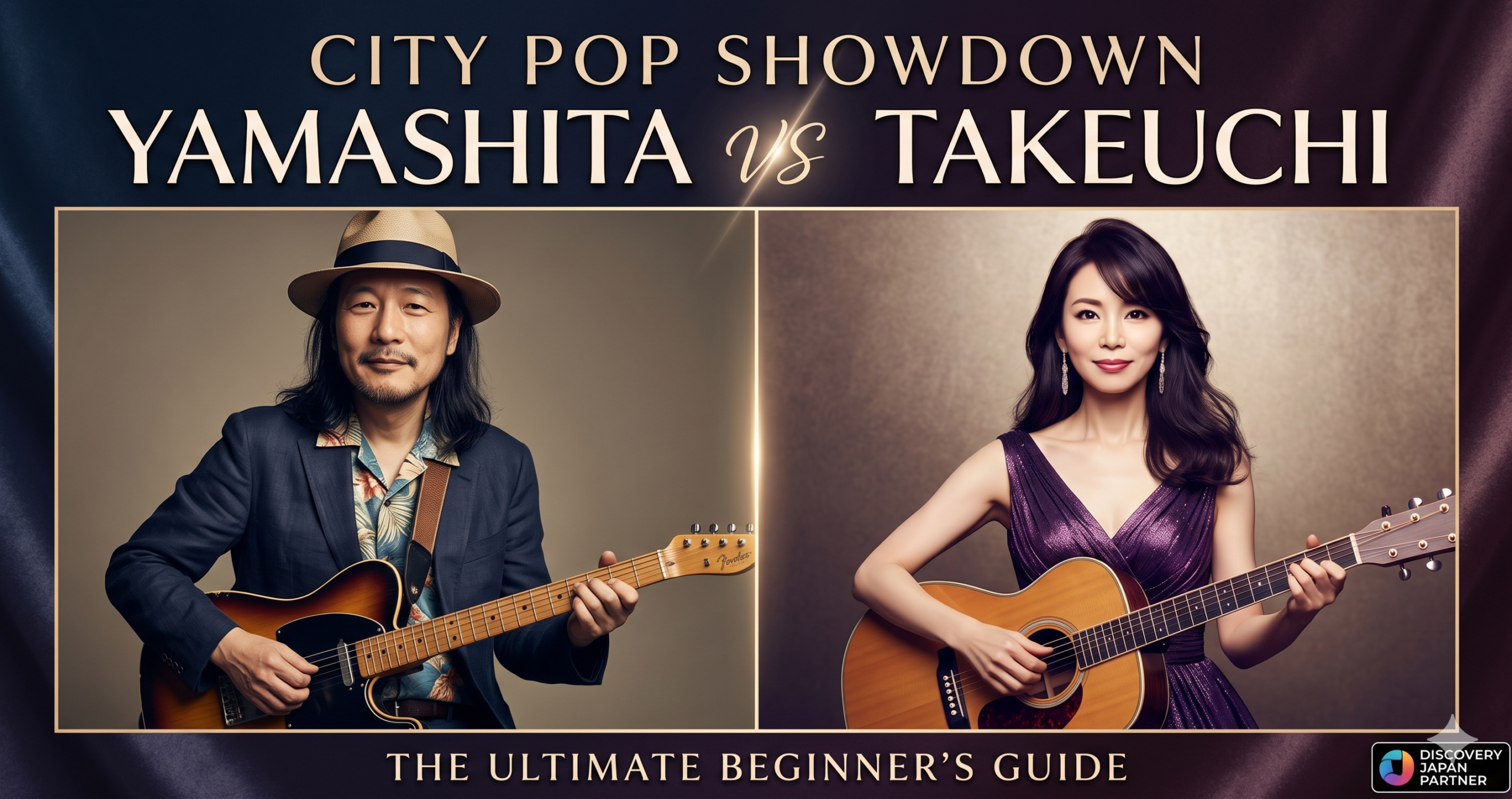
Tatsuro Yamashita and Mariya Takeuchi stand as the two most influential figures in Japanese City Pop – a music genre that emerged in the mid-1970s and peaked during the 1980s, blending Western soft rock, funk, and jazz fusion with the sensibilities of Japan’s booming urban culture. For new listeners, music fans exploring Japanese genres, or anyone trying to understand why these two artists matter so much, this comparison focuses on the choice that usually comes first: whether to start with the genre’s foundational architect or its most accessible modern gateway. If you’re drawn to City Pop’s nostalgic, cosmopolitan soundtrack reflecting urban lifestyles, you’ll inevitably encounter both names, and knowing which to prioritize can shape how quickly the genre opens up.
City Pop is a Japanese music genre that emerged in the mid-1970s and peaked during the 1980s. It is characterized by complex jazz-influenced chords, strong basslines, and a sophisticated, Western-influenced sound, often incorporating polished production techniques similar to American soft rock.
The single biggest distinction: Yamashita is the foundational architect – the “King of City Pop” whose albums defined the genre’s vocabulary – while Takeuchi is the global revival catalyst whose viral hit unlocked City Pop for a worldwide audience decades after its original peak. That difference also explains why this comparison matters now: Japanese City Pop is not just a retro playlist trend, but a window into Japan’s 1980s urban culture and pop evolution, and the easiest way into it depends on whether you value influence, style, or simple access. The short answer: Most listeners should start with Mariya Takeuchi. Her music is far more accessible on streaming platforms, her signature track “Plastic Love” provides an immediately compelling introduction to City Pop’s emotional depth, and her catalog offers a smoother on-ramp for newcomers. Yamashita is the essential next step for anyone who wants to understand the genre’s roots and sonic craftsmanship – but his deliberate absence from major streaming services creates real barriers for casual discovery.
- What Is Tatsuro Yamashita’s Role in City Pop?
- What Is Mariya Takeuchi’s City Pop Legacy?
- Tatsuro Yamashita vs Mariya Takeuchi: How They Compare at a Glance
- Musical Style, Japanese Language, and Sound
- Accessibility and Availability
- Influence on City Pop Genre and Japanese Culture
- International Recognition, Japanese Language, and Modern Relevance
- Tatsuro Yamashita vs Mariya Takeuchi: Which Should You Choose?
- Frequently Asked Questions
What Is Tatsuro Yamashita’s Role in City Pop?

Tatsuro Yamashita (b. 1953, Tokyo) is widely known as the “King of City Pop” and a former member of Sugar Babe, one of the earliest groups to foreshadow the genre’s polished sound. His defining strengths include foundational influence on the genre’s musical language, consistent production quality across decades, beloved seasonal staples in Japanese culture like “Christmas Eve,” and a studio-author approach where he arranges, mixes, and performs much of the instrumentation himself.
What Is Mariya Takeuchi’s City Pop Legacy?
Mariya Takeuchi (b. 1955, Shimane Prefecture) is the artist who sparked City Pop’s global rediscovery, often called the “Queen of City Pop.” Her defining strengths include the international breakthrough of “Plastic Love,” strong compositional skills across her catalog, estimated sales exceeding 16 million units in Japan by 2009, and a late-career recognition that brought new generations of learners and listeners into the genre.
Tatsuro Yamashita vs Mariya Takeuchi: How They Compare at a Glance
| Factor | Tatsuro Yamashita | Mariya Takeuchi |
|---|---|---|
| Best for | Deep album immersion, technical craft appreciation | Easy crossover, digital discovery, genre entry point |
| Peak Era | 1980–1982 (Ride on Time, For You) | Mid-1980s (Variety, 1984) and 2010s revival |
| Most Famous Song | “Christmas Eve” (35+ consecutive years in Oricon Top 100) | “Plastic Love” (1985; viral global hit in 2010s) |
| Availability | Very limited on streaming; primarily physical media in Japan | Widely available on global streaming platforms |
| Global Recognition | Revered by genre aficionados and audiophiles | Central figure of the international City Pop revival |
Musical Style, Japanese Language, and Sound
Musical approach matters enormously when choosing your entry into City Pop, because the genre is characterized by complex jazz-influenced chords and strong basslines – and both artists interpret that foundation differently.
Tatsuro Yamashita’s Musical Style
Yamashita’s sound is built on lush analog soundscapes, heavy use of major-seventh chords, precise vocal harmonies, and layered instrumentation including strings, horns, Rhodes piano, and electric guitar. His albums like Ride on Time and For You reward patient, full-album listening – each track flows into the next with a conceptual ambition that reflects City Pop’s sophisticated, Western-influenced sound. He often produces, arranges, and mixes everything himself, giving his records a distinctive sonic consistency.
Mariya Takeuchi’s Musical Style
Takeuchi leans toward pop structure with verse-chorus hooks, emotionally evocative lyricism, and vocal delivery that balances clarity with personal expressiveness. Mariya Takeuchi’s “Plastic Love” is considered a globally iconic City Pop hit – its upbeat funk bass, brass, and synths set against melancholic lyrics about romantic disillusionment create a bittersweet aesthetic that captures city pop’s emotional duality in a single track. Her album Variety showcases how she wrote most of the songs herself, varying styles experimentally across the record.
Winner: Yamashita – for listeners who want to hear how City Pop’s sonic vocabulary was built. But Takeuchi’s more immediate, emotionally direct songwriting is the better introduction for most people encountering the genre for the first time.
Accessibility and Availability
None of this matters if you can’t actually hear the music – and this is where the two artists diverge most dramatically.
Yamashita’s Accessibility
Yamashita has famously kept most of his discography off major streaming platforms like Spotify and Apple Music. Reports indicate he objects to compressed audio formats and wants listeners to experience his music with high fidelity. Physical media – CDs, vinyl, Japanese-only releases – remains the primary route for accessing his albums, and international listeners often turn to marketplaces that stock a wide selection of Tatsuro Yamashita albums, singles, and merchandise. Even YouTube videos are selectively released, often limited to official promotional content. For English speakers outside Japan, this creates significant barriers: regional licensing issues, import costs, and limited digital stores.
Takeuchi’s Accessibility
Takeuchi’s catalog tells a different story. “Plastic Love” and many of her albums are present on global streaming platforms. Her compilations like Impressions – which sold over 3 million copies in Japan alone – have received international digital reissues, and fans can also find Mariya Takeuchi CDs, DVDs, and related merchandise through Japan-focused marketplaces. Her Expressions collection offers another accessible compilation. The pathway from curiosity to listening is far smoother.
Winner: Takeuchi – by a wide margin. Yamashita’s aesthetic philosophy is admirable, but his absence from streaming means many potential fans simply never discover his work. Takeuchi meets listeners where they already are.
Influence on City Pop Genre and Japanese Culture
Understanding influence helps you appreciate what you’re hearing in the same way that knowing a language’s history enriches your understanding of its grammar and vocabulary – and City Pop has its own rich history worth exploring.
Yamashita’s influence is foundational and multi-layered. His work with Sugar Babe in the mid-1970s, alongside collaborations with Haruomi Hosono and Eiichi Ohtaki, helped establish the genre’s musical norms. The genre incorporates polished production techniques similar to American soft rock, and Yamashita was central to developing that approach in a Japanese context. City Pop represents a cultural marker of Japan’s bubble economy in the 1980s, and Yamashita’s albums from that era – the sonic richness, the analog warmth – serve as the genre’s canonical keystones. His emphasis on arrangements, fusion influence, and studio perfection set the course for what City Pop would become.
Takeuchi’s influence operates differently: she played an important role in the genre’s global revival. City Pop found a new global audience due to internet culture and viral tracks, and “Plastic Love” was the single most significant catalyst for that rediscovery. Her music unlocked cross-generational and cross-cultural diffusion – younger listeners who never experienced the genre during its domestic peak found their way in through YouTube algorithm recommendations and sample culture. City Pop has influenced modern J-Pop and genres like vaporwave and future funk, and Takeuchi’s tracks appear frequently in those derivative forms.
Winner: Tie – but for different reasons. Yamashita built the foundation; Takeuchi ensured the world would hear it. Both represent essential chapters in the genre’s story, in the same way that understanding both old Japanese and modern forms gives you a complete picture of the language’s evolution.
International Recognition, Japanese Language, and Modern Relevance
For contemporary fans exploring City Pop from outside Japan, modern relevance determines which artist you’ll encounter first and most often.
Takeuchi dominates here. “Plastic Love” originally peaked modestly at #86 on Oricon in 1985, selling roughly 10,000 copies. But when uploaded to YouTube in the mid-2010s, it became a viral sensation – re-entering charts in 2021 and introducing millions of international listeners to City Pop. Her music appears in curated playlists, lo-fi mixes, and future funk remixes across YouTube, TikTok, and streaming platforms. She’s become the publicly visible person of the revival for most people outside Japan.
Yamashita holds deep respect among dedicated fans, audiophiles, and collectors. His influence is cited frequently in scholarly retrospectives and genre analyses. But his limited streaming presence means he has fewer touchpoints for casual discovery. You won’t stumble across Go Ahead! or Big Wave in an algorithm-driven playlist – you have to seek them out deliberately.
City Pop lyrics often focus on urban life and nightlife, and both artists capture that Tokyo-centered energy. But in terms of who’s actually reaching international ears today, the distinction is clear. The broader City Pop compilation scene has also helped introduce new listeners to the genre’s wider range of artists.
Winner: Takeuchi – her global visibility is unmatched. Yamashita’s cult status and audiophile loyalty are real, but they serve a narrower audience.
Tatsuro Yamashita vs Mariya Takeuchi: Which Should You Choose?
- Choose Tatsuro Yamashita if you want to understand City Pop’s foundational DNA, appreciate sophisticated arrangements and studio craft, prefer full-album listening experiences, or are already comfortable importing physical media from Japan. His roughly 9 million albums sold as a solo artist reflect decades of consistent quality, and tracks like “Christmas Eve” – which has appeared in Japan’s Oricon weekly singles Top 100 for over 35 consecutive years – demonstrate his cultural staying power.
- Choose Mariya Takeuchi if you’re new to the genre, want immediately accessible music on your preferred streaming platform, are interested in the international revival story, or enjoy emotionally direct songwriting. Her estimated 16+ million units sold and the global phenomenon of “Plastic Love” make her the most natural beginning for any City Pop journey, especially if you also enjoy browsing broader Japanese brand products and collectibles online.
The strongest all-around recommendation for a first-time listener is Takeuchi. Start with “Plastic Love,” explore Variety, then let curiosity pull you toward Yamashita’s catalog – where the genre’s deepest rewards await. Both artists are essential for complete City Pop appreciation; the question is simply which door you walk through first. The genre flourished alongside Japan’s post-war economic miracle, and hearing both perspectives gives you the full story of that extraordinary musical moment.
Frequently Asked Questions
Can I enjoy both artists or do I need to pick one?
Absolutely enjoy both – they complement rather than compete with each other. The ideal listening path for most learners of the genre is to start with Takeuchi’s most accessible tracks like “Plastic Love” and her Variety album, then move to Yamashita’s Ride on Time and For You once you’ve developed a sense for City Pop’s sonic palette. Together they represent the genre’s full emotional and musical spectrum – Takeuchi for immediacy and global resonance, Yamashita for depth and historical context.
Why is Tatsuro Yamashita’s music harder to find online?
Yamashita has deliberately kept most of his discography off platforms like Spotify and Apple Music. Reports indicate he objects to the compressed audio formats used by streaming services, preferring that listeners experience his music in high fidelity through physical media. Additional barriers include regional licensing complexity and historic contract arrangements. Legal ways to access his music include importing Japanese CDs and vinyl, purchasing from Japanese digital stores, checking for occasional official YouTube releases, or browsing J‑Pop CD and DVD catalogues on Japan-based marketplaces. Albums like Melodies are available through specialty retailers that ship internationally.
Which artist better represents “authentic” City Pop for learning Japanese?
Both represent authentic but different aspects of the genre. Yamashita embodies the foundational authenticity – he helped create City Pop’s musical vocabulary from the beginning, drawing on American soft rock, jazz fusion, and funk to build something distinctly Japanese. Takeuchi represents emotional and cultural authenticity – her songwriting captures the genre’s bittersweet urban sensibility, and her role in the global revival ensured City Pop’s legacy would extend far beyond its original era. City Pop is recognized for its nostalgic, cosmopolitan soundtrack, and both artists deliver that in complementary ways. Asking which is more “authentic” is like asking whether the person who wrote the grammar rules or the person who made the language come alive in daily life matters more – you need both for the complete picture.


Comments