
- Why We Can’t Stop Playing with Things in Our Hands
- The Human Hand: Built for Gripping, Tapping, and Fidgeting
- The Psychology of “Busy Hands”: Why We Want to Move Our Fingers
- What Is a Handspinner (Fidget Spinner)? Basic Structure and Feel
- From 2017 Boom to Everyday Companion: A Short History of Fidget Spinners
- How Handspinners Interact with Our Hands: Grip, Muscles, and Connective Tissue
- Stress Relief and Focus: What a Fidget Spinner Can (and Cannot) Do
- Types of Handspinners: Materials, Shapes, and Features to Know
- Why Choose a Handspinner from Discovery Japan Mall
Why We Can’t Stop Playing with Things in Our Hands
It is 2026, and halfway through a video meeting, you catch yourself spinning a small metal object between your thumb and index finger. You did not decide to pick it up. Your hand just reached for it, one everyday example of unconscious hand behavior. This scene plays out millions of times a day in offices, classrooms, and living rooms worldwide.
This article answers a deceptively simple question: why do our hands always want to move? We will walk through the anatomy and psychology behind restless fingers, explain what a handspinner is and how it supports stress relief, and then show you how to choose and buy one at Discovery Japan Mall. The human hand is a remarkably sensitive body part packed with nerves, connective tissue, and muscles specialized for both sensory and motor function, including power grip and precision grip, and that wiring makes it almost impossible to keep still when the brain is active.
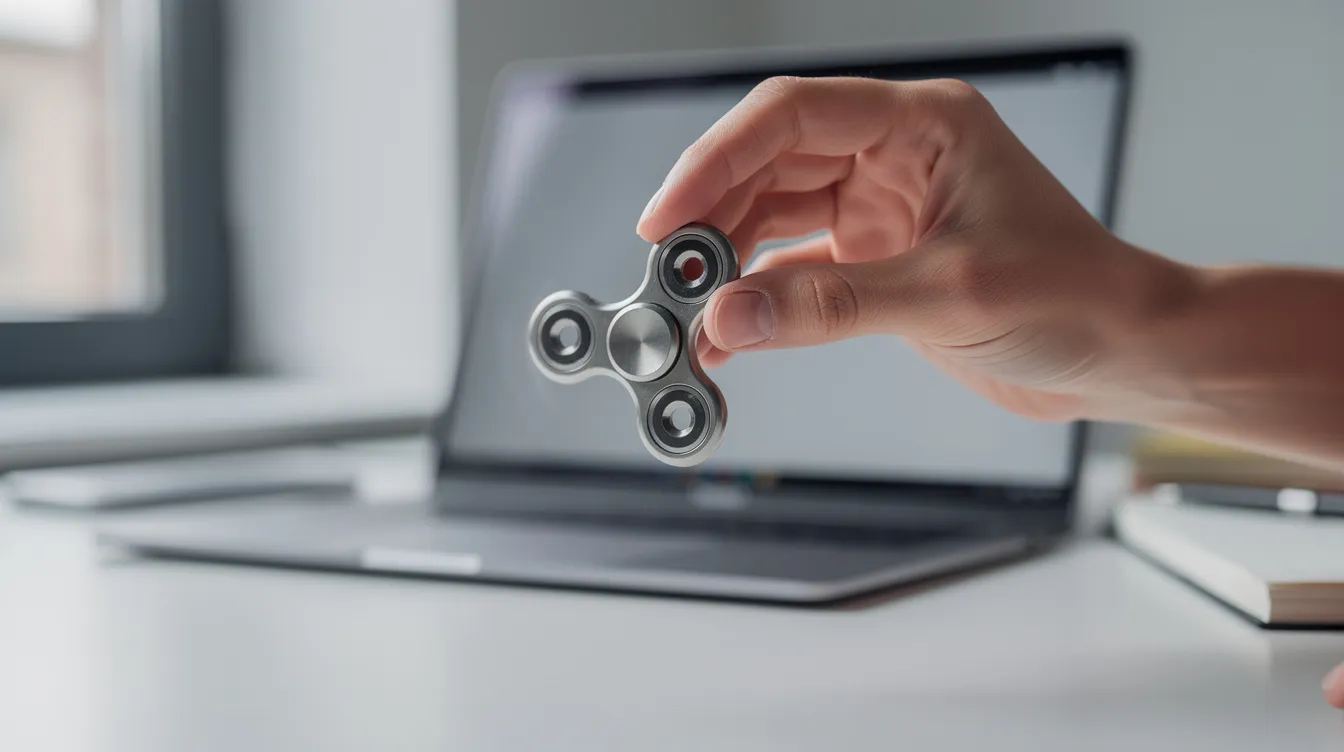
The Human Hand: Built for Gripping, Tapping, and Fidgeting
The human hand evolved to do two things exceptionally well: grip objects with force and manipulate them with precision. These same abilities explain the small, unconscious hand movements we make when thinking, waiting, or listening. A hand built for grasping branches and crafting tools does not simply switch off when there is nothing to hold.
That capability comes from an impressive structure. The hand contains 27 bones – eight carpal bones in the wrist, five metacarpals in the palm, and fourteen finger bones spread across five digits. Over 30 muscles, organized into two groups (intrinsic muscles inside the hand and extrinsic muscles in the forearm), work alongside tendons and ligaments to produce motion. Two arteries – the radial and ulnar – supply blood, while the median nerve and ulnar nerve carry sensory and motor signals, keeping every finger connected to the brain.
How the hand grips matters here:
- A power grip wraps the whole palm plus four fingers and thumb around an object, generating force through long flexor muscles in the forearm.
- A precision grip uses fingertips – typically thumb and index finger – with fine control from lumbrical muscles and interossei, bent at the metacarpophalangeal joints.
- Most people hold a handspinner in a precision grip, pinching the center cap while flicking an arm with the middle finger.
Fingertip skin is one of the most touch-sensitive areas on the human body. Research shows approximately 141 mechanoreceptor units per cm² at the distal fingertip, dropping to about 25 per cm² in the palms. These receptors detect pressure, vibration, and movement – which is exactly why the smooth spin and micro-vibrations of a fidget spinner feel so pleasant against the skin of your fingers.
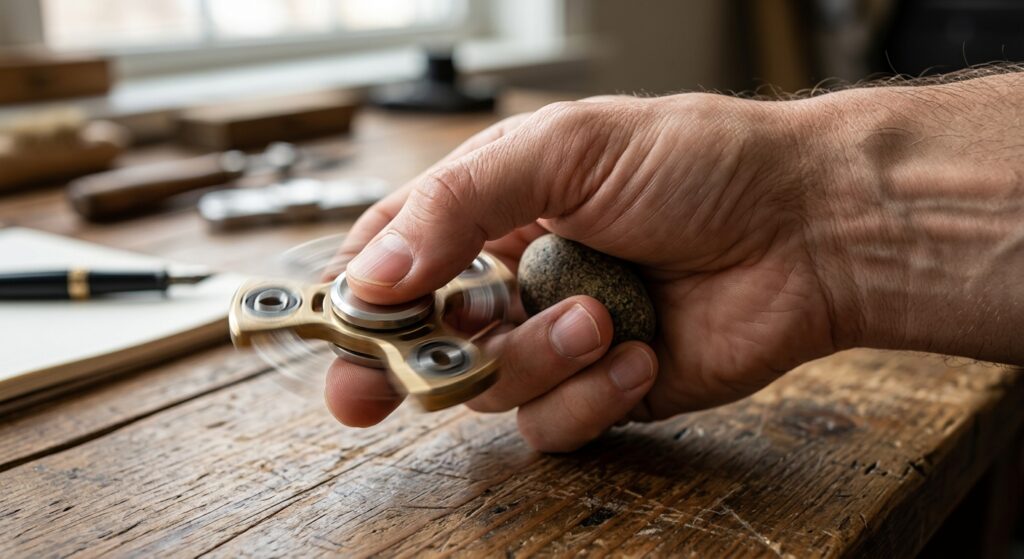
The Psychology of “Busy Hands”: Why We Want to Move Our Fingers
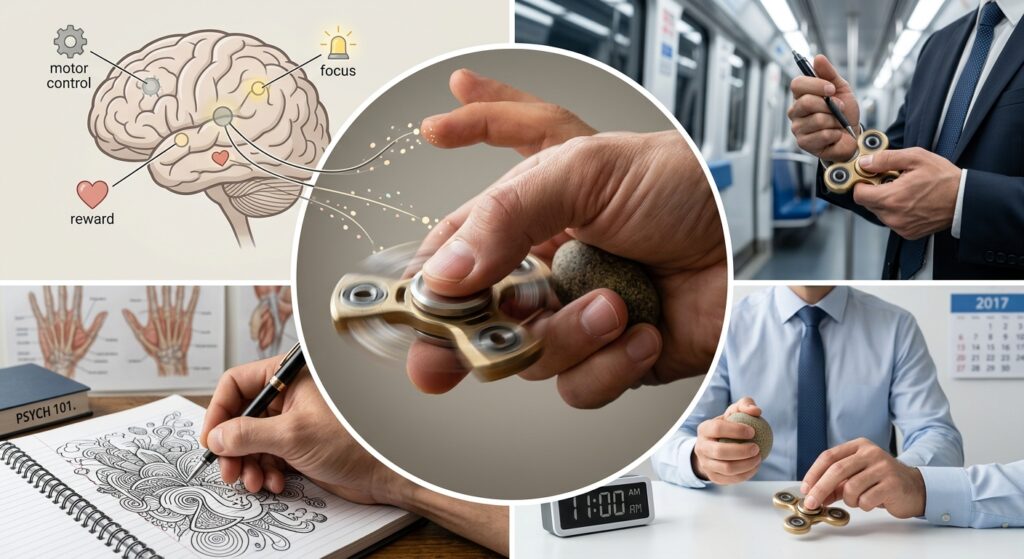
Nearly every person has experienced the urge to tap a table, click a pen, or roll an object between their fingers during a long phone call. This is not a character flaw. It is tied to how the brain manages arousal and attention.
Psychologists call it self-regulation: using small, repetitive movements to modulate internal tension. When a person is thinking deeply, feeling anxious, or trying to concentrate, low-level sensory input through the hands can assist the brain in filtering out distracting thoughts. The sense of touch from a precision grip feeds a steady stream of feedback to motor and reward circuits, which some researchers believe helps stabilize focus.
Hand spinners provide sensory stimulation for individuals with ADHD, and the repetitive motion of a fidget spinner can offer sensory feedback that some users find soothing. A 2021 study by Aspiranti and Hulac found that second-grade students with ADHD improved on-task behavior from roughly 25–30% at baseline to 55–80% when using a spinner under structured rules.
Real-life examples of this impulse represent a long history of busy hands:
- Students doodling in notebooks during lectures, effectively writing without writing
- Office workers squeezing stress balls through the 2000s
- Commuters and remote workers spinning fidget spinners since 2017
These methods all deal with the same underlying need: keeping hands occupied so the rest of the mind can work.
What Is a Handspinner (Fidget Spinner)? Basic Structure and Feel
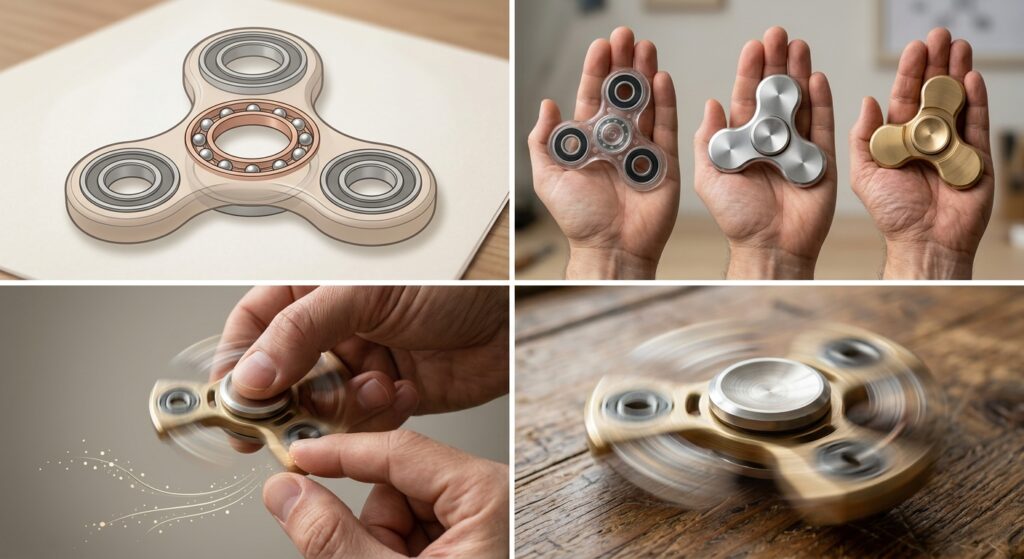
A hand spinner is a small, stress-relieving toy designed to spin smoothly between fingers. At its core, a hand spinner consists of a central bearing and two or more weighted lobes or arms arranged around it. You hold the center cap, flick one arm, and the device rotates.
The central bearing reduces friction, allowing smooth rotation. Inside it, tiny steel or ceramic balls sit between an inner ring and an outer ring, fixed in place but free to roll. The weighted lobes create inertia, enabling the spinner to maintain momentum – a quality spinner can sustain rotation for one to five minutes from a single push.
Common materials include:
- Lightweight plastics (ABS, polycarbonate) – affordable, thin, and suitable for kids
- Aluminum alloy or stainless steel – cooler to the touch, more durable
- Brass or copper – heavier, delivering stronger tactile feedback in the palms
The experience goes beyond just watching something spin. Users feel a gentle vibration through their fingertips, hear a soft humming, and see visual blur patterns as the arms rotate. This combined stimulation across touch and vision is part of why spinners work as a form of stress relief for so many people.
From 2017 Boom to Everyday Companion: A Short History of Fidget Spinners
Fidget spinners exploded into global consciousness around spring 2017. At their peak in May of that year, they accounted for roughly 17% of all online toy sales in the United States. Manufacturers – primarily based in China – flooded platforms like Amazon and brick-and-mortar toy stores with inexpensive plastic tri-spinners, and online marketplaces such as Discovery Japan Mall.
Early marketing often positioned the fidget spinner as more than a toy, claiming benefits for people with ADHD, autism, or anxiety. While some evidence did support improved on-task behavior under specific conditions, many schools banned spinners by mid-2017 after teachers found them distracting in classrooms full of children.
The craze did not simply vanish, though. Instead, the market matured:
- Cheap plastic models gave way to precision-machined metal spinners
- Ceramic and hybrid bearings replaced basic steel for longer, quieter spins
- Collector and enthusiast communities emerged, benchmarking spin times and comparing form, balance, and finish
Today, the handspinner is present in desk drawers and commuter bags as a quiet, everyday companion rather than a viral clock-chasing novelty.
How Handspinners Interact with Our Hands: Grip, Muscles, and Connective Tissue
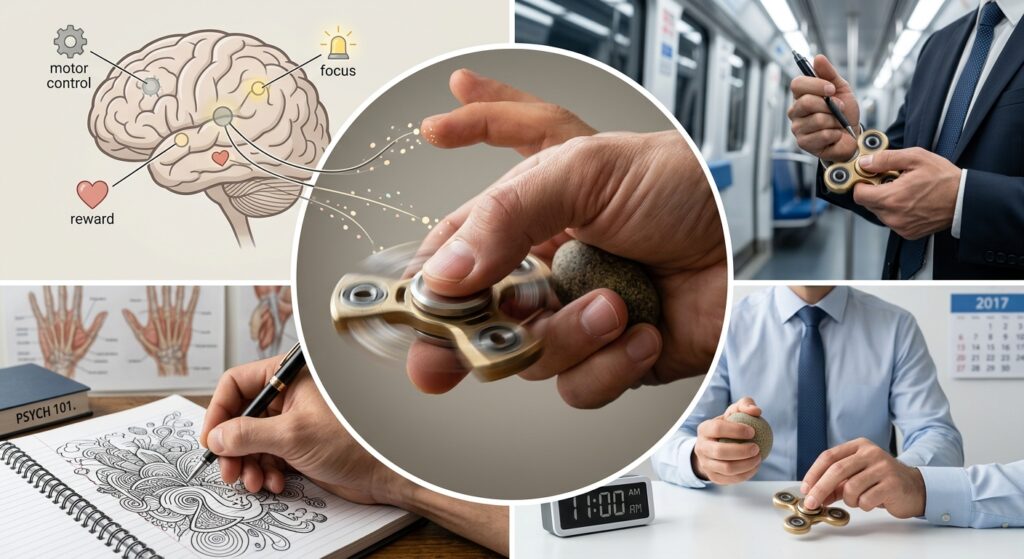
Spinning a handspinner engages the hand’s intrinsic muscles along with finger extensors and flexors in the forearm. Tendons glide inside their sheaths, supported by flexible ligaments and fascia – all working together in a movement so light you barely notice it.
Here is what each body part does during a typical spin:
- The thumb and index finger pinch the center cap in a precision grip, with metacarpophalangeal joints slightly bent to hold the spinner stable.
- The middle finger, ring finger, or sometimes little finger flicks one arm to initiate rotation. The force required is minimal.
- In a power grip – used with heavier metal spinners – all four fingers and the thumb wrap around the body, engaging more of the forearm’s long flexor tendons before a bigger flick.
- The left hand can mirror the right for ambidextrous use or for passing the spinner between hands during tricks.
Hand spinners can also enhance fine motor skills in children, because the coordinated pinch-and-flick motion exercises the same neural pathways used in writing and grasping small objects.
Moderate use is gentle on joints. Unlike forceful pen clicking or hours of stretched keyboard typing, a smooth spinner places very little pressure on tendons and ligaments, making it a relatively joint-friendly form of hand movements even for someone with a big hand or one hand that tends to fatigue easily.
Stress Relief and Focus: What a Fidget Spinner Can (and Cannot) Do
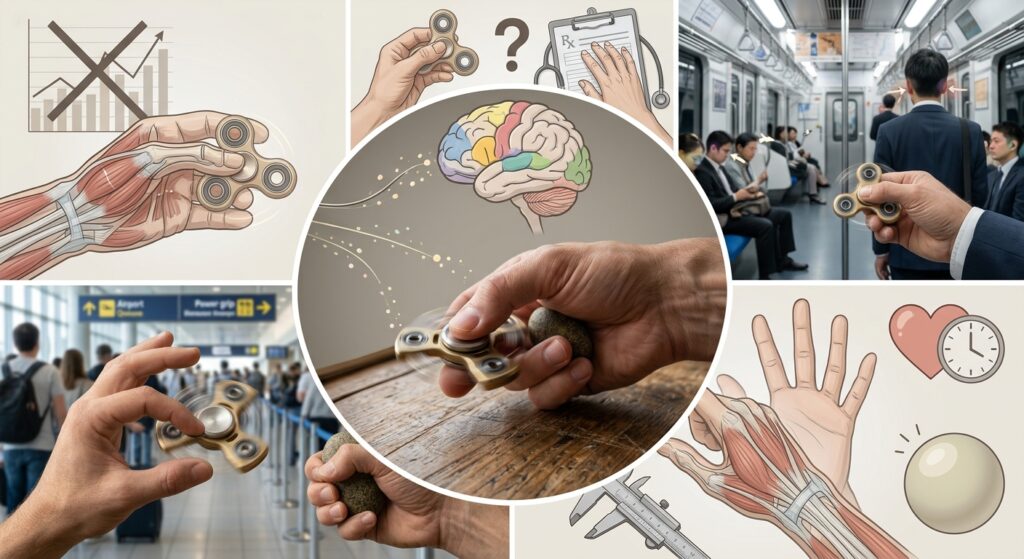
Many users subjectively feel calmer when they keep their hands busy with a spinner during tasks such as phone calls, studying, or waiting. Fidget spinners may serve as a brief distraction from stress and anxiety – and neuroimaging research backs this up. An fMRI study found that rotating a spinner activates the supplementary motor area, cerebellum, and striatum – brain regions associated with motor control and reward.
Hand spinners help reduce anxiety and stress levels through simple, rhythmic action. They improve focus and concentration during tasks for some users, and using hand spinners can promote relaxation through repetitive motion.
However, it is important to be honest about limitations:
- Some studies suggest fidget spinners may not reliably improve focus for everyone. A study of preschoolers with ADHD found poorer attention on spinner-use days.
- A spinner is not a medical treatment. If anxiety or attention issues are serious, consult a doctor for proper evaluation.
- In shared spaces, noise or visual movement can distract others.
Everyday scenarios where a spinner works well:
- During a train commute in Tokyo, spinning quietly in one hand
- At a desk between tasks, resting the brain for 30 seconds
- While waiting in line, channeling nervous energy into objects you can control
If your fingers, wrist, or forearm feel sore, pause and gently stretch. Treat the handspinner as a light stress relief tool, not an all-day exercise device.
Types of Handspinners: Materials, Shapes, and Features to Know
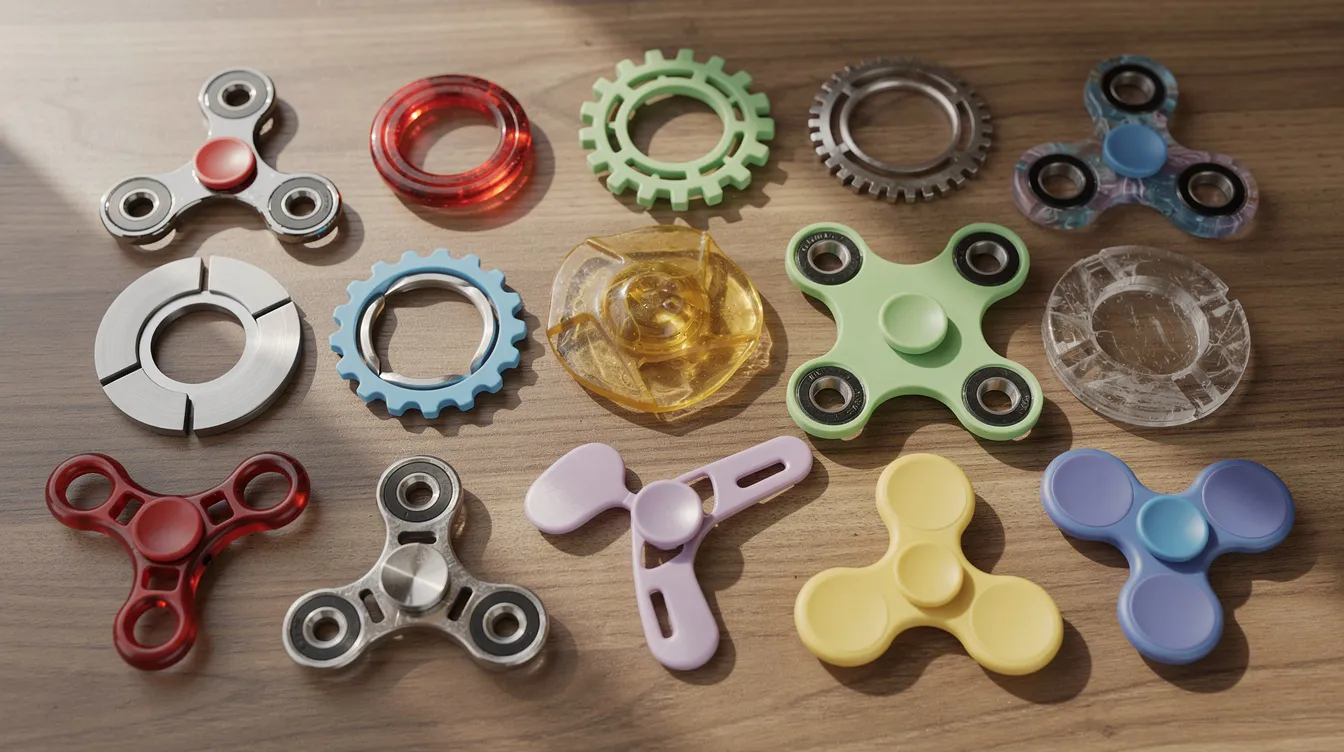
There is no single “best” spinner. The ideal choice depends on how you want it to feel, look, and sound. Hand spinners come in various designs and colors, and the market now includes some surprising forms.
Common shapes:
- Classic tri-spinner (three arms) – balanced, familiar
- Dual-bar (two arms) – compact, fits easily in a pocket
- Circular ring spinner – smooth edge, different aesthetic
Materials compared:
- ABS or polycarbonate plastic – best for beginners or kids; light, affordable
- Aluminum or stainless steel – cooler touch, solid construction, durable
- Brass or copper alloys – heavier spin, stronger feedback in palms and fingers
Why Choose a Handspinner from Discovery Japan Mall
Discovery Japan Mall curates a wide selection of Japanese and Japan-inspired products, from handspinners to newly arrived Japanese watches, and its handspinner collection reflects the same commitment to quality and thoughtful design. Japanese spinners often feature smooth bearings, refined anodized finishes, and motifs that represent Japanese craftsmanship and pop culture.
For international customers, Discovery Japan Mall provides access to spinners that are otherwise difficult to obtain outside Japan, alongside J-POP CDs and DVDs in its Japanese music and video catalog. Product pages include transparent details: bearing type, weight in grams, approximate spin time, and materials.
Whether you need a discreet desk companion or a conversation-starting collectible, Discovery Japan Mall offers the range and the quality to match your preference.

Comments